Get Full Government Meeting Transcripts, Videos, & Alerts Forever!
Get email alerts on the General Plan topic
No spam. Unsubscribe anytime.
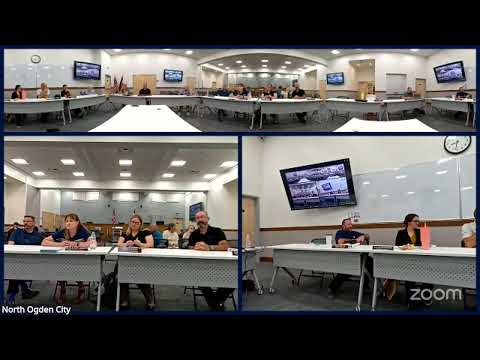
North Ogden council and planning staff open multi‑month review of general plan, focusing on housing variety and annexation
Summary
City planning staff and the City Council held an extended discussion about updating North Ogden's general plan to address a statewide housing shortfall, local entitled units, annexation strategy and whether to 'vest' the plan to provide development predictability.
City planning staff and members of the North Ogden City Council spent the meeting’s first hour discussing how the city should update its general plan to respond to regional growth pressures and a statewide housing shortage.
Scott (city planning staff) told the council the state is working from a 44,000‑unit housing shortfall figure and said North Ogden currently holds “over 2,000 entitled building units that we would give a building permit to tomorrow,” listing West States annexation, Northside Valley, Village of Prominent Point and Patriot Point among the identified projects. He said developers are not building those units now because of financing and materials costs and that the city should focus on policy levers it can actually control.
The discussion centered on three recurring questions: what housing types the city should encourage (including “missing middle” or smaller single‑family footprints and accessory dwelling units), how to manage annexations and whether to vest the general plan so the city has greater predictability when developers assemble parcels.
“We are dealing with regional and statewide housing shortages,” Scott said, and argued North Ogden can influence the form of future housing but not all market drivers. Several council members argued for more housing variety so residents can downsize within the city rather than leaving. One council member said examples of “patio homes” and townhomes previously approved had later priced higher than hoped; another council member reiterated that without off‑site subsidies the city cannot make housing substantially less expensive than market rates.
Staff explained the mechanics of vesting the general plan: giving future land‑use certainty can speed development and help developers assemble parcels, but it reduces the city’s flexibility as markets and conditions change. Scott recommended a cautious approach to vesting with scheduled reviews — for example, revisiting the plan every five years.
The council also discussed a proactive annexation approach for small pockets of Weber County (islands) along Washington Boulevard, and whether the city should include recommended land uses for areas outside city limits that the city expects to negotiate for in the future. Scott said the general plan can include “future land use” designations for areas not yet annexed so the city has a stated position when annexation proposals arrive.
The conversation closed with staff asking commissioners and council members for direction on (1) adopting moderate‑density zoning tools such as ADU allowances, (2) updating commercial zoning to protect retail viability, and (3) finalizing a water impact fee study and embedding conservation policies in code. Staff said the notes from the meeting will go back into the general plan update process.
Ending: Staff said the discussion would be ongoing; planning commission members were invited to develop a short set of actionable items for the council to consider in future work sessions.