Get Full Government Meeting Transcripts, Videos, & Alerts Forever!
Get email alerts on the Recreation Pickleball topic
No spam. Unsubscribe anytime.
Carmel council agrees to study split-court plan, sound fixes and alternate sites after months of pickleball disputes
Summary
Carmel-by-the-Sea council heard hours of testimony on noise, parking and enforcement around pickleball at Forest Hill Park, directed staff to return with two ordinances and costed options for sound attenuation and locks, and to continue searching for alternate public courts.
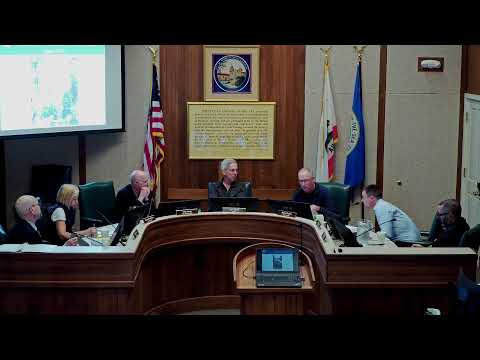
CARMEL-BY-THE-SEA, Calif. — The Carmel-by-the-Sea City Council on Wednesday heard more than three hours of public testimony and staff briefing on a contentious debate over pickleball play at Forest Hill Park and instructed staff to return with two ordinance options, cost estimates for sound attenuation and locking gates, and continued work to identify alternate courts.
The council convened a special meeting to review a Forest and Beach Commission policy that would reserve the east side of the Forest Hill tennis courts for two permanent pickleball courts, leave the west side for tennis and add a dividing fence and electronic locks to separate the uses. Tom Ford, presenting for city staff, told the council the commission adopted the policy and that “before we had spent money on that ... we wanted to bring this before council” because some elements (permanent nets, locks and modifications) would cost money. Ford said part of the package already implemented limits on days and hours: pickleball 10 a.m.–4 p.m. on Tuesdays, Thursdays and Saturdays; tennis 10 a.m.–4 p.m. daily.
Why it matters: neighbors and players described competing harms. Neighbors described repeated, high‑pitched paddle 'pops' that they say carry to nearby houses and disrupt daily life, while players and some business owners said the courts provide important recreation, social connection and tourism value. The council sought options that would reduce impacts on adjacent residents while preserving organized recreation.
What staff and the commission recommended and why
Ford and Forest and Beach Commission chair Tamara Mickey summarized a multi‑year process that included public outreach, comparison with nearby cities (Monterey, Pacific Grove, Yountville), six commission hearings, and basic acoustic field measurements that staff described as “rudimentary.” Ford said staff and the commission considered quiet balls and paddles, restricted hours, acoustic fencing and different court configurations. The commission’s recommended policy would: install two permanent pickleball courts (fixed nets) on the east half of the site; remove or paint over pickleball striping on the west half to prioritize tennis; add a mid‑court dividing fence and automatic locks on the two gates; and keep the interim time limits in place until implementation.
Public testimony: health, property and community trade-offs
Public commenters were sharply divided. Pickleball players said the courts are free, accessible recreation — particularly important to retirees and rentals/hotels that bring visitors who spend locally — and argued use has declined since the commission reduced the number of courts. Susie Querrey, who said she and other players helped buy nets and paint courts, asked the council to “approve the plan submitted by the Forest and Beach Commission.”
Neighbors said the sport’s character and sound are incompatible with the compact residential neighborhood around Forest Hill Park. Didier Diaz, a nearby resident, told the council, “Unless an effective noise mitigation measure is identified, pickleball should not be allowed at Forest Hill Park and that ban needs to be enforceable.” Kimberly Edwards, who said she lives a block from the courts, said the venue “was never intended for pickleball; it was tennis.” Several neighbors said they stopped calling police because they felt the issue was not enforceable.
Other speakers urged compromise. Jean Rasch, who helped mediate a similar conflict in Pacific Grove, suggested keeping 1 tennis court permanently for tennis and converting only a single pickleball court (rather than two) to reduce player volume while preserving drop‑in public access. Multiple commenters proposed using school or district properties, or existing nearby public courts, as alternative locations.
Public safety and enforcement data
Acting Chief Treher reported that the Police Department logged about 14 calls for service related to the courts in the recent tracking window (Acting Chief Treher provided the number while noting officers did not always need to respond). Staff also told the council that after interim rules were adopted the Police Department received roughly three calls per month in an early monitoring period; officials said neighbors told staff they called less over time because they perceived the rules as unenforceable.
Sound mitigation, fencing and costs
Staff and commissioners said measured sound levels and a consultant’s advice indicated that the pickleball “pop” is an impulse/high‑frequency sound that simple decibel readings do not fully capture, and that acoustic mitigation is technically challenging in the site’s sloped topography. Ford said a partial implementation (nets and locks) would cost about $13,000 (approximate). Commissioners and staff gave rough ballpark estimates for acoustic fencing and other attenuation in prior meetings; estimates mentioned during the discussion ranged from roughly $10,000 (Pacific Grove example cited by staff for their installation years ago) to larger figures in the tens of thousands for a more complete attenuation “box” around the playing area. Staff said final engineering and footings would need a building permit and might raise costs further.
Council action and direction to staff
The council did not take a formal legislative vote at the meeting. Instead, after hearing testimony and discussion, members instructed staff to return at a future meeting with: 1) a draft ordinance based on the Forest and Beach Commission recommendation (including proposed court layout, locking mechanisms and implementation steps); 2) an urgency ordinance option that would prohibit pickleball at the Forest Hill location until the council adopts a mitigation plan (if the council chooses that path); 3) detailed cost estimates and engineering information for different sound‑attenuation options (mid‑court dividing wall only, full attenuation of the pickleball half, footings/structural requirements); 4) options for access control (electronic locks, reservations/permit models) and enforcement language; and 5) an updated analysis of alternate public sites (including ongoing work with the Carmel Unified School District concerning courts at the bridal/middle school site and a planned site visit to Pacific Grove’s fenced courts).
Councilmembers said they wanted options that preserve flexibility (for instance evaluating 50/50 vs. 60/40 court splits and whether retaining the tennis net on the pickleball side improves safety) and documentation staff can use to return with a decision. Mayor Burns and other councilmembers said they would attend a site visit to Pacific Grove to hear how acoustic fencing performs before finalizing the city’s approach. Staff said current interim rules (10 a.m.–4 p.m. Tue/Thu/Sat for pickleball, tennis allowed daily) remain in effect until the council acts.
What’s next
Staff will come back with the two ordinance options, cost and engineering estimates for sound attenuation alternatives, implementation details for locks and access control, and further analysis of alternate locations. The council requested a field visit to Pacific Grove’s acoustic fencing and directed staff to keep working with the school district and other possible sites as potential long‑term alternatives. Until the council adopts a change, the interim day/hour rules remain in effect.
Ending
The meeting closed with council members thanking the large and civil turnout and directing staff to return with the materials and ordinance drafts requested, leaving the question of the Forest Hill courts’ permanent configuration for a future agenda and formal action.