Get Full Government Meeting Transcripts, Videos, & Alerts Forever!
Get email alerts on the Housing Policy topic
No spam. Unsubscribe anytime.
Lake Oswego staff outline multi-year housing production strategy work plan; focus on nonresidential rezoning and Foothills plan
Summary
City planning staff updated the council Sept. 2 on implementing the Housing Production Strategy (HPS): a code audit, rezoning of nonresidential parcels, Foothills District planning and tax-increment financing for affordable housing are among the priorities. Staff urged a phased approach and noted state conditions from DLCD.
City planning staff presented a progress update Sept. 2 on the Lake Oswego Housing Production Strategy (HPS) and related projects, including a code audit, nonresidential rezoning work, the Foothills District plan, and options for tax-increment funding and housing tax exemptions.
Eric Olsen, the city’s long-range planning manager, told the council the HPS implementation is a multiyear effort and highlighted near-term priorities for 2025–2027: a comprehensive code audit to identify barriers to housing and economic development; a rezoning methodology focusing first on nonresidentially zoned properties to enable multifamily housing; and related work on system-development charges and fee structures for cottage clusters.
Olsen said the city has applied for several grants to support the work, including a Metro 2040 planning and development grant and a Department of Land Conservation and Development (DLCD) planning assistance grant. He described coordination needs with recent state legislation (referenced in the transcript as HB 2138 and SB 1537) that will affect middle housing and other code changes; staff said they are waiting for further state guidance on those laws and plan to coordinate the city’s code audit with required state implementation.
The Foothills District project — a separate, two-year planning effort that could include rezoning and urban-renewal considerations — has a consultant contract finalized in June and a community advisory committee appointed. Olsen said the Foothills timeline aligns with the HPS midpoint reporting schedule so the city can quantify added capacity as required by the state.
Councilors asked about residential rezoning and potential community opposition. Several council members expressed concern about wholesale rezoning of single-family areas; staff said the proposed approach would prioritize nonresidential sites first and that state changes (middle-housing requirements) may address a portion of residential capacity without broad rezones. Councilor Corrigan and others supported focusing on nonresidentially zoned properties to unlock capacity with fewer community conflicts.
Staff reported two tax-exemption programs: a nonprofit low-income-housing tax exemption already adopted and used for Mercy Greenbrae (Merrill Hearst Commons) and requested for El Nido; and a proposed low-income rental housing tax exemption for both nonprofit and for-profit developers that staff plans to bring forward. Olsen said DLCD had conditioned HPS approval with several reporting-focused items and asked the council to demonstrate tangible action on at least one publicly partnered affordable-housing recommendation for the HPS midpoint report; staff suggested the forthcoming Foothills urban-renewal/TIF work as a feasible option.
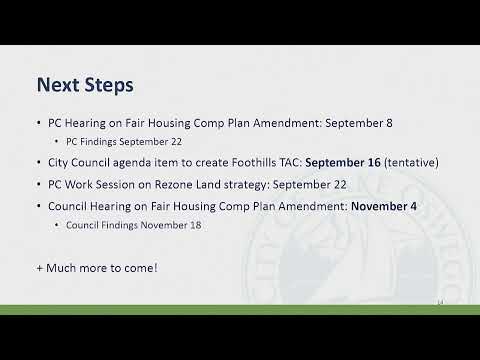
Other items mentioned included potential updates to system-development charges (SDCs) by dwelling size, a planned transportation system plan update, and a draft Fair Housing comprehensive-plan amendment the planning commission will consider next week; the council is scheduled to consider the fair-housing amendment at its Nov. 4 meeting.
Staff requested council direction to proceed with the scoped work plan emphasizing nonresidential rezoning first and to pursue grant funding and consultant support through DLCD rosters or similar consultants. Several councilors supported that prioritization; others cautioned about community reaction to residential rezoning and emphasized the need for careful public engagement.