Get Full Government Meeting Transcripts, Videos, & Alerts Forever!
Get email alerts on the Immigration Enforcement Community Response topic
No spam. Unsubscribe anytime.
Monrovia residents demand investigation after death during immigration enforcement; council outlines legal limits and next steps
Summary
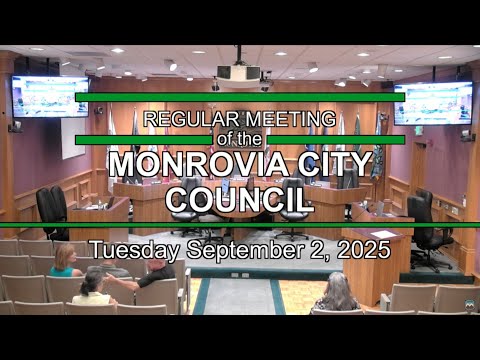
Public comment at Monrovia City Council on Sept. 2 focused on the death of Roberto Carlos Montoya Valdez during an immigration enforcement action Aug. 14; community members called for a state investigation and local safeguards while city officials outlined legal limits and pledged to monitor federal litigation.
Public comment at Monrovia City Council on Sept. 2 centered on the death of Roberto Carlos Montoya Valdez following an Aug. 14 immigration enforcement action near the Home Depot parking lot. Community members and faith leaders urged the council to seek accountability, ask for a memorial, and take local steps to protect immigrant residents.
"Carlos Montoya was not an unknown pedestrian. He was a beloved father and a grandfather and a member of our community," said Ally Ceja, who identified herself as a Duarte resident who shops and participates in downtown Monrovia. Ceja and other speakers said federal accounts dehumanized Montoya by calling him an "unknown pedestrian" and called for an immediate investigation and a memorial at the Home Depot site.
Jean Grant, who identified herself as affiliated with the Immigration Resource Center of the San Gabriel Valley, said the community held a vigil attended by clergy and more than 1,000 people and warned against letting the incident "go by." Reverend Francisco Garcia, speaking for a coalition of faith leaders, urged the council to recognize human dignity in city policy and to pursue state-level investigation and memorialization of Montoya's death.
Several public speakers also raised concerns about automated license-plate readers (ALPRs), sometimes called "Flock" cameras, that capture plate data and can feed national databases used by law enforcement. Sherry Lochner, who said she grew up in Monrovia, described locations where cameras are installed and asked whether the city had authorized them and what steps the city would take to inform residents.
City Attorney Steele and city staff responded with legal and operational clarifications. Steele said the courts determine who may join the federal litigation challenging certain federal enforcement actions and that a city must ask a federal judge for permission to intervene. "In federal court, you have to ask a court for permission to participate in a lawsuit like that," he said, describing the process by which Los Angeles obtained permission to intervene and noting that a later group of cities' request remains pending.
On the question of enforcing a federal temporary restraining order (TRO), Steele said enforcement actions or allegations of violations are handled by the federal court through contempt procedures and evidence that is likely to emerge later in the case.
City Manager Dylan and police representatives explained the local investigative roles. Because Montoya's death occurred on the 210 Freeway, Dylan said the California Highway Patrol is conducting the investigation into the cause of death, and Monrovia officers contributed witness statements and other information. "To date, we have received exactly zero communication from the federal government on anything that happened," Dylan said, and he described continuing information-gathering and outreach to state officials.
On traffic- and surveillance-related concerns, the city said it uses ALPRs for law-enforcement purposes and that the Monrovia system reads license plates, not faces. "They don't do facial recognition," Dylan said, "They only read the license plates." He added that some camera locations mentioned by speakers are private or on other jurisdictions' rights-of-way, not city-owned equipment. Monrovia's ALPR use is governed by a publicly posted policy and was adopted after a required public hearing, city staff said.
Council members and the mayor expressed sympathy for Montoya's family and residents concerned about enforcement activity. Councilmember Belden asked staff to submit a letter asking state officials, including the attorney general and governor, to describe steps being taken on state-level investigation and to keep the council updated on opportunities to participate in litigation or coordinated regional actions. City Attorney Steele said staff will remain in contact with the Los Angeles City Attorney's Office and report back if additional agencies seek to intervene.
Speakers at the meeting urged further local action, including sanctuary-city policy discussion, memorialization of Montoya, and aggressive disclosure about surveillance equipment placements. City staff repeatedly clarified the boundaries of municipal authority, noting state statutes that limit local cooperation with federal immigration enforcement and the limited legal avenues for a city to force federal compliance with a TRO.
The council did not take a binding vote at the Sept. 2 meeting to join litigation or to adopt a new sanctuary designation. Instead, staff were directed to monitor legal developments, stay in touch with the Los Angeles City Attorney's Office, continue information-sharing with state agencies and to report back to the council on options and next steps.
Community groups present included the Immigration Resource Center of the San Gabriel Valley and clergy and faith-based coalitions that said they will partner with the city on next steps and memorial plans.
The council closed public comment and moved to other agenda items after expressing condolences to Montoya's family and promising to follow up on the investigative and legal questions raised by speakers.