Get Full Government Meeting Transcripts, Videos, & Alerts Forever!
Get email alerts on the Environmental Cleanup Billing topic
No spam. Unsubscribe anytime.
Committee hears debate on bill allowing cleanup firms to bill insurers after crashes
Summary
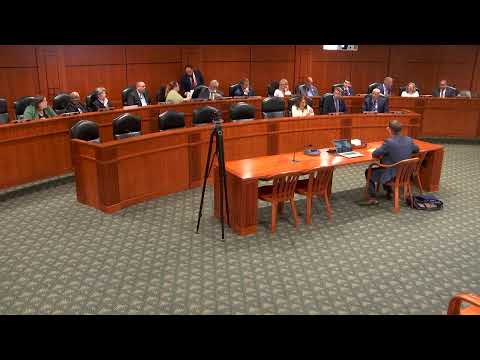
The House Committee on Natural Resources and Tourism heard testimony Sept. 3 on House Bill 44-11, a sponsor-led proposal to allow environmental cleanup contractors to bill insurers directly for remediation after vehicle crashes instead of seeking payment from local governments.
The House Committee on Natural Resources and Tourism heard testimony Sept. 3 on House Bill 44-11, a bill sponsored by Representative Phil Green that would amend state littering law so qualified environmental responders and towing companies can seek payment directly from insurers for cleanup of “injurious substances” after vehicle crashes, rather than the property owner or local unit of government fronting those costs.
Representative Phil Green, sponsor of the bill, said the measure is intended as a “cleanup” to existing law to restore pre-2025 billing practice: “This bill does not deal with the cost to clean it up. This bill does not deal with the process post a claim is made. What this bill does is cleans up the littering law … and leave out the taxpayer out of this whole deal.” He said the change would allow cleanup firms to bill insurers directly as they did before April 1, 2025.
Why it matters: county and municipal officials told the committee that under current practice some local governments are being billed for cleanup costs and then have to pursue reimbursement from insurers, a process they described as time-consuming and costly. Jimmy Johnson, governmental affairs specialist for the Michigan Association of Counties, said a recent Gratiot County crash spilled about 80 gallons of diesel and shut M-46 for roughly nine hours; he told the committee the county was left managing reimbursement disputes and financial exposure.
Opponents — including insurance-industry witnesses — warned the change could incentivize fraud and predatory billing. Craig Sopich, director of strategy, policy and government affairs for the National Insurance Crime Bureau (NICB), told the panel the NICB opposes House Bill 44-11 because, in its view, the bill “creates an incentive for insurance fraud by encouraging these unscrupulous towing and highway remediation companies to inflate expenses for debris and waste cleanup and then threaten litigation unless those demands are met.” Sopich said NICB data show an 89% national increase in predatory towing and a 31% increase in Michigan over the past three years, and that NICB has received examples of invoices as high as $17,000 for cleanup after a small two-vehicle collision.
Supporters, including environmental responders and local-government associations, said the bill would protect local governments and ensure responders can be paid promptly. T.J. Craven, an attorney who represents environmental cleanup companies, argued the statute currently requires vehicle removers to clean up glass and injurious substances but does not give those companies a clear mechanism to recover costs: “Nowhere in the statute does it mention insurance companies,” he said, and the bill would allow cleanup firms to seek compensation rather than leaving counties and municipalities to advance payments and litigate later.
Committee members pressed sponsors and witnesses on several points: whether the statutory terms are being applied as intended, whether costs can vary widely depending on the size and nature of a spill (a semi-tractor versus a passenger car), and whether stronger consumer protections or billing standards are needed to guard against inflated invoices. Representative Hoadley expressed concern about “wild west” billing and asked what guardrails would prevent excessive charges; Representative Scott and others said the cleanup should not create an opening for predatory behavior and suggested separate legislation addressing insurance standards might be needed.
Sponsor Representative Green repeatedly framed the bill as a narrow correction to how the Natural Resources and Environmental Protection Act (NREPA) is being interpreted after litigation and regulatory changes. He said the change is not a directive for insurers to pay bills, only to allow direct billing so disputes remain between private parties and do not immediately burden taxpayers or local governments.
Testimony and written positions read into the record included support from the Michigan Association of Counties, the County Road Association, Michigan Township Association, Michigan Towing Association and Michigan Municipal League; opposition or concerns were recorded from NICB, the Insurance Alliance of Michigan, the Michigan Farm Bureau and several property/casualty industry groups. The Department of Environment, Great Lakes, and Energy (EGLE) said it was evaluating the bill and had taken no formal position at the time of the hearing.
Votes at a glance: the committee also handled several other housekeeping and sponsor-report motions earlier in the session. Those items were reported out of committee with recommendations as recorded on the record (roll-call votes):
- House Bill 46-94 (reported as amended as a new substitute): committee roll calls recorded an amendment adoption vote of 16 yays, 0 nays, 0 pass; later motion to report passed 15 yays, 0 nays, 1 pass.
- House Bill 46-95 (reported with recommendation): reported by roll call, 15 yays, 0 nays, 1 pass.
- House Bill 47-98 (reported with recommendation): reported by roll call, 15 yays, 0 nays, 1 pass.
- House Bill 46-72 and House Bill 46-73 (exempting Gold Star families from recreation passport fees): each reported with recommendation by roll call, 15 yays, 0 nays, 1 pass.
(Those bills were disposed of by committee motion and roll-call; the record shows the committee reported them with recommendations. No final floor action is recorded here.)
What’s next: The committee held the public hearing and received testimony; no committee vote on House Bill 44-11 was recorded in the hearing transcript. Sponsors and multiple members indicated they expect additional bills or amendments could be introduced to address concerns raised about billing standards, consumer protections and potential fraud. Representative Green said further public discussion would continue and noted NICB planned to provide testimony.
Ending note: Committee members repeatedly emphasized the trade-offs at stake — avoiding local-government exposure to large cleanup bills, while guarding consumers and insurers against possible predatory billing. Several members suggested separate legislative or regulatory action could be needed to standardize billing practices or to add stronger penalties for fraudulent invoices.