Get Full Government Meeting Transcripts, Videos, & Alerts Forever!
Get email alerts on the Water Infrastructure topic
No spam. Unsubscribe anytime.
EGLE proposes Part 41 operator certifications, new requirements for privately owned sewers; lawmakers press for broader outreach
Summary
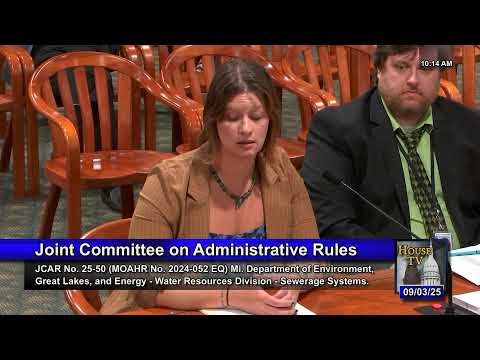
The Joint Committee on Administrative Rules heard testimony on proposed changes to Part 41 — Michigan's sewage-system rules — during a hearing where Department of Environment, Great Lakes, and Energy staff described new collection-system classifications, operator certifications and requirements for privately owned systems.
The Joint Committee on Administrative Rules heard testimony on proposed changes to Part 41 — the state rules for sewage systems — during a committee hearing where Department of Environment, Great Lakes, and Energy staff outlined new collection-system classifications and operator certification requirements and lawmakers pressed for wider outreach and funding details.
Sydney Hart, legislative liaison for the Department of Environment, Great Lakes, and Energy (EGLE), told the committee the rule package would clarify who is covered and how compliance would be enforced. EGLE assistant division director Chris Alexander and engineering specialist Steven Eich gave the committee a program overview; certification specialist Alyssa Sarver described the stakeholder process and training options. Eich said, "the language of Part 41 identifies the requirements for sewage systems, which includes your sewer pipes, your pumps, and wastewater treatment facilities."
The rule package would add four proposed collection-system classifications (C4 through C1) based on population served, introduce certification requirements for collection-system operators that mirror wastewater-plant licensing levels, and create a retention-treatment-basin classification for wet-weather facilities. Eich summarized the agency's goals: the rules would ensure the right systems are built, properly maintained, and operated by certified staff so "the public health is protected." Sarver described 18 stakeholder meetings held between 2020 and 2022 and said the draft rules were modified after the public hearing to base classifications on population rather than number of connections.
Why it matters: EGLE officials told lawmakers the changes are intended to reduce basement backups, overflows and storm-response problems that followed intense precipitation events — including a 2021 storm that a lawmaker said left "upwards of 16 to 20,000 homes" with sewage backups in Southeast Michigan. Eich said many contributing municipalities currently lack formal oversight for their collection systems and that the changes aim to inventory and maintain that infrastructure.
Lawmakers' concerns and EGLE responses
Committee members pressed EGLE on outreach to small and rural municipalities, the extent of stakeholder representation and the financial and implementation burden on local governments. Multiple legislators said they were unconvinced EGLE had contacted every affected community; EGLE staff said they used gov delivery lists, webinars, trade association outreach and conference presentations but acknowledged some communities could opt out of notifications and that not every municipality on record may have received notices. "I'd like to be on the side of caution and say no, we have not contacted every municipality," an agency representative told the panel.
On costs and funding, EGLE staff pointed to state revolving funds (SRF) as a financing option and said the department continues to request additional water-infrastructure funding. Chris Alexander described permitting public-notice requirements and said some permit application costs were anticipated: "if it's a general permit, then there's a $75 application fee" and an annual fee "I think ... $150." Sarver said the rules themselves do not include new application fees and that continuing-education costs for certification renewals were assumed in the regulatory impact statement; she said alternatives to formal education would be available through existing subrules and board policies.
Transition, enforcement and escrows
EGLE described an implementation approach intended to avoid abrupt workforce requirements. The draft would allow restricted or interim licenses in an initial period (the proposal describes a five-year window after a facility is classified during which options such as restricted licenses or credit for hands-on experience would apply), and also allows experience-based pathways so long-time operators could obtain certification without completing every lower-level exam.
The draft also would require privately owned sewer systems that serve the public to demonstrate financial capacity for long-term maintenance; EGLE described an escrow mechanism for privately owned systems so money for repairs and replacements would be available even if an owner ceases to exist. When asked how many contributing municipalities would be covered, an EGLE official replied, "About 500." Committee members sought clarity about what happens if an existing privately owned system lacks an escrow; EGLE said enforcement or case-by-case remedies would follow and that the agency's enforcement unit could pursue administrative orders where owners fail to maintain systems.
Permits and next steps
EGLE staff repeatedly distinguished the rulemaking from a separate permit process the department is considering (often discussed in the hearing as a CMOM — capacity, management, operations and maintenance — permit). Staff said rule adoption would establish the regulatory foundation and that additional stakeholder work would be needed before any new permit is proposed or issued. Chris Alexander described permit public-notice timelines and stakeholder steps: "Any permit ... has a required public notice process of at least 30 days," he said. EGLE told the committee it would continue stakeholder engagement, provide additional outreach (including district-level meetings), and said it would supply the committee with its gov-delivery subscriber list on request.
What the committee did (and did not) do
The committee held the hearing and asked questions but took no formal votes on the rule package or on any motion. EGLE declined requests to pause the rulemaking and said it would continue the process while continuing stakeholder outreach and work on any future permit design.
Ending note
EGLE staff closed by offering to follow up with members and to meet with municipalities that request technical assistance. "If there are any additional questions or there's a municipality that you're hearing from that would like to sit down, please let us know, and we're happy to coordinate that," Hart said. Lawmakers left the hearing still seeking clearer statewide outreach, a complete list of notified entities and more detail on the costs municipalities would face if the rules and any subsequent permit are finalized.