Get Full Government Meeting Transcripts, Videos, & Alerts Forever!
Get email alerts on the Economic Development Incentives topic
No spam. Unsubscribe anytime.
Lawmakers Press for Oversight, Transparency After Mundy megasite incentive push
Summary
At a House oversight subcommittee hearing, witnesses and lawmakers criticized the Michigan Economic Development Corporation(MEDC) and Michigan Strategic Fund for secrecy and generous incentives tied to the Mundy megasite, urging bans on nondisclosure agreements and statutory changes to the stateeconomic-development apparatus.
LANSING
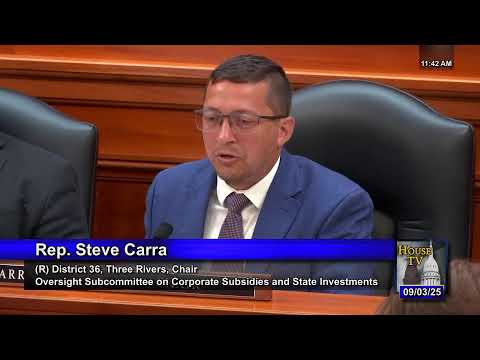
Lawmakers on the Michigan House Oversight Subcommittee on Corporate Subsidies and State Investments pressed witnesses on the transparency and scale of proposed incentives connected to the Mundy Township "megasite," focusing on nondisclosure agreements, site-preparation spending and authority exercised by the Michigan Economic Development Corporation and Michigan Strategic Fund.
At the hearing, James Hohman, director of fiscal policy at the Mackinac Center for Public Policy, told lawmakers "there was $6,000,000,000 signed or included in the letter of intent, and that's not including all of the possible money that this company was going to get from the federal government." Hohman said only about $259,000,000 of that figure had been authorized by statute and that the remainder would have required new programs or appropriations.
Hohman and other witnesses criticized the confidentiality that surrounded the deal. "I don't think we should be offering billions of dollars to secret companies and not telling people about who they're offering it to or how much," Hohman said, and recommended that letters of intent, memoranda of understanding and other pre-deal documents be made public before they are executed.
John Molina, who introduced himself as president of the Center for Economic Accountability, argued the scale of the proposed incentives and the MEDC's role require deep legislative review. Molina said the aggregate state and local package tied to the project could reach far beyond the state contribution and called for legislative reconsideration of the Michigan Strategic Fund Act and the MEDC's statutory authority. He urged banning the use of nondisclosure agreements by state or local officials in economic-development deals and said, quoting a recent proposal, that "until there's better oversight, perhaps they shouldn't be receiving any state funds at all."
Committee members cited details from a subcommittee site visit to the Mundy site. Chair Cara said the panel found the tract to be a roughly 2-mile-by-1-mile rectangle largely planted in corn and soybeans; members reported about 50 houses demolished around the perimeter and one recently demolished church. Committee members also said the subcommittee found a small, limited on-site construction presence and no obvious utility infrastructure such as natural gas hookups.
Lawmakers and witnesses highlighted several specific concerns:
- Scale vs. economic return: Hohman noted an initial $2.2 billion in near-term cash payments to the company and an advertised estimate of 9,400 jobs over 10 years. He stressed the fiscal scale of the incentives relative to expected statewide economic effect, writing that 9,400 jobs would be roughly 0.2% of current Michigan employment and that the cash outlay would be a substantial share of state spending.
- Site-preparation spending: Witnesses and lawmakers referenced roughly $250 million (figures cited as $250 million and $259 million in testimony) authorized for site-preparation work. Committee members asked whether those funds were used for demolition and buyouts, and Chair Cara said the committee would ask the MEDC for confirmation of the funding source.
- Nondisclosure agreements: Multiple witnesses said homeowners and others near the site had been asked to sign nondisclosure agreements as part of buyouts; witnesses urged a legislative ban on NDAs for economic-development deals to preserve public accountability.
- MEDC authority and process: Witnesses said the MEDC effectively negotiated terms that would require new legislative programs and appropriations, while the agency did not disclose the letter of intent until after the company announced it would not proceed. Molina recommended revisiting the Michigan Strategic Fund Act of 1984, adding skeptical or evidence-based seats to MSF/MEDC boards, and increasing statutory disclosure and conflict-of-interest requirements.
- Local impacts and governance: Committee members reported residents in nearby Maple Creek Preserve and Flint-area neighborhoods were either opposed, unaware or split in support, and raised concerns about HOA governance — including that several HOA board members reportedly did not live in the neighborhood.
Committee members asked witnesses about alternative uses for the money and whether site-preparation subsidies produce net state benefits after accounting for opportunity costs. Hohman suggested legislators should require cost-benefit standards that compare incentive spending with alternative investments, such as infrastructure or education.
No formal votes were taken at the hearing. Committee members said they would seek follow-up information from the MEDC about the source and use of site-preparation funds, the number and terms of nondisclosure agreements associated with buyouts, and the terms of any letters of intent or memoranda of understanding tied to the Mundy site.
The subcommittee hearing drew on testimony and questioning from both sides of the ideological spectrum and included repeated calls from witnesses for statutory changes to increase transparency and accountability in Michigan economic-development programs.