Get Full Government Meeting Transcripts, Videos, & Alerts Forever!
Get email alerts on the Pediatric Hospice Pilot topic
No spam. Unsubscribe anytime.
Action committee sets timeline and data priorities for statewide pediatric hospice pilot report
Summary
Connecticut's pediatric hospice action committee set a fast timeline to produce a report to the state assembly, identified data gaps and owners for work streams, and discussed RN certification, resource centralization and possible models including Massachusetts.
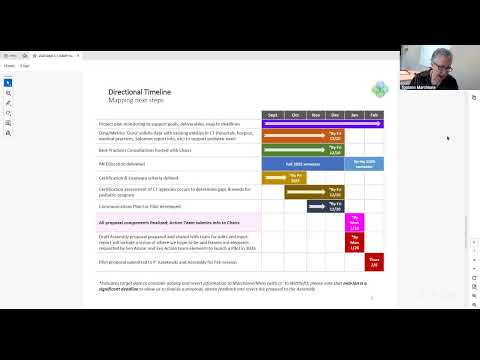
Melissa, an organizer of the Pediatric Hospice Action Committee, said the group must produce a report to the state assembly that "prove[s] the need for having a program" and include metrics, analysis of existing state programs and pilot cost estimates.
The committee is operating on a compressed schedule: members were asked to assemble material by mid-December for internal synthesis, with a draft report due to the assembly by Thursday, Feb. 6, according to Melissa. The group agreed to reconvene in two weeks and to treat the next session as an action-team meeting to vet models and data needs.
Why it matters: committee members told the meeting that strong, verifiable data and clear staffing and licensure frameworks will be essential to win legislative support and to design any pilot that would deliver pediatric hospice or palliative services in homes and hospitals statewide.
At the meeting, members mapped work streams, named likely activity owners and discussed immediate priorities: collecting state-level metrics, compiling written family and provider testimonials, developing RN training and certification pathways, and drafting rules or regulations that could define minimum standards for pediatric hospice providers.
Eileen, who identified herself as leading nurse-education work affiliated with Fairfield University's Eagan School of Nursing, said her program closed an application window with eight pediatric nurses interested in pursuing national board certification and that they aim for board testing by December. She also highlighted existing curriculum and the Kenrick Foundation grant that supports the certification effort.
Barbara, who described involvement in home health and hospice regulation development, told the group the state is separating home health care regulations from hospice regulations so hospice can be licensed as a standalone category. "We are in the throes of developing those regulations right now," she said, and she said the committee's guidance could be used as a placeholder in the new hospice rules.
Members emphasized data gaps. Jasmine and others reported difficulty obtaining comprehensive counts from the Department of Social Services on Katie Beckett waiver recipients; DSS previously provided condition-level data but not reliable counts or wait-list metrics. Several members said wait-list durations for the waiver can be long ("5 to 10 years" was cited anecdotally) and that a clear picture of how many children die at home without hospice support would strengthen the case.
The group discussed models from other states and the value of comparative analysis. Dr. Moss and representatives from the Solomon Center were asked to summarize relevant white papers and suggest one or two program models that might fit Connecticut, with the committee exploring a "menu" approach: a primary model plus modular options to match Connecticut's existing service landscape.
Committee members also described work already under way to centralize family resources. One speaker said an interactive map of community resources, compiled with both children's hospitals and national partners, aims to publish live links in September. Members proposed that the coalition serve as a statewide warehouse of resources and guidance for families and clinicians.
Next steps assigned in discussion (not formal motions): owners will gather data points and written testimonials, Eileen will continue RN certification work, Barbara will map regulatory language where a pediatric hospice requirement could be placed, and Peter was asked to coordinate slide materials and outreach. The Solomon Center will prepare a short presentation on national models for the next action-committee meeting.
The committee scheduled its next meeting in two weeks to review white-paper summaries, data inventories and draft sections for the Feb. 6 assembly submission. The meeting closed with organizers asking members to email data points in advance so staff can synthesize inputs.