Get Full Government Meeting Transcripts, Videos, & Alerts Forever!
Get email alerts on the Building Code topic
No spam. Unsubscribe anytime.
Bellflower council introduces ordinance to adopt 2025 California building codes; public hearing set for Sept. 22
Summary
At a Sept. 3 special meeting the Bellflower City Council introduced Ordinance No. 1449 to adopt the 2025 editions of California building codes, discussed local amendments on fire access and battery storage, and set a Sept. 22 public hearing for second reading and possible adoption.
The Bellflower City Council on Sept. 3 introduced Ordinance No. 1449 to adopt the 2025 editions of the California Building Code and related California building standards and set a public hearing for Sept. 22, 2025, for second reading and possible adoption.
The ordinance covers the 2025 editions of the California Building Code, California Residential Code, California Electrical Code, California Mechanical Code, California Plumbing Code, California Energy Code, California Fire Code, California Existing Building Code, California Wildland-Urban Interface Code, California Green Building Standards Code, California Reference Standards Code and the California Building Standards Administrative Code, with local amendments based on Bellflower conditions.
Council members and staff focused discussion on several substantive changes in the 2025 cycle: the local adoption of Fire Code Section 503 (which staff said gives local officials authority to set requirements for fire access roads and related features), updated provisions for electric-vehicle (EV) charging and battery storage, permit expiration and extension timelines, and the city’s self-certification and audit process for plans.
Alan (building official) summarized the update: “This is for the 2025 building codes update. As you may be aware, every 3 years, the CBC is updated.” He said much of the current cycle’s changes relate to fire protection, solar and EV charging, battery storage and permit expiration time frames, and that some local amendments implement authority already exercised by staff. On Section 503, he said the provision “gives us an option to go around to still make things safe, but still accommodate.”
Council members asked for specifics about how the new code will affect existing projects and applicants. Staff said projects with a building-permit application and plans submitted before the ordinance’s effective date that obtain building permits within 90 days of that effective date would be exempt from the updated regulations. Beth (staff) told the council, “The biggest message that we need to get across is that, people that are in the pipeline right now really need to get their permits, you know, 90 days from the effective date.” Staff also advised the council that the state code cycle takes effect Jan. 1, 2026, and that the ordinance adopted by Bellflower could be made effective earlier (staff said ordinances could take effect before Sept. 30 if the council adopts an urgency ordinance at the Sept. 22 meeting).
Council members sought clarification on several practical items: whether Section 503 would allow the city to be more or less stringent on fire access features (staff said adoption gives local authority and a backstop for enforcement), how EV charging requirements intersect with existing parking conditions, and how lithium-ion battery storage will be regulated because of fire risk. Staff noted that the code updates reflect statewide standards and that applications currently under review are compliant with existing rules but that they expect more EV- and battery-related applications in coming months.
On permit timing and extensions, council members discussed apparent differences in wording and practice. Staff said permits generally require inspection within the first 12 months after issuance and that extensions can be granted; staff described typical extension practice as more lenient than some state defaults and discussed 90- and 180-day windows in the course of the exchange. For temporary occupancies, staff said these are determined case by case by the building official and typically range from about 30 to 180 days depending on the situation.
Council members also questioned the composition of the Board of Appeals. Staff advised the council that the state lays out guidelines for certain appeals and that the city council can serve as the appeals body in many cases but can call on outside professionals when a specific technical expertise is required. Outside counsel (Mr. Verger) added that appeals to a construction appeals board are rare.
Self-certification and audit practice drew repeated questions. Staff said applicants using self-certification must submit declarations and documentation from architects or engineers taking responsibility for the work; the city performs an immediate cursory review followed by a full plan check and staff said they still perform standard plan-review procedures. Alan stated the review is done for every self-certified submission and that applicants proceed at their own risk while the city completes its checks.
Council member Sanchez and others asked about enforcement tools for unsafe or dilapidated buildings. Staff and counsel said the local amendments include explicit authority for the building official to take action on unsafe structures, including shutting off utilities when necessary.
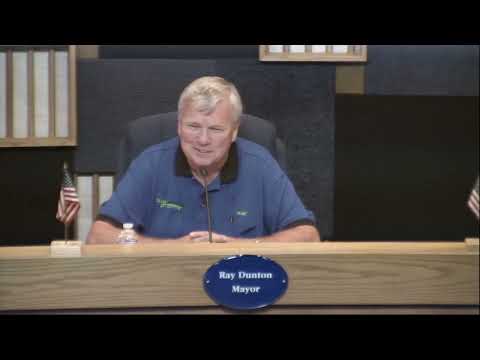
A formal motion to read Ordinance No. 1449 by title only, waive further reading, introduce the ordinance and set a public hearing for Sept. 22, 2025, was made by Mayor Pro Tem Tim Santinez and seconded by Council member Coops. The council voted unanimously (5-0) — Council member Sanchez (Aye), Mayor Pro Tem Santinez (Aye), Council member Coops (Aye), Council member Morris (Aye) and Mayor Dutton (Aye) — to introduce the ordinance and set the hearing. The city manager read the ordinance title into the record during the meeting.
Next steps: the council will hold a public hearing Sept. 22 for second reading and possible adoption. Staff advised the public that code changes would be effective Jan. 1, 2026, under the state cycle and reiterated the 90-day permit pull window for projects in the pipeline; staff also recommended proactive public outreach to notify applicants, designers and residents of the changes.
Votes at a glance
• Ordinance No. 1449 — Introduce, waive further reading; set public hearing for Sept. 22, 2025. Motion: Mayor Pro Tem Tim Santinez. Second: Council member Coops. Vote: 5-0 (Sanchez, Santinez, Coops, Morris, Dutton) — outcome: approved (introduced).