Get Full Government Meeting Transcripts, Videos, & Alerts Forever!
Get email alerts on the Housing Governor Square topic
No spam. Unsubscribe anytime.
Court appoints receiver for Governor Square; council keeps resolution in committee while members review court order
Summary
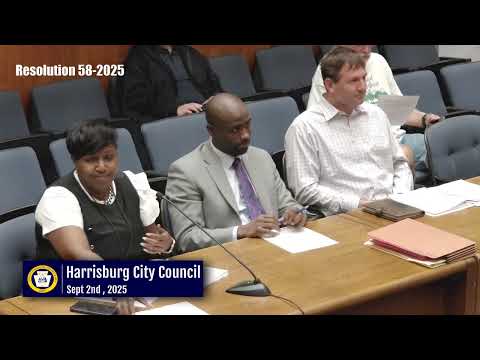
The Harrisburg administration committee discussed Resolution 58 of 02/2025 on the receivership of Governor Square, a troubled multi‑building affordable housing property, after a court on Friday issued an order appointing Midtown Asset Consulting LLC as receiver.
The Harrisburg administration committee discussed Resolution 58 of 02/2025 on the receivership of Governor Square, a troubled multi‑building affordable housing property, after a court on Friday issued an order appointing Midtown Asset Consulting LLC as receiver.
The resolution before the committee would authorize the city to petition for and support the receiver and to “appropriate and expend city funds as necessary to stabilize, restore, and preserve the properties subject to reimbursement.” The law bureau told council members the court order had just been received and that the city would be fully reimbursed for any monies it spends related to the receivership.
Why it matters: Governor Square houses more than 200 units across several buildings and has been the subject of longstanding housing and safety concerns. The city has already advanced seed funding and faces decisions about ongoing cash flows, the pace and scope of repairs, and how to protect tenants during restoration.
Midtown Asset Consulting owner Justin Heinley, the court‑appointed receiver, told council he will pursue a three‑phase plan. “The global intention with the property is to ensure that we restore all 222 units to a code compliant condition,” Heinley said, adding that some buildings “are beyond condemned and may require demolition and reconstruction.” He described an initial six‑month phase focused on life safety, securing the property and preparing a full budget and restoration plan that will be submitted for judicial and city review. Heinley said he anticipates the work could take up to ten years.
Heinley said operational revenue will come from current rent collections and that Wynne (also transcribed as “Wing”) Residential is the HUD‑qualified property management firm currently collecting rent under existing contracts. “The current rent roll is $46,382, of which only about $39,000 was collected. Currently, there’s a balance of $838,000 in delinquency,” Heinley said. He added that the receiver has been granted access to accounting, bank accounts and property management software to perform a full reconciliation.
Vice President Green asked about the $250,000 the city has put forward from revenue recovery funds and about the receiver’s monthly fee schedule. Heinley confirmed the city contributed $250,000 as seed funding and said the receiver’s fees (as presented in the court documents) are planned to decline across phases; he said much larger capital will be required for full restoration. Heinley cited a prior early‑2020s financial analysis that estimated “upper‑teens of millions” for complete restoration and said grant funding and rent recovery would be pursued to cover capital costs.
Council members pressed Heinley on tenant protections, relocation and affordability. Heinley said HUD rules limit changes to tenant protections and that preserving existing tenants was “paramount” and a HUD requirement. He said the receiver will prioritize finding comparable units for displaced tenants when necessary and give current residents first opportunity to return to rehabilitated units.
Several members asked about transparency and oversight. President Hill said council should have time to review the new court order; she asked the law bureau and the solicitor to answer lingering questions. Hill said she would add Resolution 58 to the next legislative session agenda and suspend rules to allow additional discussion before a formal vote; she also said the resolution would remain in committee while members and counsel review the court order.
The law bureau told members the court order will be reviewed to identify which provisions match the city’s proposed stipulation and which were suggested by opposing counsel. The law bureau also confirmed the city will be reimbursed for expenses the city pays in connection with the receivership, and that repayment could be through rent collections, grants or eventually the sale of the property if other options are not available.
The committee did not take a final vote on the resolution; members requested time to read the court order and scheduled further questions and updates from the receiver at upcoming meetings.
Looking ahead: The receiver said he expects to present a clearer financial and restoration plan after the initial six‑month assessment. Council asked for regular updates and public meetings so tenants and the wider community can track progress.