Get Full Government Meeting Transcripts, Videos, & Alerts Forever!
Get email alerts on the Housing Incentives topic
No spam. Unsubscribe anytime.
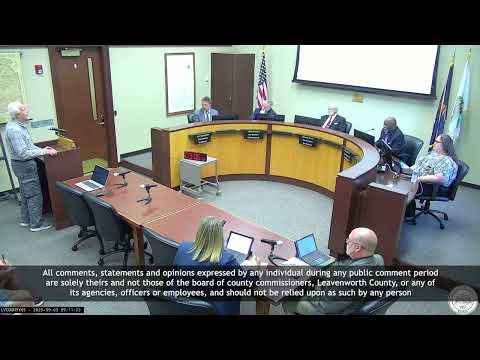
Leavenworth County commissioners split over Fairlane Townhomes Phase 2 RHID; developers, city and residents clash
Summary
Leavenworth County commissioners debated a developer request to create a 20‑year Reinvestment Housing Incentive District for Fairlane Townhomes Phase 2 in Lansing, with supporters citing workforce housing and infrastructure improvements and opponents saying the RHID shifts risk and tax dollars to county taxpayers.
Leavenworth County Commissioners spent more than an hour debating a request from a Lansing developer to create a 20‑year Reinvestment Housing Incentive District (RHID) for Fairlane Townhomes Phase 2, a 21‑unit market‑rate rental project in the City of Lansing.
The developer, appearing with a City of Lansing representative, said the proposal meets Lansing and county RHID policy goals, would add market‑rate workforce housing, and would fund on‑site infrastructure improvements the project needs. The packet shows the RHID is capped at about $852,000 and the developer estimated the county would receive “almost $68,000” in additional county tax revenue over the RHID term; county staff provided a separate estimate showing a projected net positive impact to the county of $14,807 over the RHID term.
Why it matters: commissioners framed the debate as a choice between encouraging residential infill and protecting county tax revenue. Supporters argued the RHID will spur infill investment, improve drainage and roadway frontage, and supply workforce housing near employers. Opponents, and several members of the public, said the program shifts infrastructure cost and development risk from private developers to taxpayers and creates unfair advantages for developers who receive incentives.
Details of the proposal and proponents’ case The applicant said the project would replicate the Phase 1 buildings and include 19 two‑bedroom units and two one‑bedroom units. The developer told commissioners the site requires significant off‑site and on‑site drainage work, curb and gutter improvements, and storm infrastructure; engineering estimates in the packet show substantial site infrastructure costs the applicant says make the project infeasible without RHID support. The developer said the project would start in the fall if approved and estimated a roughly 24‑month construction timetable.
City and school district approvals City of Lansing staff told the commission the Lansing City Council approved the RHID unanimously and the local school district granted its approval in a separate vote (5‑2 as reported). Lansing’s representative said a traffic study was completed and that the RHID cap represents about 26% of total project cost, and that only new property tax revenue generated by the construction would be used to fund the RHID (i.e., the city and school portions of incremental taxes only).
Public comment and commissioner concerns Multiple residents spoke during public comment opposing RHIDs for Lansing and Leavenworth County. Sarah George and Betty Kleindance told the commission they opposed using tax dollars to subsidize developers and said the county should protect taxpayers. John Redden criticized RHIDs generally, saying the original intent was rural housing development and that lobbying has expanded RHID use to suburban/urban areas.
Commissioner debate focused on several recurring issues: whether RHIDs shift risk or cost from developers to taxpayers; the fairness of granting incentives to some developers and not others; whether the county should defer to city and school district decisions; and state law design that requires approval from multiple taxing entities. One commissioner urged legislative change so that approval by one taxing entity would not require identical action by others; others said the county must act under current state statute.
Votes and legal steps The packet and the public record contain multiple formal motions on this item. Commissioners first moved to approve the RHID for Fairlane Townhomes Phase 2; the record includes a roll‑call style outcome described in the transcript as 3‑2 in favor. Later in the meeting, staff advised the commission to reword the record because under statute the RHID could be approved by default unless the commission adopted a resolution finding an adverse effect. A separate motion was then made to adopt a resolution finding an adverse effect and to nullify the RHID (Resolution 2025‑31). The transcript records that motion was moved and seconded and was put to a vote; the transcript records vocal responses but does not contain a clear, unambiguous final roll‑call tally for the nullification motion in the text provided. The packet lists the developer’s stated RHID cap as approximately $852,000.
What remains unsettled / next steps - The developer said the Phase 2 project “is not happening without RHID”; the transcript records the developer saying the pro forma shows negative cash flow for the first seven years and breakeven only much later. Commissioners asked for, and staff referenced, the county’s fiscal impact memo and the developer’s pro forma in the meeting packet. - Commissioners debated statutory limits, whether the county should adopt a uniform approach for future RHIDs, and whether state law should be revised to allow partial approvals by taxing entities. Several commissioners said they want legislative changes; others said they will apply the statute as written. - The city’s approvals and the applicant’s engineering materials and pro forma remain in the public packet.
Speakers quoted or referenced in this report are named as recorded in the meeting record and include the following.