Get Full Government Meeting Transcripts, Videos, & Alerts Forever!
Get email alerts on the Supportive Housing Services topic
No spam. Unsubscribe anytime.
Multnomah County commissioners press Metro for equitable SHS funding, shared KPIs and stronger housing strategy
Summary
At a board work session, Multnomah County commissioners discussed Metro’s ongoing Supportive Housing Services (SHS) reform work, urging clearer governance, shared performance measures and more housing production to ensure the county receives funding proportional to need. No formal votes were taken.
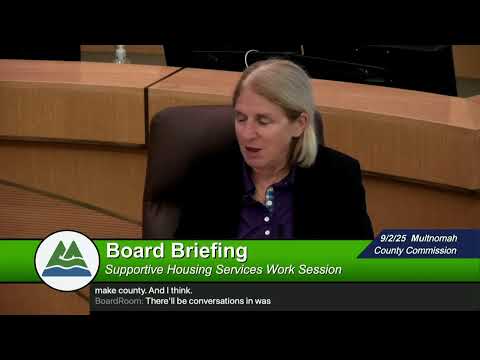
The Multnomah County Board of Commissioners used a Sept. work session to press Metro and local partners for clearer regional governance, shared performance measures and a stronger housing-production strategy tied to the Supportive Housing Services (SHS) measure.
The board — chaired at the briefing by the Multnomah County Board of Commissioners chair (title used in the meeting) — heard reports from commissioners who participated in a Metro convening led by Metro Council President Lynn Peterson and raised concerns about funding equity, performance metrics and the need to pair shelter with housing supply.
Commissioner Singleton, who served on the Metro work table, said discussions at the table included a proposed tri-county governance structure and a set of key performance indicators (KPIs) meant to measure progress toward making "homelessness rare, brief and nonrecurring." Singleton said the county and Metro need KPIs that align across jurisdictions so providers are not subject to conflicting requirements.
Commissioner Bridal Edwards, who also attended the Metro discussions, said the group moved from an early focus on governance changes toward an emphasis on demonstrable reductions in homelessness. "We really actually need to be able to show a real reduction in homelessness," Bridal Edwards said, arguing that governance change alone will not persuade voters or produce the outcomes Metro and counties seek.
Both commissioners and county staff flagged two recurring concerns: (1) Multnomah County appears to receive a smaller per-capita share of regional SHS funding than Clackamas and Washington counties, a disparity cited in a Metro audit as roughly "about half" on a per-capita basis; and (2) without more housing production, expanded shelter and services will be only a short-term response.
County staff said Metro is not likely to place a revised SHS measure on the ballot in November 2026 and that Metro staff have discussed a potential 2028 timeline for any renewal. Commissioners said that any regional ballot strategy should proceed in parallel with efforts to increase housing supply and fill financing gaps for projects that use low-income housing tax credits, gap financing and land acquisition.
Commissioners and staff discussed specific operational reforms that Metro and counties could pursue, including shared definitions of target populations (for example, narrowing the definition used for permanent supportive housing to match evidence-based criteria for chronic homelessness), portability of vouchers and supports across county lines, and aligning contracting and outcome requirements so multi-county providers do not face conflicting goals.
County staff confirmed that the new shelters the city is opening will be entered into the Homeless Management Information System (HMIS), a step commissioners said will strengthen data and allow better case conferencing and handoffs between providers. Commissioners raised concerns about mobility and retention: one county official described difficulty providing ongoing housing-retention services when a client moves to a different county.
No formal actions or votes were taken at the work session. Commissioners said the next steps include drafting a shared Multnomah County board letter to Metro and City of Portland counterparts stating county priorities for governance, KPIs, funding equity and housing production; sharing the Metro reform proposal and county feedback internally; and convening city and county staff and councilors to align outreach, shelter and placement strategies ahead of the 2027 budget and any future ballot work.
The session included multiple reminders that the underlying policy goal should not be renewal for its own sake but building a system that measurably improves outcomes for people experiencing homelessness in Multnomah County. "The goal should be to create a system that actually functions for the human beings," one commissioner said, adding that renewal of funding would flow from demonstrable progress rather than being the primary objective.
The board did not adopt any formal recommendations at the meeting; commissioners asked staff to circulate materials from the Metro convening, share a one-page timeline of Metro’s process, and return with further updates in upcoming board meetings.