Get Full Government Meeting Transcripts, Videos, & Alerts Forever!
Get email alerts on the Public Safety Sales Tax topic
No spam. Unsubscribe anytime.
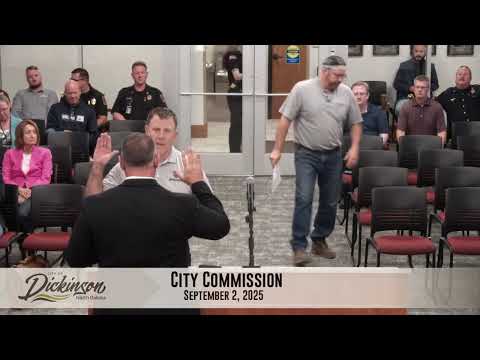
Dickinson commissioners discuss placing 1% public safety sales tax on 2026 ballot
Summary
City staff outlined a proposed 1% public safety sales tax and commissioners discussed placing a resolution on the June 2026 ballot to fund police, fire and EMS needs; no resolution was formally adopted at the Sept. 2 meeting.
Dickinson City Administrator Dossinger presented a proposed 1% public safety sales tax and asked commissioners for guidance on whether to place a resolution on the June 2026 ballot.
The proposal would add a 1% public safety tax on retail sales in Dickinson. Dossinger told the commission that, at 1%, “we're right around approximately about $7,000,000,” and that the draft allocation would send 80% of revenues to the city for public safety personnel, equipment, facilities, technology and capital improvements and 20% to Stark County for its public safety needs.
Commissioners discussed what the tax would and would not affect. Commissioner Bair confirmed with staff that ambulance transport charges would still generate a billing to the patient and would not be covered by the tax. Dossinger and other commissioners noted that the city’s sales-tax rate (6.5%) is lower than comparable municipalities and that adding the 1% would capture some sales by nonresidents and visitors who use local public-safety services.
Several commissioners expressed support for asking the voters. Commissioner Decker said other municipalities in the state have used similar taxes and suggested bringing a resolution forward; Commissioner Decker also noted rising equipment costs, including fire engines and ambulances. Commissioner Murphy asked what items would be excluded; Dossinger said staple groceries and certain agricultural products are typically excluded and that vehicle sale proceeds go to the state and do not produce city sales-tax revenue.
No formal vote to adopt or place a resolution on the ballot was taken at the meeting. Dossinger confirmed that, if the commission passes a resolution in the coming months, the referendum would appear on the June 2026 ballot and ultimately would be decided by voters.
Commissioners asked staff to return with follow-up details if they wish to proceed with a ballot placement resolution.
Looking ahead, staff said a successful ballot measure would be used primarily to address rising public-safety operating and capital costs, which the city projects at approximately $15.82 million for 2026 across fire, police and EMS budgets.