Get Full Government Meeting Transcripts, Videos, & Alerts Forever!
Get email alerts on the Transit Operations And Funding topic
No spam. Unsubscribe anytime.
OCTA official says disciplined planning, youth programs drove ridership back to pre‑COVID levels
Summary
Orange County Transportation Authority presentation highlighted financial reserves, free youth and community college ride programs, upcoming OC Streetcar service and fleet electrification — and named funding risks including Metrolink operating shortfalls, cap‑and‑trade uncertainty and coastal rail erosion.
Daryl Johnson of the Orange County Transportation Authority told the SB125 Transit Task Force that OCTA has rebuilt stability in its transit system through multi‑decade planning and fiscal safeguards and that recent youth and community college fare programs have materially increased ridership.
Johnson said OCTA’s transit programs account for “just over 50% of the agency’s annual budget” and described the agency’s “disciplined planning and sound financial management,” including a 20‑year comprehensive business plan and a long‑term operating reserve meant to protect service if revenues fall. “We set aside funds in a long term operating reserve to ensure that we could fund our financial future,” he said.
Johnson highlighted two fare programs designed to build long‑term riders: free rides for students at all nine Orange County community colleges and a countywide youth ride‑free program. He said those two programs together accounted for 16% of all rides in the last calendar year, up from less than 5% previously — a threefold increase in those rider segments.
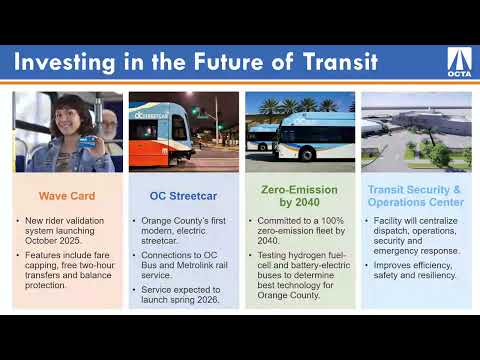
On network performance, Johnson told the task force OCTA achieved 102% of pre‑COVID ridership last fall and pointed to service changes, frequency improvements and route optimizations as factors in recovery. He also described near‑term operational changes: a new rider validation system called the Wave card, fare capping and two‑hour transfers; testing of zero‑emission battery electric and hydrogen fuel cell buses; and testing of OC Streetcar vehicles for a three‑car, four‑mile line from Santa Ana Regional Transportation Center toward Harbor Boulevard.
Johnson closed by listing funding and infrastructure risks: a need for sustainable operating support for Metrolink and other regional rail agencies as ridership remains below pre‑pandemic levels; uncertainty about cap‑and‑trade revenue that OCTA said supports $367 million in projects; continuing capital and infrastructure cost pressures for zero‑emission bus procurement and refueling infrastructure; and erosion and sea‑level rise threats along a coastal rail segment in southern Orange County. He told the task force he welcomed questions and said OCTA is “very committed to the 0 emission future.”
The oral briefing was followed by questions from task force members about the community college pass funding model; Johnson said OCTA seeded the first agreements and now most community colleges share costs through modest student fees and other contributions, and he offered to provide detailed funding figures to the task force in writing.
Looking ahead, Johnson said revenue and capital pressures will require continued strategic planning and that OCTA is investing in operations, security and a new operations center in Anaheim to centralize response and security functions.
Ending: The presentation served as an overview of OCTA’s recent program choices and the agency’s stated strategy to protect service via reserves, targeted fare programs and investments in electrification and streetcar service. Johnson’s slides and remarks were presented as background to task force discussions of funding, operations and regional coordination.