Get Full Government Meeting Transcripts, Videos, & Alerts Forever!
Get email alerts on the Commission Governance topic
No spam. Unsubscribe anytime.
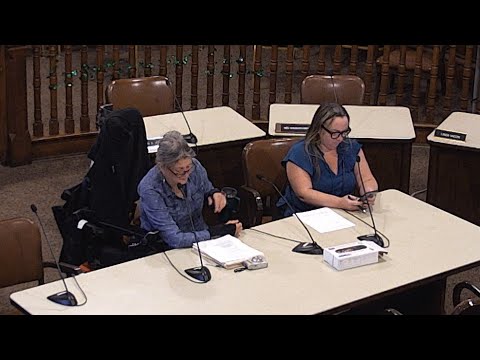
Holyoke Commission on Disabilities reviews member roles, budget and outreach plans
Summary
At its Aug. 28 meeting, the Holyoke Commission on Disabilities discussed membership roles and recruitment, approved minutes, reviewed a small city budget and procurement steps (including a Zoom subscription), advanced plans for a community survey, and noted an upcoming state hearing on the Trails for All bill.
The Holyoke Commission on Disabilities met Thursday, Aug. 28, and discussed internal roles and recruitment, municipal procurement and budgeting for the coming fiscal year, a planned community needs survey and state-level trail-access legislation.
Lynn Horan, chair of the Holyoke Commission on Disabilities, opened the meeting with a round of introductions and asked members to describe their skills, limitations and preferred roles on the panel. "Weare a very unique sort of commission," Horan said, noting the commission membership requirements that favor people with lived experience of disability.
Why it matters: commissioners said clarifying roles and communications will help the volunteer board maintain continuity when members face health or caregiving responsibilities. Horan noted the panel had endured an "unusually difficult last 12 months" of illnesses and family losses that temporarily reduced participation, and said the commission must organize to handle future absences.
Members described experience that they said qualifies them to serve. Jessica Libren, vice chair, summarized more than 15 years working directly with people with disabilities and said she brings budgeting experience. "I worked directly with the disabled special needs populations for over 15 years," Libren said. Sarah Wiedemann described her background as an American Sign Language interpreter and current role as a full-time caregiver; Marlene described decades in paratransit and transportation planning; Betty summarized decades in Holyoke public schools and special education leadership. Kelly Curran identified herself as the cityADA coordinator and said she had created a shared drive for commission documents.
Budget and procurement: the commission confirmed it has a modest municipal budget for fiscal year July 2025through June 2026 and described initial spending plans. "Our first purchase will be a Zoom account," Curran said, noting the purchase will support longer virtual meetings, captioning and translation.
Curran described the practical procurement steps: "If it's under $10,000, [a clerk] can just put in a requisition, and that'll get a purchase order cut, and services should be able or product should be delivered shortly after. If it's over $10,000, we have to get 3 quotes," she said. Commissioners raised a related City Council discussion that had considered lowering some spending thresholds; Curran and Horan said they were monitoring that debate and did not expect it to affect the commission's immediate purchases.
State grant account ("22g" funds): Horan said the commission is pursuing a separate state account (referred to at the meeting as "22g funds") to create a modest revolving account for multi-year projects. She said city finance and Council supporters have been receptive but that the item is likely to be postponed until later this year to allow the commission to show examples of how it would use funds. Horan said Councilor Patty Devine and Councilor Jenny Rivera have supported the order so far; she said Council consideration could be delayed until November.
Survey and outreach: commissioners approved a plan to begin neighborhood outreach and a community needs survey to guide future recommendations. Horan said the commission will start by attending downtown events and partner organizations (Horan named La Esperanza, Providence Ministries, the senior center and VCARE) and that the panel will use a mix of in-person distribution and an online survey platform such as SurveyMonkey. The plan includes Spanish-language translation and manual distribution for people without internet access. Horan said commissioners expect to draft final survey questions over the winter and aim for distribution in late winter or spring.
Trails for All bill: the commission heard an update on a state-level bill to expand trail access. Horan said members submitted a letter of support and that the bill may be assigned to a hearing either Sept. 2 or Oct. 7; the Massachusetts Office of Outdoor Recreation is hosting a virtual public forum on Sept. 15 and a hike on Sept. 26 at Belle Isle Marsh Reservation. Horan urged commissioners to attend or submit comment.
Sign and accessible-parking applications: commissioners reviewed the status of several pending accessible-parking (handicap placard) applications and agreed to follow up with city staff and the city clerk to prevent applications from getting delayed in the municipal process. Betty agreed to continue helping track outstanding applications, and Jessica agreed to assist.
Votes at a glance: the commission approved minutes from the June meeting by voice vote. Commissioner Betty made the motion to approve the minutes; Leanna seconded. The chair called the voice vote; commissioners present answered "aye" and the motion carried.
The meeting closed after further brief administrative discussion and a reminder that the commission is recruiting at least two additional members.
Ending note: commissioners emphasized the workload of volunteers and the importance of building institutional continuity, including documentation on a shared drive and dividing key operational tasks so the commission can sustain activities when members are temporarily unavailable.