Get Full Government Meeting Transcripts, Videos, & Alerts Forever!
Get email alerts on the Education Scholarships topic
No spam. Unsubscribe anytime.
Adams County to apply for COSI Achieve, continue support for existing scholarship cohorts
Summary
Lindsey Melki, chief of staff for Adams County, told commissioners the county will apply for the Colorado Opportunity Scholarship Initiative (COSI) Achieve grant, proceed with disbursement of a previously awarded Launch grant and apply for the Matching Student Scholarship (MSS) to support the remaining cohorts already enrolled.
Lindsey Melki, chief of staff for Adams County, told commissioners the county will apply for the Colorado Opportunity Scholarship Initiative (COSI) Achieve grant, proceed with disbursement of a previously awarded Launch grant and apply for the Matching Student Scholarship (MSS) to support the remaining cohorts already enrolled.
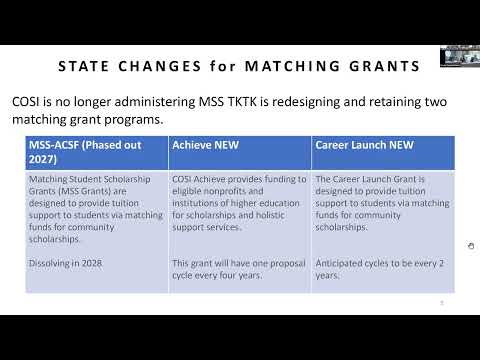
The request follows a staff presentation on changes to COSI’s grant structure and how those changes would affect Adams County’s decade-old scholarship program. Lisha Frandina, executive director of the Adams County Education Consortium, told the commission that state changes are reducing direct county matches and moving COSI funding to nonprofits through a competitive process.
Frandina said, “we were putting in around 500,000 a year, and the state was matching another 500,000.” She also told the board the county has “a fund balance of $930,000” and that the scholarship fund “is bringing in about $450,000 a year.” Staff said those balances and revenue will be used to maintain current cohort commitments while the county applies for the new grant opportunities.
Why it matters: commissioners repeatedly described the county scholarship as a targeted effort reaching mainly first-generation and low-income students and emphasized that shrinking state matches would reduce award size or the number of recipients unless the county increases its match. Several commissioners urged a short-term approach to preserve existing cohorts and a longer-term review of whether marijuana sales tax revenue remains the best source to fund the program.
Discussion and staff recommendation
Frandina summarized program changes and recommended splitting county investment across three COSI program buckets — the existing MSS for current cohorts, Achieve, and Launch — so the county can continue awarding some funds annually despite the state’s proposed four-year cycle for the new grant model. She said the new COSI model will make awards less frequent (available every four years) and emphasize targeted workforce or in-demand majors.
Commissioners pressed staff for details on eligibility, residency and school-of-attendance rules. Frandina said eligibility must be need-based and go to students who “live in Adams County or go to school in Adams County,” and that funds must pay tuition at public postsecondary institutions (including eligible charter schools and community colleges). She explained the county had historically funded four-year cohort commitments and that the county’s approach had included wraparound supports that improved student persistence.
Several commissioners emphasized competing priorities in the county budget. Commissioner Julie said she was “wrestling” with whether providing scholarships is an appropriate county role, noting other needs such as after-school care and social services. Commissioner Steve and others described the scholarships as a targeted, high-impact program that has historically doubled the state completion rate for participants and supported first-generation students.
Numbers discussed
- County contribution historically: about $500,000 per year (staff reported this as the county contribution that was matched by the state). - State match historically: about $500,000 per year (as reported by staff). - Fund balance reported by staff: $930,000 (to cover current cohort obligations). - Annual fund revenue reported by staff: roughly $450,000 per year. - Typical scholarship award cited from past cycles: about $3,000 per student per year; staff said the new model may average about $1,500 per student per year if the county preserves the same budget under reduced state matching. - COSI Achieve application deadline noted by staff: September 1 (staff said the Achieve application has that deadline).
Formal action taken
At the end of the presentation, county staff stated the immediate plan and commissioners gave consensus direction rather than a recorded roll-call vote. Staff said, “we are gonna apply for Achieve. Yes. We're gonna move forward with disbursement of launch, and we're gonna apply for MSS as well because that is our referral,” and commissioners indicated agreement to pursue those steps and to form a short-term working group to study long-term strategy.
What was not decided
Commissioners did not change the legal restriction on how marijuana sales tax may be used; several commissioners asked staff to confirm the 2014 ballot authorization’s limits and to return with options that fit those constraints. Commissioners also deferred a final decision on the county’s long-term match level (which would determine whether scholarship amounts remain near $3,000 or fall to roughly $1,500). Several asked for more analysis on residency rules, charter-school inclusion and the balance between wraparound services and direct awards.
Next steps
Staff will submit applications for Achieve and MSS, disburse the previously awarded Launch grant to the Adams County Education Consortium, and convene a working group to return to the board with options for long-term use of the county’s marijuana sales tax for education purposes. Staff said final award amounts will depend on the state’s COSI decisions and that the county can adjust spending after awards are announced.
Ending
Commissioners agreed to continue short-term support for students currently enrolled in scholarship cohorts and to study whether and how the county should alter the scholarship program going forward, while staff pursues the three grant opportunities and returns with detailed budget options.