Get Full Government Meeting Transcripts, Videos, & Alerts Forever!
Get email alerts on the Sewer Extension Perry Hall Manor topic
No spam. Unsubscribe anytime.
Baltimore County moves Perry Hall Manor sewer plan from pump station to grinder-pump system after property talks fail
Summary
Baltimore County is redesigning the Perry Hall Manor sewer extension as a low-pressure grinder-pump system after county negotiators failed to secure property for a planned sewage pump station, officials said at a community meeting Thursday evening.
Baltimore County is redesigning the Perry Hall Manor sewer extension as a low-pressure grinder-pump system after county negotiators failed to secure property for a planned sewage pump station, officials said at a community meeting Thursday evening.
"This is a health project," Lauren Buckler, director for public works and transportation, said at the virtual meeting. She and technical staff described a switch from a gravity-and-pump-station design to individual grinder pumps at each participating home and answered residents' questions about costs, timeline and property access.
County engineers told residents the change was necessary because the county could not acquire a site for the pump station despite multiple attempts. "They made the choice not to sell to the county," Buckler said about property owners the county approached. With the pump-station option unavailable, staff presented a low-pressure design that places grinder pumps on each participating property and pressure mains in the roadway.
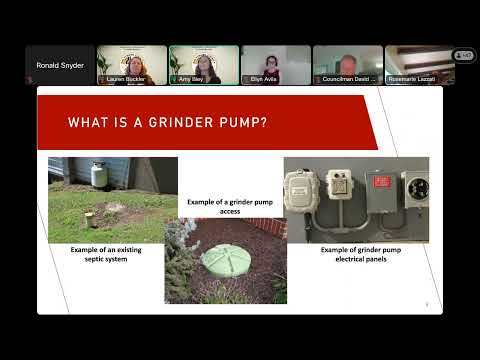
Amy Bly, sewer design section chief for the county Department of Public Works and Transportation (DPWT), said the system will be designed so homes drain by gravity to a watertight grinder-pump basin. "All of the grinder pumps will be installed and owned and maintained by Baltimore County," Bly said. She added that the county already owns and maintains about 3,000 grinder pumps countywide and that the devices include alarm panels and 24/7 dispatch for service calls.
County staff said the redesign affects part of the community but is not wholesale: the project serves 109 properties overall, and 36 homes that were originally expected to reach a gravity system tied to the pump station will now receive grinder pumps. "A 100% is going to be served by grinder pump," Bly said when summarizing the change in service for the neighborhood.
Officials also addressed costs and funding. Ellen (project staff, DPWT) said state funding of $4,500,000 is secured and will be applied to the property-owner share of connection costs. Because the new design is not yet fully engineered, staff said they do not yet have final connection charges; they expect the per-property increase compared with the earlier estimate to be modest. "When we're talking about up, we're talking about the neighborhood of a couple thousand dollars," Buckler said, adding that design work must finish before staff can provide detailed cost breakdowns.
Staff described homeowner responsibilities and program rules. Right-of-entry agreements allowing county crews to install grinder pumps on private property will be mailed to owners first; the county will follow with an easement purchase around the grinder pump after construction to ensure long-term access for maintenance. Officials said charges for the project will appear on the July 1 tax bill after construction is complete, and property owners will have one year from construction completion to connect.
Ellen said electrical upgrades required for a grinder-pump installation will be included in the county's connection work and financed as part of the connection charge; owners who qualify for the county's assistance programs may be eligible for deferred or reduced costs. Staff noted a 40-year financing option for property assessments is available and that a separate low-income program can defer costs for eligible homeowners.
The county outlined a tentative schedule: permitting is expected to wrap up by the end of the calendar year, design completion in 2026, advertisement and award of construction contracts in 2026, and construction completion in 2028. Staff said the project will be advertised using a traditional low-bid procurement method and that the county contractor will install mains, grinder pumps, electrical work and roadway repaving; homeowners will contract privately for the pipe between their house and the grinder pump, which is the only portion the homeowner's plumber will install.
Several residents pressed staff on environmental risk, backups and responsibility for damage. Officials said there is no greater leak or environmental risk with a low-pressure system than with a gravity-fed system, and that backup investigations follow the same claims process used for other sewer incidents. "If that were to happen, you are welcome to file a claim, and our claims division would handle that," DPWT staff said when asked about damage claims.
Staff also addressed alternatives and prior estimates. The earlier pump-station design had an estimated cost around $10,000,000 (engineers' estimate from previous work that was not bid), and routing the project onto Gunpowder State Park property would have roughly doubled the project cost, officials said. Because the new design has not been fully bid, the county does not have a firm final project total and promised to provide detailed cost allocations once the design and bids are complete.
Next steps include mailing right-of-entry packets (which will include a map with the proposed grinder location), completing design and advertizing for construction, posting answers to frequent questions on the project web page, and holding a community meeting after bids are received. Councilman Marks closed the meeting by thanking staff and saying he looked forward to moving the project forward.
Questions that residents raised repeatedly at the meeting — including whether they may opt out after the design change, how long a grinder pump lasts, and how easements will be handled — were answered as described above or will be addressed in the FAQ and follow-up communications the county promised to send.
Ending: County staff emphasized they will continue community outreach as the design is completed and costs are finalized and that property owners may contact the project team directly with questions before the next public meeting.