Lifetime Citizen Portal Access — AI Briefings, Alerts & Unlimited Follows
Advisory committee explores scenario planning, identifies tourism, climate and funding as top uncertainties
Loading...
Summary
Juneau City and Borough advisory committee members and staff used the meeting’s main session to introduce scenario planning for the comprehensive plan, define three critical uncertainties, and run a preliminary ranking of 15 “resilient strategies.”
Juneau City and Borough advisory committee members and staff used the meeting’s main session to introduce scenario planning for the comprehensive plan, define three critical uncertainties, and run a preliminary ranking of 15 “resilient strategies” to test how policies might perform under different futures.
Staff explained scenario planning as a way to test policy options against plausible futures rather than assuming past trends will continue. The committee heard that the project team developed 10 drivers of change from expert interviews and prior meetings; staff said those drivers were distilled into three critical uncertainties that the land‑use scenarios will use for testing: tourism and its spillover effects; climate change and environmental hazards; and federal and state funding and policy decisions (the latter combining several drivers including transportation/infrastructure vulnerabilities and state fiscal stability).
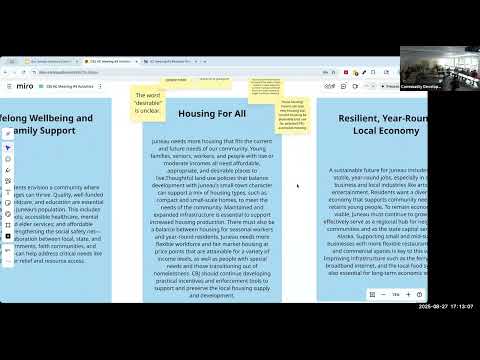
After a short break, participants reviewed 15 strategy cards and used an online poll to indicate which strategies they felt would perform well against each critical uncertainty. Staff cautioned the poll was an initial “temperature check” and not a formal vote. Poll results discussed on the record included counts reported verbally by staff (participants later repeated counts in discussion):
- Tourism and spillover effects: top‑ranked strategies included economic diversification beyond tourism (12 votes), waterfront/downtown development and economic vitality (9 votes each), and multimodal transportation systems (7 votes). Affordable housing and strategic land use received fewer votes than some expected (about 4 votes reported by staff).
- Climate and environmental hazards: mitigation of natural hazards and protecting/restoring environment were top picks; participants emphasized the need to treat mitigation as managing risk and focusing on engineering, stormwater upgrades and sensible siting of new development rather than an absolute prohibition on all development in hazard areas.
- Federal and state funding/policy uncertainty: participants favored strategies that strengthen the local economy’s diversity and support Juneau’s regional hub role, and again flagged affordable housing and strategic land use as important if outside funding declines.
Discussion highlighted specific policy considerations rather than single answers. Participants suggested prioritizing infill and higher density where hazard exposure is low and existing infrastructure can be upgraded; protecting parklands and wetlands that provide flood resilience; investing in multimodal transit and circulators to reduce downtown congestion; and creating more neighborhood‑scale centers (the Mendenhall Mall/Twin Lakes corridor, parts of North Douglas and downtown Douglas were named as possible nodes) to reduce single‑corridor vulnerability and support year‑round commerce. Several participants advocated exploring diversified tourism offerings (longer‑stay visitors, accommodations such as cabins or hut networks) to reduce day‑trip cruise impacts.
Staff and participants discussed feasibility versus aspiration. Several attendees asked poll participants to consider both feasibility (what can be implemented given local authority and likely funding) and resilience (what would perform well across scenarios). Staff said subsequent meetings would run deeper workshops, produce mapped land‑use scenarios and apply quantitative metrics (transport access, water use, emissions, land consumption) to compare outcomes.
The committee closed by restating outreach options: the survey remains open through September; CBJ staff said they would e‑mail the resilient strategies to online participants; and staff noted a potential follow‑up meeting at Douglas Library on Wednesday, Sept. 10, 5–7 p.m., for additional conversation.