Get Full Government Meeting Transcripts, Videos, & Alerts Forever!
Get email alerts on the Development Proffers School Proffers topic
No spam. Unsubscribe anytime.
City staff outline limits of development proffers for schools; level‑of‑service study set to inform any policy
Summary
City planning staff and legal advisors briefed council and the school board on post‑2016 proffer law, the narrow uses allowed for school proffers, sample per‑unit proffer estimates using FCPS methodology, and a citywide level‑of‑service study that will inform any proffer policy; council directed staff to pursue PPEA/RFI materials.
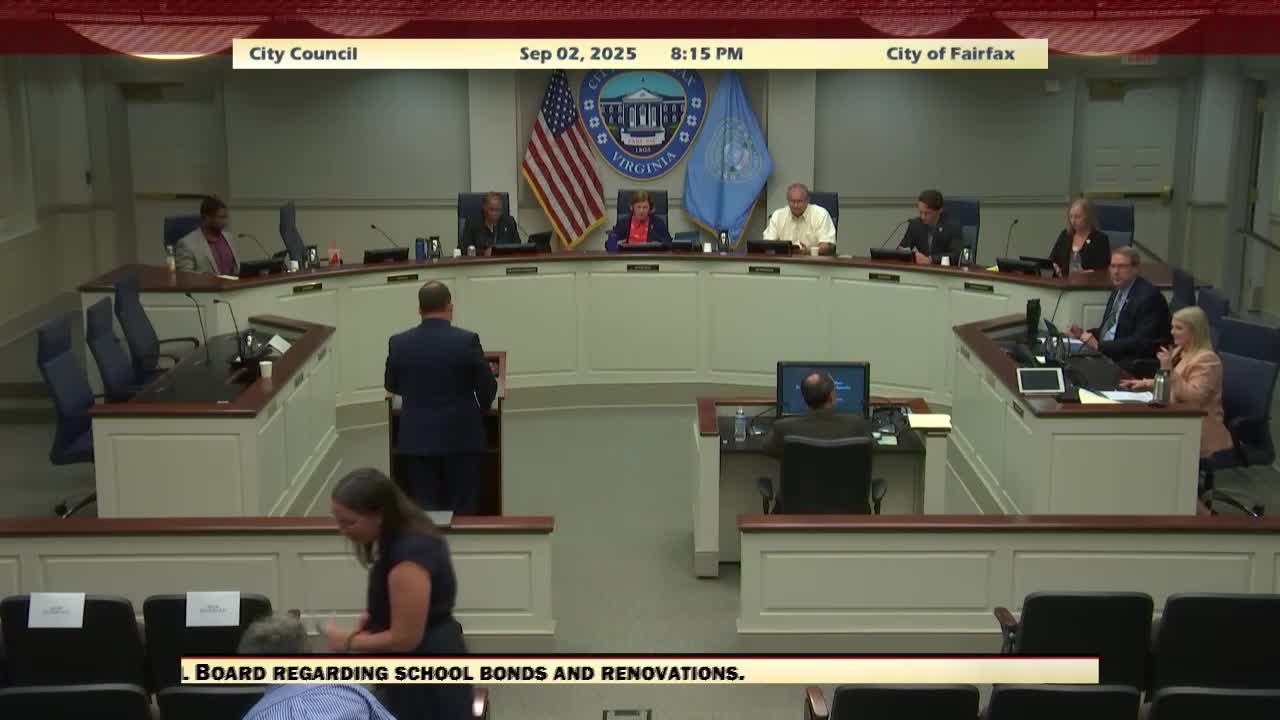
City planning staff, supported by legal and school officials, briefed the Fairfax City Council and the Fairfax City School Board on Sept. 2 about how development proffers (voluntary commitments from developers during rezonings) are treated under Virginia law and what limits apply when proffers are sought to help offset school costs.
Ms. Clark, moderating the presentation, introduced the topic and said the session would cover the state enabling authority, recent legal changes, how proffers are accepted, and school‑specific considerations. City staff member Mr. Harden and planner Eric Foreman led the substantive discussion.
State law and key constraints City staff emphasized the 2016 amendments to the Virginia Code that tightened rules for residential rezonings and monetary proffers. The changes require proffers to address impacts “specifically attributable” to the new development and to provide a “direct and material benefit” to that development; courts have placed a high burden on localities to justify restrictive or denial decisions. Staff noted several operational constraints: - Monetary proffers must be applied to capital projects that expand capacity and cannot be used to pay operating costs or routine repairs. - Proffered funds applied to capital projects must begin being used within 12 years of acceptance; otherwise they may be subject to state reversion. - Not all areas are treated the same: rezonings within small‑area plans or activity centers that meet statutory criteria have exemptions that allow more flexibility.
School proffers: formulas, limits and examples Eric Foreman summarized how school proffers generally must be linked to student generation. That requires two elements: an estimate of how many students a new housing unit will generate and an assessment of how much new school space (square footage) and construction cost that student yield would require. Foreman noted Fairfax County Public Schools (FCPS) maintains a commonly used methodology to convert expected students into a dollar proffer; the FCPS method (last updated in 2022) produced a recommended contribution of $14,956 per expected student.
Using the city’s student‑generation ratios and FCPS’s per‑student metric, staff showed sample illustrative contributions: - A 400‑unit multifamily project (illustrative) could generate roughly 32 students and a recommended contribution on the order of $478,000 under the county methodology. - A 50‑unit townhouse project could generate about 11 students and a recommended contribution near $164,000 in the illustrative scenario.
Foreman emphasized these sample figures are ballpark estimates and not “surgically precise.” He cautioned that proffers can only be used for capacity‑enhancing construction or renovation. Maintenance‑type work (for example, routine roof repairs that do not add capacity) generally does not qualify as a use of proffer funds under state law.
Staff cautions and process Staff highlighted other important constraints: once a proffer is accepted with a rezoning, it cannot be renegotiated later to adjust for actual student counts; proffers are voluntary and historically in Fairfax City have been proposed by applicants on a case‑by‑case basis. City staff said they currently lack a formal citywide proffer policy and that adopting one would require careful choices about geography (accept proffers citywide or only in activity centers), formulas and level‑of‑service standards.
To inform that work, the city has engaged a consultant to produce a citywide level‑of‑service study (transportation, parks, public safety and schools). Staff said the consultant’s report is expected in late spring to early summer 2026 and would inform recommended proffer formulas and thresholds.
Council discussion and next steps Councilmembers asked procedural and policy questions—how often the FCPS per‑student amount is updated (staff said 2022, generally every 5–6 years), what happens if collected proffer money is not spent within 12 years (state reversion), and how proffers could interact with existing planned school renovations. Several councilmembers urged caution and data‑driven analysis; Councilmember Hall asked whether proffer schedules should be considered now or postponed until the level‑of‑service study completes.
At the meeting’s close staff reported a majority of council members supported pursuing public‑private partnership (PPEA/P3) solicitations for selected CIP projects and directed staff to prepare materials and next steps for formal solicitations and to continue work on level‑of‑service analysis.
Ending City staff said they would return with recommendations after the level‑of‑service study and that any formal proffer policy would be brought to council for deliberation; staff reiterated proffers are not a guarantee of revenue for the schools and are limited by statute to capacity‑adding capital projects.