Fort Myers emergency management outlines storm readiness, debris and vessel-recovery rules
Loading...
Summary
Fire Chief Trace McMillian told the Environmental Advisory Board on Sept. 2 that the City of Fort Myers runs a small emergency-management operation focused on pre/storm/post actions, debris contracts and coordination with state and federal partners; staff updated the board on surveys and permitting required to remove derelict vessels.
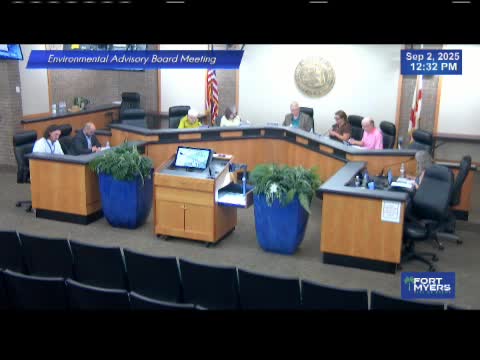
Fire Chief Trace McMillian, who also serves as the city—s emergency management director, told the City of Fort Myers Environmental Advisory Board on Sept. 2 that the city runs a compact emergency-management operation focused on preparing for, responding to and recovering from severe storms.
McMillian said the emergency management function is staffed by roughly "two and a half" people in the fire department, supported by subject-matter experts from utilities, public works and other departments. He described a season-based checklist system for departments, pre-staged debris sites and about 50—to—60 preestablished disaster contracts that the city can mobilize after storms.
"We try not to put all our resources in one bucket," McMillian said, noting the city purposefully maintains vendor contracts across regions so suppliers remain available when Southwest Florida is impacted. He urged residents to download the city's emergency-management app, which includes a "report damages" feature tied to the city's incident-tracking system.
Why it matters: McMillian—s presentation laid out how the city converts short-term emergency response into longer-term recovery work and federal reimbursement. The board asked detailed follow-up questions about stormwater runoff, debris removal, private construction-site discharges and the rules that govern derelict boats.
Key points from the presentation
- Staffing and structure: Emergency management sits in the Fort Myers Fire Department; McMillian said Christina Matthews is the emergency manager and Jennifer Smith is the coordinator. He described a "holistic" approach that draws on staff from other departments for operations.
- Pre-storm planning: Departments run checklists that address generators, lift stations, chemicals and continuity of operations. Hurricane season is June 1—to—Nov. 30; the city begins its seasonal roll-out in the spring.
- Contracts and debris: McMillian said the city maintains dozens of disaster contracts and prestaged debris sites. Initial emergency spending is typically paid up front by the city and later reimbursed through FEMA public-assistance (PA) funding.
- Federal reimbursement and programs: McMillian described the PA reimbursement process and said the city uses Florida—programs intended to speed recovery (including a Florida-based recovery scoring program he called the FROC process) to accelerate some payments for debris and emergency work.
- Communication and public information: Noelle Casagrande, the city's public-information officer, manages social media, the website and press coordination; McMillian said the city aims to "over-communicate" during events and uses an app to push messages to residents.
- Environmental response during and after storms: McMillian said the city coordinates with the U.S. EPA, Florida DEP and other partners to monitor pollution risks such as boil-water conditions, carbon-monoxide hazards from generators, asbestos and other toxics that can arise after major events. He stressed rapid debris removal and remediation to limit ongoing environmental and public-health impacts.
- Stormwater and construction-site runoff: City Engineer Nicole Setzer told the board that private construction sites must comply with state and local stormwater rules and that the city does not have special exceptions for hurricane events. "We do go out and inspect those sites on a regular basis," Setzer said, but she added that post-storm inspections may be hard to prioritize if search-and-rescue or critical public-safety tasks are ongoing.
- Monitoring water quality: Staff said the city follows its MS4 (municipal stormwater) sampling program. After a storm the city will take additional samples as soon as it is safe to establish a post-event baseline and watch for expected spikes followed by declines.
- Infrastructure aspirations: Board members asked about upgrades. Setzer said a consistent seawall elevation along the Caloosahatchee and remote-operated telemetry for weirs (to open or close remotely) are high-priority items the city is exploring for grant funding.
- Derelict vessels and marina recovery: Staff reported the city has directed Tetra Tech, the contracted environmental emergency firm, to perform benthic and bathymetric surveys required for an Army Corps permit before removing derelict vessels at a marina site. The board was told the U.S. Army Corps of Engineers treats sites with vessels present longer than two years as locations requiring environmental assessment before removal.
- Regulatory roles for vessel removal: Staff summarized that private marina operators are typically responsible for sunken or derelict private vessels in their facilities, and that the Florida Fish and Wildlife Conservation Commission (FWC) recently (in July) received authority in state law to remove vessels and assess costs against the registered owner in some cases.
What board members asked and staff responses
Board members raised a range of operational questions, including whether developers have specific pre-storm runoff requirements (Setzer said property owners are responsible for compliance and the city will inspect and require cleanup if a site discharges illegally), whether ferries or rail could be used for post-storm logistics (Setzer noted the Seminole Gulf Railway is privately owned and that bridges and private infrastructure can take months to rebuild), and how nonprofit partners (Red Cross, Salvation Army, Harry Chapin Center, United Way and others) are used for feeding and donations distribution.
"We're not good at running large-scale donations distribution," McMillian said. "We try to partner with nonprofit feeding agencies who do that work daily."
Quotes
"We try not to put all our resources in one bucket," Trace McMillian said of disaster contracting.
"We don't have any plans to put in place for those private sites that are discharging," Nicole Setzer said about private construction-site runoff; "we do have a team that goes out and inspects those sites on a regular basis."
Ending
McMillian asked board members to contribute ideas for the city's forthcoming five-year emergency-management strategic plan and invited volunteers to take part in the planning process. Staff also said follow-up materials, including the Tetra Tech survey schedule and Army Corps permitting timeline for the marina site, will be provided when available.