Get Full Government Meeting Transcripts, Videos, & Alerts Forever!
Get email alerts on the School Bonds And Capital Financing topic
No spam. Unsubscribe anytime.
Fairfax City officials outline scale and timing of $220 million school bond; council to consider awarding design contract next week
Summary
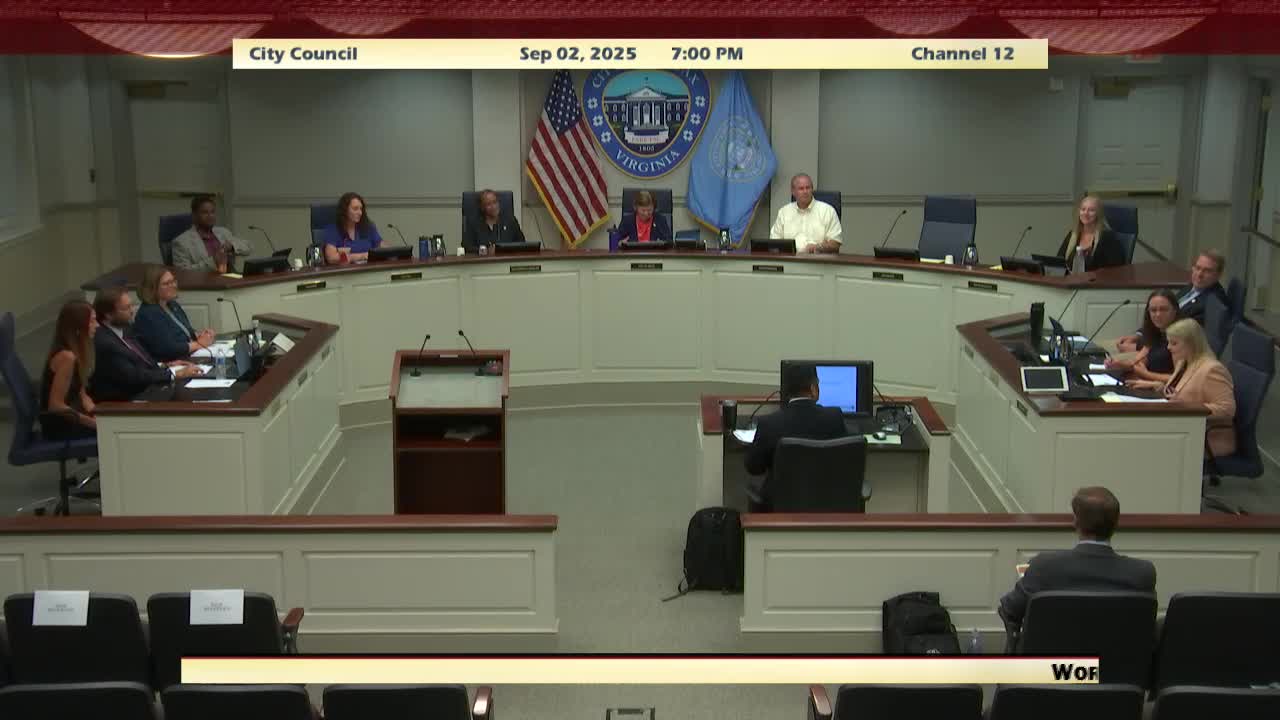
Fairfax City and the Fairfax City School Board held a joint work session Sept. 2 to review financing and timing for school projects approved in last year’s $220 million bond referendum, with City Chief Financial Officer JC Martinez and Davenport & Company LLC advising on the budgetary and credit implications.
Fairfax City and the Fairfax City School Board held a joint work session Sept. 2 to review financing and timing for school projects approved in last year’s $220 million bond referendum, with City Chief Financial Officer JC Martinez and Davenport & Company LLC advising on the budgetary and credit implications.
Davenport advisor Kyle Laux said the city and school board had provided him a list of priorities—Daniels Run Elementary School, Providence Elementary School and the Fairfax High School roof—and that Davenport’s role was to analyze those priorities and the likely fiscal impact. “It is not for us to tell you which projects to do,” Laux said. “That’s obviously the purview of the governing bodies here.”
The presentation reported that planning costs of roughly $3.0 million for the schools are included in the FY2026 capital improvement program and will be funded from existing CIP dollars rather than new borrowing. The high school roof, originally budgeted at about $4.5 million for FY2026, was delayed one year in collaboration between the school board and city to help balance the FY2026 budget; the school board chair said delaying the roof risks higher future costs and described that choice as “kicking this can down the road.”
Why it matters: Davenport and city staff stressed the scale of the $220 million package relative to Fairfax City’s budget and credit profile. The city holds a top-tier (AAA) credit rating that lowers borrowing costs, but taking on large, generational capital projects will push debt-service ratios upward unless offset by strong fund balances, budgetary discipline or new revenues.
Key figures and timing - Voter-approved bond: $220,000,000 (referendum passed last November) - FY2026 planning appropriation: about $3,000,000 (from existing CIP funds) - Deferred high school roof originally estimated: $4,500,000 (pushed into a later year) - Planning interest-rate assumption used by advisers: 5% (conservative planning assumption); advisers said current market rates are in the low 4% range - Value of one penny on the real-estate tax rate (planning estimate): about $835,000 - Projected stepped-up annual debt service if the full program is borrowed incrementally: roughly $1.8 million (initial), rising over several years to a peak around $16–17 million per year near the end of the decade, per Davenport’s illustrative cash flows - Tax-equivalent impact (if the only revenue source were the real-estate tax and it did not grow): Davenport’s planning estimate is about 2.5 pennies in 2027, another ~2 pennies in 2028 and a larger increase in 2029 (roughly 9 pennies that year), producing a multi-year cumulative impact in the 15–20 penny range across several years depending on timing and revenue assumptions
Advisers and staff emphasized these are order‑of‑magnitude estimates for planning; they assumed no revenue growth and did not assume passage of any new local sales tax. Laux said the planning approach is intentionally conservative so decision-makers can adjust when more information is available.
Revenue options and state timing City and school officials discussed a potential 1% local sales-tax option under consideration in parts of Virginia. Davenport estimated a 1% sales tax for Fairfax City could generate roughly $12–14 million per year—an amount close to the peak debt service projected for the school program—but advisers and staff cautioned that even if the measure were enacted at the state level, a local referendum and implementation steps mean revenues would not realistically appear until FY2028. Laux and Martinez reiterated they did not assume those revenues in the FY2027 budget and instead modeled the program with conservative assumptions.
Cumulative CIP pressures and other projects City staff told councilmembers the city’s five‑year CIP also includes several large non-school projects—property yard replacement, Fire Station 3, upgrades to the Willard Sherwood Center and a police garage addition—whose combined proposed cost could add the equivalent of roughly 10 cents on the real-estate tax rate over the same multi-year window if fully financed. Staff emphasized those other projects have not been fully appropriated and remain subject to council decisions.
Council responses and next steps Most council members who spoke expressed support for completing school renovations and repairing the high school roof, while also raising concerns about cumulative tax burden and sequencing of CIP projects. Councilmember Peterson asked staff about the combined, cumulative tax impact of all proposed CIP projects; staff said those projects could add roughly 10 cents over multiple years in addition to any school-related increases, depending on timing and whether council approves full appropriations.
On process, the council was told an item to award a contract to start the design work for the school renovations will appear on the Sept. 9 council agenda. City staff said the design contract’s total value exceeds the $3.0 million currently available, and the Sept. 9 action would commit the city to the design procurement while staff plan to fund the remainder in future budgets. The council will vote on that award next week unless the item is deferred.
Public-private partnerships and other levers Several council members asked staff to pursue public-private partnership options (PPEA/P3 solicitations) for some non-school CIP projects to reduce the city’s up-front burden. City staff said they would begin preparing materials for a formal solicitation and noted prior requests for information had yielded only limited private-sector responses. At the meeting’s close staff said they would begin pursuing PPEA/RFI work unless there was objection.
What the meeting did not decide There were no final authorizations to issue bonds or to raise taxes at the Sept. 2 session. The council will consider the design contract award on Sept. 9 and will determine budget and financing choices through the FY2027 budget process and later budget years.
Ending Staff and Davenport said they will return with more detailed budget scenarios during upcoming budget deliberations. Officials reiterated that timing for any additional revenues (notably a state-enabled local sales tax) and future interest‑rate movements will materially affect how the city sequences borrowing and budget responses.