Get Full Government Meeting Transcripts, Videos, & Alerts Forever!
Get email alerts on the Climate Action Adaptation topic
No spam. Unsubscribe anytime.
Belmont staff, consultants outline update to Climate Action and Adaptation Plan; commissioners and public ask about implementation and equity
Summary
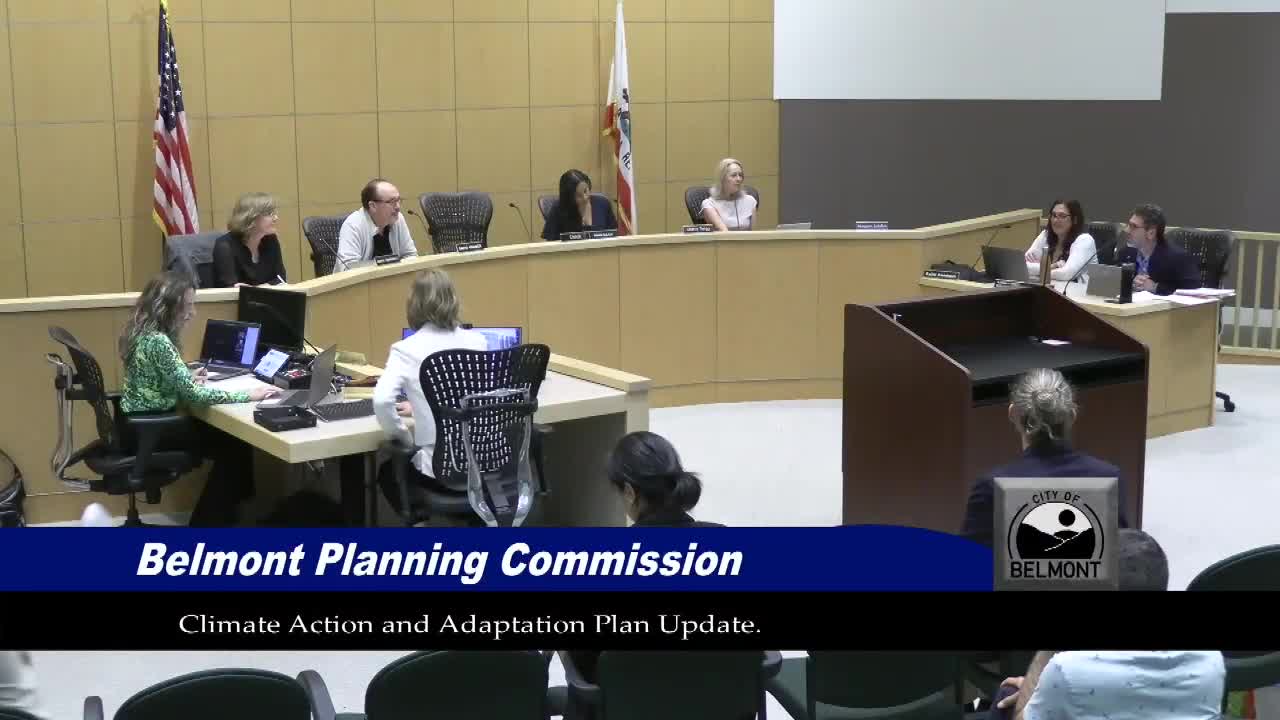
City staff and Rincon Consultants presented an update to Belmont’s Climate Action and Adaptation Plan on Sept. 2, reviewing greenhouse‑gas inventories, forecast scenarios and candidate strategies for buildings, transportation, waste and adaptation.
City staff and consultants presented an update to Belmont's Climate Action and Adaptation Plan at the Belmont Planning Commission meeting on Sept. 2, describing current greenhouse‑gas inventories, forecast scenarios and candidate strategies for mitigation and adaptation.
Karen Clark, a city analyst and project manager for the plan, and Ryan Gardiner, director of climate action at Rincon Consultants, led the presentation. They said the plan will refresh the city's 2017 climate plan, align targets with state law and add adaptation measures tied to the city's safety element update. Gardiner described the plan as containing both mitigation (reducing emissions) and adaptation (preparing for climate impacts) actions and said the work will feed eligibility for state funding programs.
The presentation summarized Belmont's 2023 emissions inventory: on‑road transportation accounts for the largest share (approximately 52 percent) and natural gas for buildings about 40 percent; electricity was small (about 1 percent) because the city receives carbon‑free power through Peninsula Clean Energy. Gardiner said the city achieved a 28 percent reduction compared with 1990 levels, exceeding the 2020 target, but that emissions have plateaued and additional measures are needed to meet 2030 and 2045 state targets.
Key strategies outlined included: accelerating building electrification (heat pumps for space and water heating), expanding EV charging and reducing vehicle miles traveled through active transportation and transit, reducing organics to meet the state's SB 1383 goal and coordinating wildfire risk reduction with urban greening. The presentation noted both opportunities (new 2025 building codes favoring electrification, state funding such as Proposition 4) and constraints (legal uncertainty around local reach codes, uncertain federal incentives, and staff capacity).
Commissioners asked technical and policy questions about accounting methods, the role of regional models for off‑road equipment, how vehicle miles traveled are counted, assumptions about vehicle ownership and parking, and whether weatherization or cool‑roof measures make sense in Belmont's moderate climate. Gardiner explained the inventory and forecast methodology, said off‑road emissions rely on a county model, and described the forecast lines for business‑as‑usual, state policy effects and the state target pathway to carbon neutrality by 2045.
During public comment, Daojian Pei, program and operations manager for Build Up San Mateo County and a Belmont resident, asked the commission to ensure the plan addresses early‑childhood facilities and childcare providers, noting that children under age 5 are especially vulnerable to extreme heat and wildfire smoke and that many childcare providers operate on thin margins and need funding and technical support to become climate resilient. Pei said the group's July 2025 Early Childhood Climate Action Plan provides practical strategies for local governments and asked staff to incorporate attention to childcare facilities.
Staff and consultants said community engagement is underway (website, survey and pop‑ups), with a virtual workshop scheduled for Sept. 11 and additional outreach through early 2026. The next steps listed were development of draft measures in January, modeling scenarios with a “spark” tool, and producing a draft plan for adoption in fall 2026.
Direct quotes from presenters in the meeting included: “What is a climate action and adaptation plan? It’s really our strategy, how we’re going to address climate change,” said Ryan Gardiner. Daojian Pei told the commission, “The Early Childhood Climate Action Plan is a call to action for all of those who care about children and families and climate resilience in San Mateo County.”
Commissioners and staff agreed to continue refining measures and to bring the draft actions back to commissions and council for review; staff asked commissioners to promote the Sept. 11 workshop and the online survey to help the planning process.