Get Full Government Meeting Transcripts, Videos, & Alerts Forever!
Get email alerts on the Budget Finance topic
No spam. Unsubscribe anytime.
SFMTA trims FY25‑26 budget, deletes more than 500 vacant positions and narrows FY26‑27 deficit to $307 million; long‑term shortfall remains
Summary
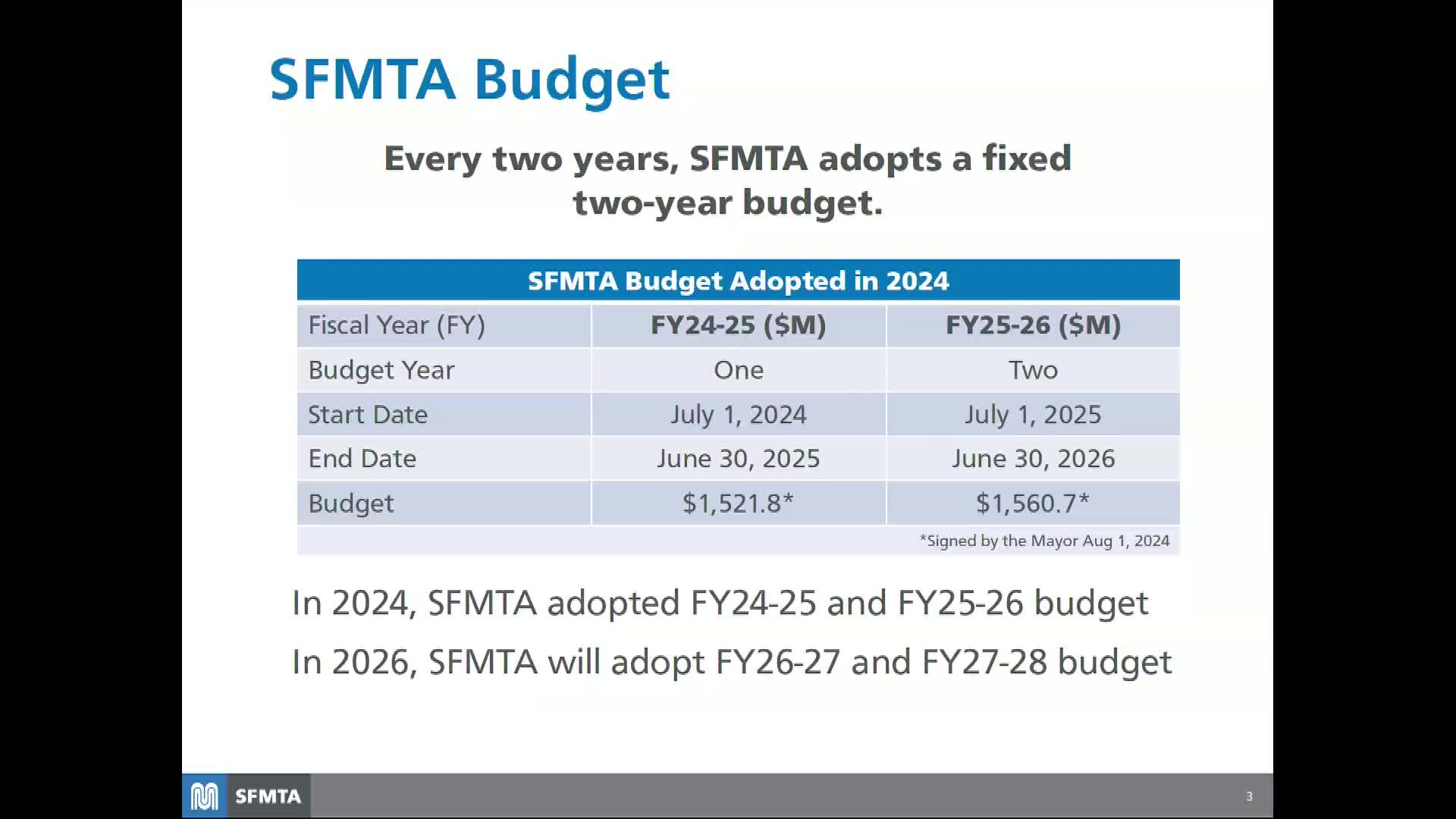
CFO Bree Mahorter told the board that SFMTA reduced the FY25‑26 budget by roughly $22 million and removed more than 500 budgeted positions (all vacant) to better align staffing with available resources; the agency now projects a $307 million deficit in FY26‑27 and said the regional revenue measure alone will not close long‑term gaps.
SFMTA Chief Financial Officer Bree Mahorter reported to the board on changes made in the FY25‑26 off‑cycle budget and the agency’s five‑year financial outlook, emphasizing that staff tightened the budget and reduced the number of budgeted but unfilled positions.
Key points: Mahorter said the agency reduced planned expenditures by about $22 million for the FY25‑26 year and deleted “over 500 positions” from the budget; she said the deleted positions were vacant and that current service levels remain in place. The deletion was intended to align the budgeted headcount with realistic funding levels and to reduce the number of positions put on “budget hold.”
Projected shortfall: The SFMTA’s updated five‑year projection shows a FY26‑27 structural deficit of about $307 million. Mahorter said the revised FY25‑26 changes reduced the earlier projection (previously cited at $322 million) but did not eliminate the shortfall. She described the deficit as a bridge problem: the agency must identify near‑term resources (one‑time or local revenue) to cover FY26‑27 until regional revenue from a proposed regional ballot measure begins to flow in FY27‑28. Even with the regional measure, Mahorter cautioned, projected expenditures grow faster than anticipated revenue over the longer term and additional local revenue or expenditure changes will be required.
Areas of savings: The agency reduced travel and reimbursements by 50%, trimmed $2 million in city work orders, cut $6 million in IT professional services (one‑time) and consolidated transit budget units to simplify payroll and monitoring. Mahorter said the agency deleted about 30 managerial positions among the larger group of vacant positions.
Board questions and next steps: Directors asked for more detail on deleted positions and the consequences for service. Mahorter said the deletions were largely technical adjustments to reflect vacancies and were not intended to force immediate additional service cuts beyond modest reductions already adopted. The board scheduled further budget workshops this fall to weigh revenue options, potential local ballot measures and targeted reductions; Mahorter said staff will present policy trade‑offs and options in September and October and bring detailed proposals before the board in December.
Ending: Mahorter urged the board to consider a combination of options —short‑term one‑time fixes, a local revenue measure to complement any regional sales‑tax measure, and selected expenditure controls — to close the FY26‑27 gap and stabilize the agency’s multi‑year outlook.