Get Full Government Meeting Transcripts, Videos, & Alerts Forever!
Get email alerts on the Market Street Ride Hailing topic
No spam. Unsubscribe anytime.
SFMTA faces public outcry after mayor allows Waymo, Uber and Lyft back on Car-Free Market Street
Summary
The SFMTA director told the board the agency will monitor the effect of allowing some ride‑hail and autonomous vehicles on Market Street; dozens of public commenters urged the board to reverse the mayor’s decision or make it a formal agenda item for study and public review.
The San Francisco Municipal Transportation Agency (SFMTA) told its Board of Directors that it will collect data and evaluate impacts after the mayor arranged to allow Waymo, Uber and Lyft to operate on a portion of Market Street.
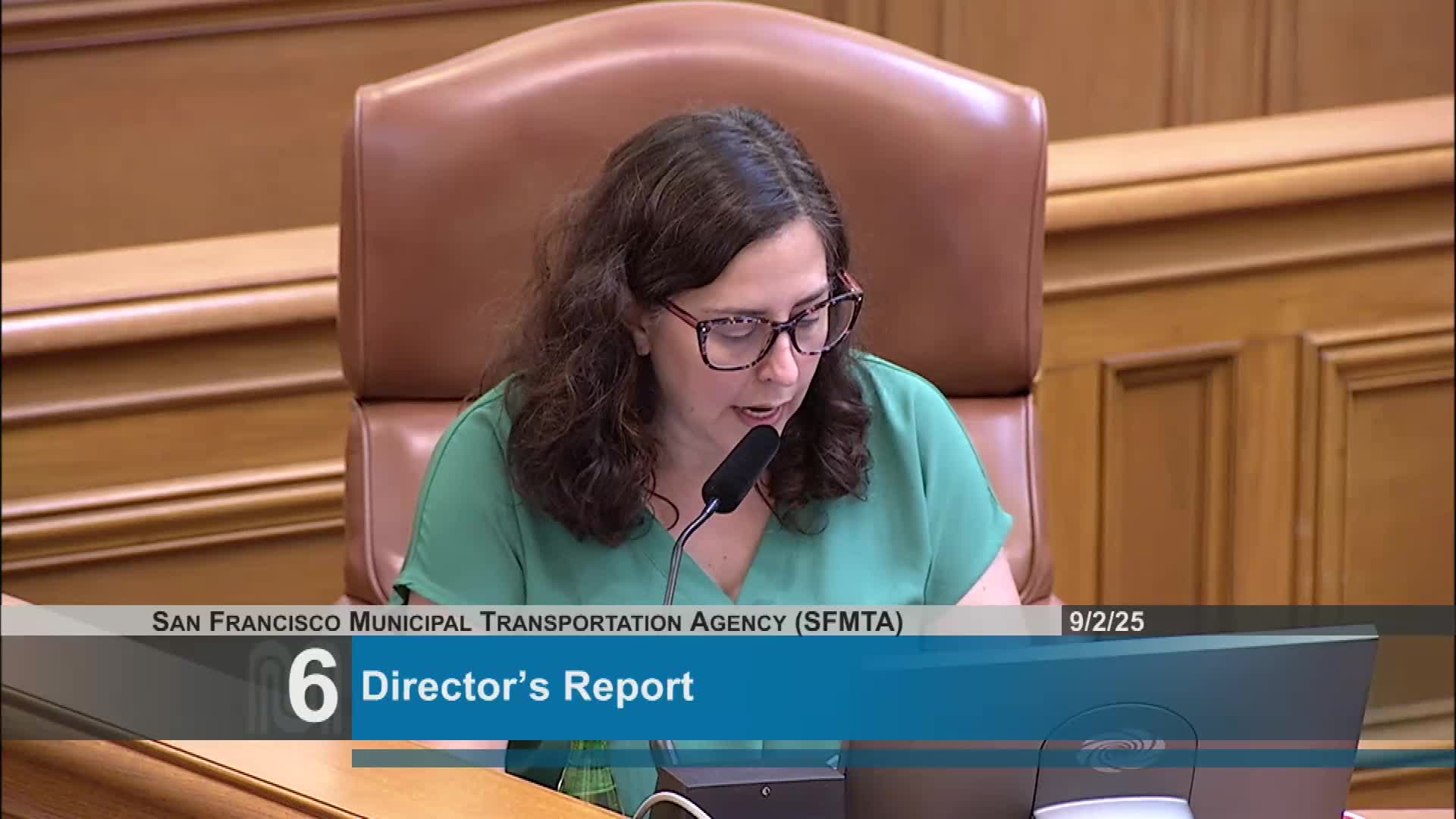
The agency’s director, Julie Kirschbaum, said staff will track Muni travel times, traffic volumes, pedestrian and cyclist counts and loading‑zone use, and produce an evaluation report within a year. “We will be evaluating Muni travel times, traffic volumes, pedestrian and cyclist counts, and loading bay activities among other data,” Kirschbaum said during her director’s report to the board.
Why it matters: Market Street is a high‑ridership, transit‑first corridor that was made car‑free following a multiyear public planning process. Dozens of transit riders, operators, business owners, disability‑rights advocates and safety groups told the board that allowing private for‑hire and autonomous vehicles risks slowing Muni, increasing crashes and reversing safety gains.
Public comment: More than 30 speakers addressed the topic during public comment, many urging the SFMTA board to put the change on a future agenda for formal review. Susan Vaughn told the board she wanted the directors to “vote against the proposal. Please do not undo Better Market Street.” Muni operator Mac Allen said the reintroduction “slows down transit services, increases congestion on our streets, and makes Market Street less safe for cyclists and pedestrians.” Griffin Lee of Connected SF urged the board to view the change as a potential equity improvement for people who do not regularly use Muni, while San Francisco Transit Riders’ Dylan Faye Briss called for “concrete metrics to assess success and damage” and for the board to close a permitting loophole the mayor used.
Stakeholder views: Walk San Francisco’s communications director Marta Lindsey and other pedestrian advocates said the car‑free policy reduced crashes and increased pedestrian activity; business owners and civic groups were split — some downtown merchants and Connected SF backed more access, while small business and cycling advocates warned that added private vehicles would not revive sidewalks and transit ridership.
Agency response and next steps: Kirschbaum said commercial service will be limited in hours (Waymo in off‑peak times and Lyft/Uber in evening and overnight windows) and that enforcement resources — including parking control officers, taxi investigators and San Francisco Police Department traffic units — would be deployed to enforce posted restrictions. She said the agency will “collect robust data on how these new services perform on Market Street,” and will adjust policy based on findings. The board did not vote on Market Street policy at this meeting.
Ending: Multiple public commenters asked the board to assert its regulatory authority over Market Street rather than leave the change to the mayor’s unilateral decision. Several urged a formal agenda item so the SFMTA board can evaluate data, public outreach and the need for environmental review before making a permanent change.