Get Full Government Meeting Transcripts, Videos, & Alerts Forever!
Get email alerts on the Economic Development topic
No spam. Unsubscribe anytime.
Residents challenge CID and tax incentives tied to Lineage cold‑storage proposal at Lone Elm and 170th
Summary
At a Sept. 2 public hearing, Olathe residents raised safety, traffic and fiscal concerns about a proposed community improvement district (CID) and related incentives tied to a planned Lineage cold‑storage project; council held the hearing but has not yet rezoned the property.
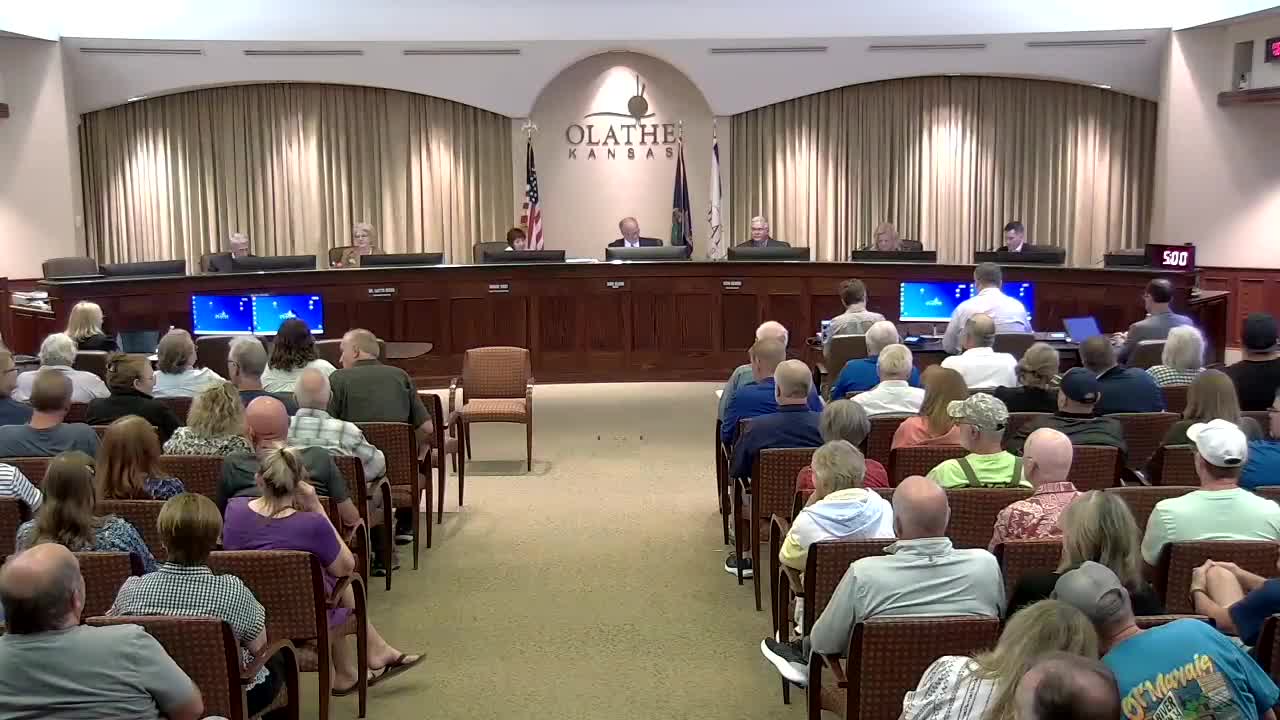
Olathe's City Council on Sept. 2 held a public hearing on creating a community improvement district (CID) at Lone Elm and 170th Street under KSA 12‑6A26, a move residents say is part of a package of incentives tied to a proposed Lineage cold‑storage development.
The hearing drew extended public comment from nearby residents who said the city's annexation agreement with the developer, signed April 15, 2025, already contains broad incentives and rights — including industrial revenue bond (IRB) authority, large property tax abatements and a CID sales tax of up to 2% — even though rezoning of the property has not yet been completed. “Why is the city council approving the creation of a CID when their property has not been rezoned?” resident Doug Dorfler asked during public comment, saying he and other neighbors believe the CID and IRB authority are part of a plan to move the project forward before zoning is settled.
Why it matters: Neighbors said the package would make it easier for a developer to proceed even if the city's planning commission or council later denies rezoning, and could increase truck traffic on Lone Elm and adjacent roadways before safety improvements are in place. The developer and city say the annexation agreement and incentives are tools to finance and attract investment; the council has scheduled the rezoning request for Sept. 16 and told speakers the ordinance to create the CID would follow.
Details from the hearing and commenters' claims
- Annexation agreement and incentives: A resident reading from the annexation agreement said it provides for IRBs for each building, an 80% real property tax abatement for 10 years, and a CID sales tax up to 2%. He described the district as a roughly $25 million commercial component for which the CID sales tax would generate about $5 million toward site work.
- Rezoning and timing: Several speakers noted that the planning commission voted 5‑2 to deny the rezoning request (a fact raised by a resident speaker). The council did not vote on rezoning on Sept. 2; city staff and the mayor said rezoning is scheduled for the council's Sept. 16 meeting and the CID ordinance would be considered afterward.
- De‑annexation clause: A public commenter said the annexation agreement allows the developer to demand de‑annexation if certain approvals are not secured within 180 days of the April 15 agreement (a date the speaker gave), which he said creates urgency for the developer to obtain approvals.
- Traffic and safety concerns: Neighbors warned of heavy truck traffic if the Lineage facility and subsequent phases proceed. Doug Dorfler told the council he expects at least “650 trucks per day” on Lone Elm; other speakers cited observed truck congestion at Lineage's existing Olathe facility and predicted spillover onto local streets. In a later comment, Jeff Walters said operational practices at the existing Lineage site (drivers leaving and returning for notifications) mean one truck can generate multiple road trips and argued that the planning commission’s traffic count understates daily truck movements.
Council action and next steps
The council closed the public hearing by voice vote after a member moved to do so; the city clerk recorded a 7‑0 roll call in favor. No ordinance creating the Lone Elm CID was adopted at the Sept. 2 meeting. Council members and staff repeatedly told speakers that rezoning will be considered at the Sept. 16 council meeting and that consideration of any CID creation ordinance would follow that rezoning action.
Comments and claims made during public comment were attributed to named residents in the meeting record; the council did not adopt substantive changes to the annexation agreement or rezoning at the Sept. 2 session.
What to expect next
The council agenda for Sept. 16 will include the developer's rezoning request; any council action on rezoning would affect whether the annexation agreement and related incentive package proceed. Residents who spoke urged the council to delay or deny zoning until traffic, safety and road‑funding concerns are resolved.