Get Full Government Meeting Transcripts, Videos, & Alerts Forever!
Get email alerts on the Outdoor Lighting topic
No spam. Unsubscribe anytime.
Maui committee advances revision to outdoor‑lighting code after debate over seabirds and safety
Summary
The Water and Infrastructure Committee voted to recommend first reading of Bill 109, which would amend Maui County Code chapter 20.35 on outdoor lighting. Supporters said the change clarifies standards and preserves roadway safety; opponents and conservation groups urged keeping the county's low‑blue standard to protect seabirds.
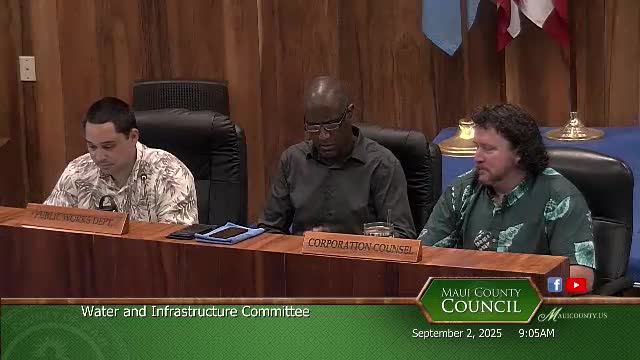
The Maui County Water and Infrastructure Committee on Sept. 2 voted to recommend first reading of Bill 109, an amendment to chapter 20.35 of the Maui County Code that would change how the county regulates outdoor lighting for streets and other public spaces. The committee substituted a proposed amendment summary form (CD1) and approved the main motion as amended on a roll call of 8–1.
The bill, introduced by Councilmember Yukile Sugimura, would update lighting standards that county staff said are intended to “support public safety and community well‑being, while reducing light pollution and protecting seabirds and other wildlife.” Jordan Molina, director of the Department of Public Works, told the committee, “We're here before you, for a bill to address, a current public health and safety issue, that exists with our current lighting ordinance as it relates to our street lighting.”
The measure drew sharply different technical and policy arguments at the meeting. Deputy Corporation Counsel Bridal Bilberry summarized litigation and technical work the county has undertaken and said the committee must weigh traffic safety against wildlife protections. Bilberry told the committee that a strict 2% cap on short‑wavelength (blue) light for streetlights ‘‘is inadequate for roadway applications’’ because it can reduce color rendering and make it harder for drivers to detect objects at night.
Deputy Chief Wade Madera of the Maui Police Department said the department supports Bill 109. Madera cited department data and operations, saying roughly “3,139 property crimes” were reported on the island between Jan. 1 and Aug. 21 and that an elevated share of property and traffic incidents happen at night; he argued better roadway lighting helps officer safety and investigations.
Conservation and wildlife advocates urged the committee to retain the county's low‑blue standard and to enforce existing ordinance provisions. Jay Penniman of the Maui Nui Seabird Recovery Project urged the committee to keep protections in place and asked the county to implement and enforce Ordinance 54‑34. Penniman said in testimony, “Please discard bill 109 and require DPW to fully implement and enforce ordinance 54 34. Mahalo.”
David Henkin, an attorney with Earthjustice, argued there are compliant fixtures that meet low‑blue specifications while providing better color rendering than the island's decades‑old high‑pressure sodium lights. Jeff Bagshaw, testifying as an individual with field experience, said he was “in strong opposition to this bill” and urged more robust data correlating lighting type to crashes and crime before changing the standard.
Technical testimony included two lighting experts on call for the county and presentations from lighting physicists. Jack Curran, PhD, and Tom Glessner (physicist) were referenced by staff as experts who had reviewed roadway optics and satellite data on sky glow; the county’s materials included a draft environmental assessment prepared during prior litigation that concluded the county’s proposed conversions would not have a significant adverse effect on seabirds.
Committee action and next steps: the committee voted first to substitute the bill with the amendment summary form (moved by Councilmember Tamara Paulton, seconded by Chair Alice Lee); that substitution passed 9–0. The committee then voted to recommend passage of Bill 109 on first reading as amended (motion moved by Councilmember Sugimura, seconded by Chair Lee). The roll call on the main motion as amended recorded eight ayes and one no (Rollins Fernandez opposed). The committee invited additional written materials and experts for the council’s further consideration before second reading.
Why this matters: the county is balancing competing priorities — wildlife protection, public safety on roadways, and the practicalities of installing and operating streetlighting across varied terrain and jurisdictions. The bill would allow the Department of Public Works to pursue lighting fixtures and operational measures (including remotely controlled dimming modules) that the department says will permit lower overall emissions while maintaining nighttime visibility on roads. Opponents say a strict short‑wavelength limit (the 2% standard in earlier ordinance language) remains necessary to reduce seabird fallout during fledging season and to protect dark‑sky values.
The committee record remains open to written testimony and technical submissions. The committee chair asked departments and outside experts to submit additional analysis and evidence to inform second‑reading deliberations.