Get Full Government Meeting Transcripts, Videos, & Alerts Forever!
Get email alerts on the Transit Funding topic
No spam. Unsubscribe anytime.
Milwaukee County transit officials outline $9.2 million 2025 shortfall; public, unions press for fixes on contractor performance, paratransit and fare evasion
Summary
Milwaukee County Transit System officials told the Committee on Transportation and Transit that the agency now projects a $9.2 million deficit for 2025 after corrective actions, down from a $10.9 million estimate, and described cost, vendor and fare-evasion issues underlying the shortfall.
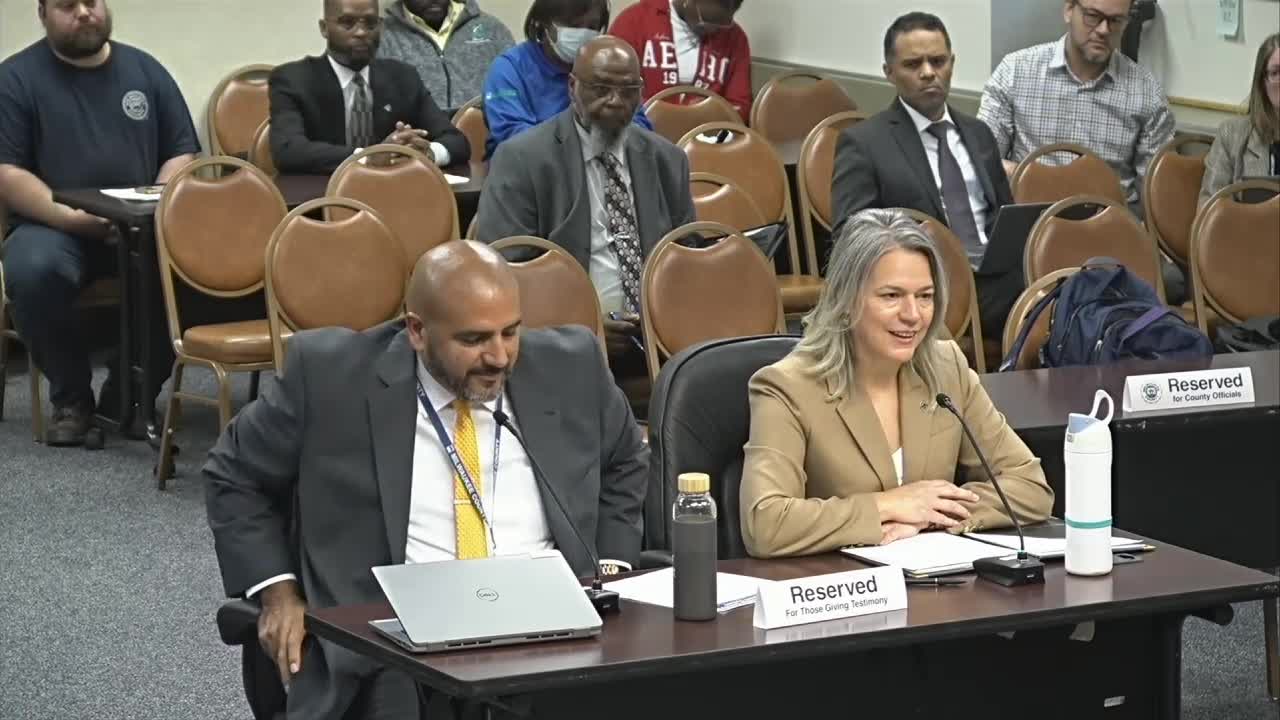
Milwaukee County Transit System (MCTS) officials told the Committee on Transportation and Transit that the agency now projects a $9.2 million deficit for 2025 after a set of corrective actions, down from an earlier $10.9 million estimate, and described steps they are taking to reduce costs and raise fare compliance.
Sandy Kellner, chief administrative officer for MCTS, said the updated projection (through June 30, 2025) reflects continuing cost pressures: a $5.9 million overrun in salary and fringe costs largely driven by higher health-care costs, a $3.3 million projected overage in paratransit services, and a $1.6 million shortfall in fare revenue. Kellner said measures that lowered the gap included $2.6 million in cuts from reduced professional services, diesel savings, and other operating economies; reduced overtime except in emergencies; process improvements; and negotiation efforts with vendors.
New MCTS President and CEO Steve Fuentes, who began in the role in late June, said the agency will use federal pandemic funds to cover all deficits in 2025 and intends to request a fund transfer at year-end when numbers are finalized. Fuentes emphasized safety and said he will not “compromise safety” for the sake of budget adjustments; he said he is reviewing operator safety shields and plans to consult with operators and union representatives.
Union leaders and public commenters pressed several themes: (1) oversight and performance of Transdev, the county’s paratransit contractor, which commenters and staff said was awarded a single-provider contract and later acquired First Transit; they attributed much of the paratransit overage to productivity shortfalls and contract design; (2) protection of paratransit’s “border-to-border” coverage and continuation of the same-day pilot taxi program for riders with disabilities; (3) accountability and transparency on how the $5.9 million fringe overage is composed (breakdowns for salaries, health care, overtime, pension, payroll taxes); and (4) stronger action on fare evasion, particularly on the Connect 1 bus rapid transit (BRT) corridor.
On fare evasion, MCTS staff presented a data-informed strategy requested by the board. Staff said earlier, anecdotal estimates suggested about 25% nonpayment, but a revised methodology estimated 30% unpaid in 2024 and about 33% nonpayment in January–May 2025; Connect 1 showed higher rates. Staff reviewed practices from other agencies — fare ambassadors, targeted enforcement, passenger education and open-loop payment (credit card/Apple Pay/Google Pay) — and estimated that lowering evasion from 33% to 30% could generate about $900,000 in additional annual revenue. Staff warned there is no single solution and that some options (expanded security or ambassador programs) would require ongoing funding; an illustrative figure for a year of additional security-type staff was roughly $1.1 million, while an ambassador program estimate was about $1.2 million depending on staffing and backfill choices.
Disability advocates and Independence First speakers urged preservation of the same-day pilot and border-to-border paratransit coverage; they asked that the county evaluate whether the single-provider paratransit model and Transdev’s scheduling software are contributing to productivity and charge-overage problems. Multiple speakers urged the committee to avoid cutting fixed-route services that people with disabilities rely on.
Committee members stressed urgency: Supervisor Rowland and others noted MCTS is relying on roughly $10.5 million in federal pandemic funds in 2025 and that without such funds the underlying gap could be near $19.7 million, creating pressure to find sustainable savings before 2027. Supervisors encouraged aggressive planning — RFPs, outreach and vendor negotiations — now so reforms can be implemented before the next budget cycle.
Public commenters included ATU Local 998 leaders (Tom Stawicki, Kyle Handel, Michael Brown and others), transit retirees and operators, representatives of Independence First (Kevin Myers, Rebecca Rabatin), and community members who described long-standing concerns about contractor performance, procurement of parts, equipment reliability and the cumulative effect on service availability. Several public speakers urged more direct police or sheriff task-force rides to enforce fares at targeted times and places; staff said enforcement approaches nationally vary and raised equity and ethical considerations for some enforcement tactics.
The committee received the informational report; the file was considered informational unless otherwise directed, and it will be considered by finance where appropriate. No formal committee action (vote) occurred on the budget projection or the fare strategy at this meeting.