Get Full Government Meeting Transcripts, Videos, & Alerts Forever!
Get email alerts on the Public Works Director Qualifications topic
No spam. Unsubscribe anytime.
Hawaii County committee amends, then postpones debate on bill removing PE requirement for public works director
Summary
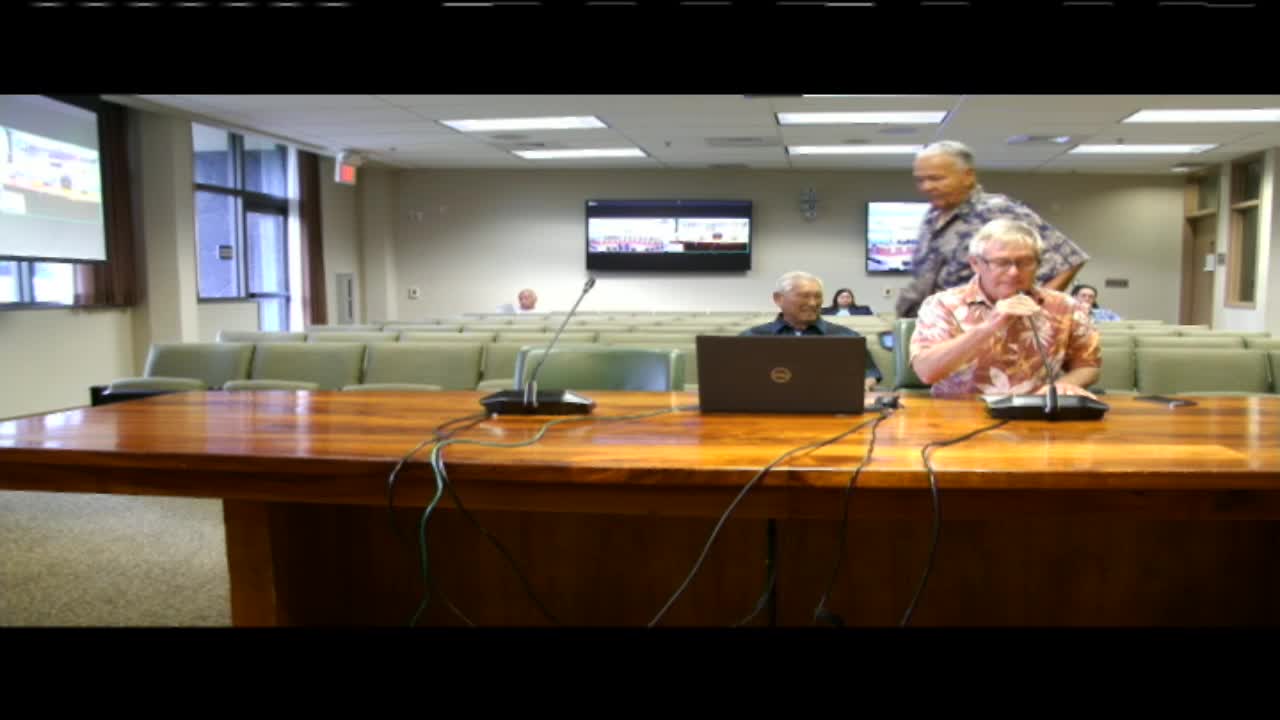
Bill 64, which would change qualifications for the Hawaii County Department of Public Works director, was the focus of extended testimony and debate at the Governmental Operations and External Affairs Committee meeting in Hilo.
Bill 64, which would change qualifications for the Hawaii County Department of Public Works director, was the focus of extended testimony and debate at the Governmental Operations and External Affairs Committee meeting in Hilo.
The committee, chaired by Jen Kaguata, considered two competing amendments to the charter change that would remove a requirement that the director be a registered professional engineer (PE) and instead permit applicants with a bachelor'level degree in engineering, architecture, public administration or a law degree, plus specified managerial experience. After debate and amendment votes, the committee voted to postpone action on the amended bill to the committee meeting on Sept. 16.
Supporters of retaining a PE requirement and opponents of the bill said during public testimony and committee discussion that a licensed engineer's training and professional obligations protect public health and safety. Curtis Beck, PE, testified that removing the licensure requirement for the director would conflict with statutory requirements governing engineers and could compromise public safety. Former public works director Hugh Ono, who also testified, said that management decisions can override professional engineers and that the presence of a PE in an executive role has been important in past departmental decisions.
Committee members debated two main amendment options. One amendment (communication 334.17), offered by Council member Inaba, would add a requirement that if the director is not a licensed PE, then a deputy director must be a licensed professional engineer; it did not explicitly assign engineering decision authority to the deputy. That amendment failed on a 4'4 roll-call vote. A second amendment (communication 334.16), offered by Council member Kimball, also requires a deputy with a PE when the director lacks licensure and explicitly assigns engineering responsibilities to the licensed deputy; that amendment passed on a 6'2 roll-call vote.
During discussion, committee members and witnesses raised practical concerns: whether a deputy with a PE could be hired simultaneously with a director who is not licensed; whether civil-service staff would defer to an unlicensed director; and how to ensure continuity of engineering authority and liability. Human Resources Director Summer Tokiero and former Director Hugh Ono both told the committee that in practice the director retains authority to operate the department and formally signs routing forms and contract approvals, even when subordinate engineers stamp technical plans. Deputy Corporation Counsel Kira Wang advised caution because the county'level charter change interacts with statutes, departmental practices and potential liability considerations.
Council member Inaba said staff would work on refinements and requested time to draft further amendments addressing hiring timelines and authority allocation; he moved to postpone the amended bill to the committee meeting on Sept. 16, and the committee approved the postponement.
Votes and formal actions recorded in committee included failed and successful amendment motions and the final motion to postpone. The committee directed staff to prepare additional amendment language for the next meeting so members can consider measures to assure engineering oversight while broadening the candidate pool for a difficult'to'fill position.
The committee heard multiple public-testimony speakers on Bill 64. Curtis Beck, PE, testified that Title 16, Hawaii Revised Statutes, chapter 115, and related licensing statutes establish licensure expectations for practitioners who bind an entity on professional engineering matters and that removing the requirement for the county director would create an inconsistency between public and private-sector engineering oversight. Testifier Floyd Eaglin urged caution and study of changes that might affect public services. Former Director Hugh Ono said he and other local engineers had prepared research and examples showing risks to public health and safety if engineering judgment is subordinated to nonlicensed management.
The committee postponed the measure to allow further drafting and outreach to engineering stakeholders and to the salary commission, which members said is reviewing compensation for the DPW director position — a variable some members said affects recruitment of licensed professionals.
Looking ahead, committee staff will draft proposed language addressing (at a minimum) hiring timelines for a licensed deputy and clearer delineation of engineering authority if the director is unlicensed. The committee scheduled further deliberations for its Sept. 16 meeting.