Get Full Government Meeting Transcripts, Videos, & Alerts Forever!
Get email alerts on the Solid Waste Recycling topic
No spam. Unsubscribe anytime.
Residents press Assembly on recycling disruptions after borough baler outage; mayor pledges fixes
Summary
Public commenters representing Regroup and other community volunteers told the assembly that recent equipment failures and program changes led to recycling material being buried. The mayor said the administration will work with community groups to restore recycling services and install new equipment.
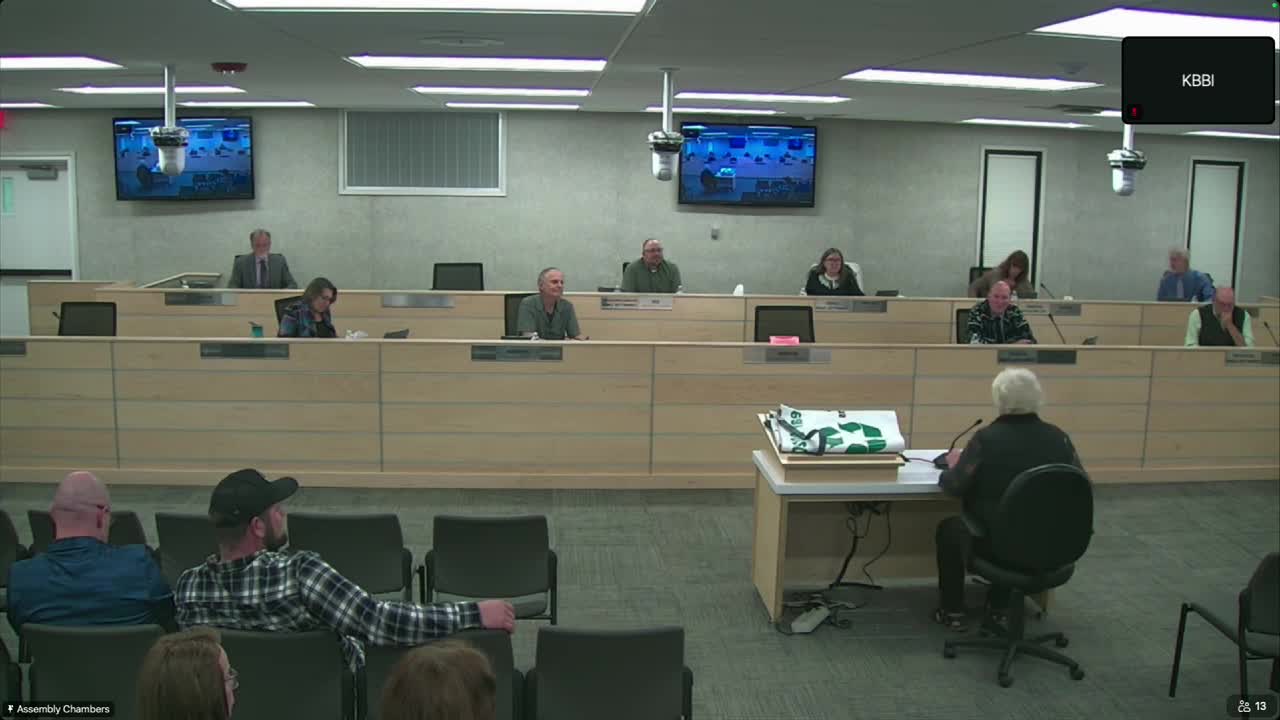
Several members of the public told the Kenai Peninsula Borough Assembly Sept. 2 that disruptions in the borough’s recycling operations have resulted in diverted or buried recyclable materials and that community volunteer groups have been relied on to sustain services.
Shan Wallace, speaking for Regroup (a community recycling nonprofit that formed in 1989), said the borough had recruited Regroup in 2007 to support electronics recycling and that the community has diverted roughly 120 tons of electronics from landfill since that time. Wallace told the assembly the borough’s baler stopped operating in December/February 2024 and that the interruption caused a backlog and, according to Wallace, some recyclable material was buried rather than processed.
A second public commenter (identified in the record by place of residence) shared comparative tonnage figures the commenter received from then‑acting solid‑waste director Tim Corrine comparing 2020 and 2024 tonnages for multiple commodity streams. The speaker said aluminum moved from "24 tons to 3,198 tons," mixed office paper fell from 98 to 60 tons, and plastics categories increased; the speaker attributed those figures to borough staff data and urged the assembly to restore processing capacity so collected recyclables are not landfilled. (The speaker attributed the figures to borough staff; the assembly did not provide an independent verification during the meeting.)
Audience members questioned what happens to materials when processing equipment fails and asked how the borough will ensure publicly collected recyclables are actually recycled rather than buried.
Mayor Peter A. Michicky responded that the administration will provide factual information to the public about solid‑waste operations and will partner with community groups such as Regroup. He said the borough is pursuing replacement equipment and operational changes, and that staff are working on a new compactor agreement and a forthcoming baler installation. "We're gonna get it right this time," the mayor said, adding the administration will coordinate volunteer efforts and batch‑loading options with Regroup once the new baler is installed.
Why it matters: Community recycling participation can be undermined when collected materials are not processed. Residents said they want transparent information about recycling operations and concrete steps to restore and improve infrastructure. Mayor Michicky acknowledged the shortfall and said staff are working on equipment procurement and operational fixes.
What the record does not show: The transcript contains public testimony and the mayor’s pledge to act; it does not include a staff presentation of a detailed recovery plan, firm timelines for equipment procurement, or a formal vote on policy changes. Some tonnage figures were read into the record as staff‑provided data; the assembly did not independently verify those numbers during the meeting.