Get Full Government Meeting Transcripts, Videos, & Alerts Forever!
Get email alerts on the Behavioral Health Recovery topic
No spam. Unsubscribe anytime.
Assembly hears Kachemak Bay Recovery Connection; supports mobile crisis dispatch agreement
Summary
Kachemak Bay Recovery Connection presented its peer‑support services and recovery‑center work; assembly included a hospital dispatch agreement for the mobile crisis team on the consent agenda and approved it by unanimous consent.
The Kenai Peninsula Borough Assembly heard a presentation Sept. 2 from Kachemak Bay Recovery Connection (KBRC) on its peer‑support services, outreach and recovery‑center operations, and on the borough consent agenda approved a resolution authorizing an agreement with Central Peninsula General Hospital Inc. to provide dispatch services for a mobile crisis team.
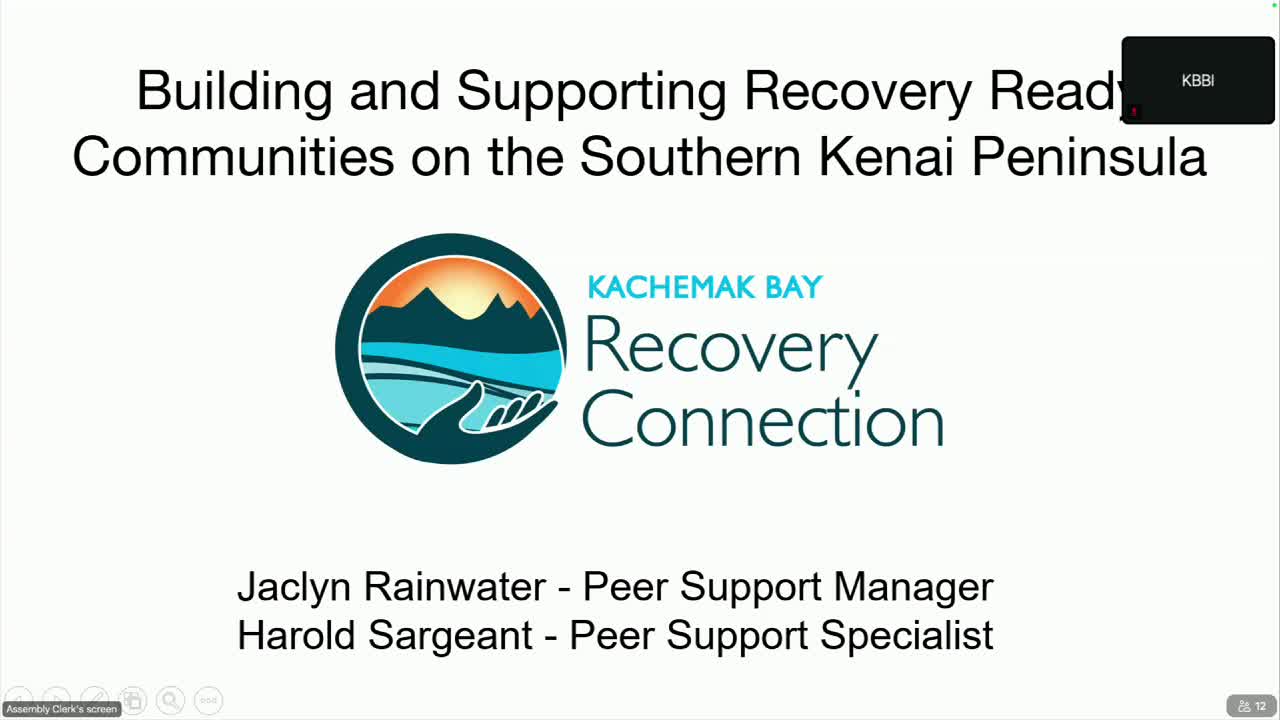
KBRC’s peer‑support manager Jacqueline Rainwater described the nonprofit’s mission to reduce stigma, provide peer support and resource navigation, and foster sober community connections across the southern Kenai Peninsula. Rainwater said KBRC’s service area extends from Ninilchik to Nanwalek and includes outreach to Russian‑speaking and tribal communities. "Recovery is not just about quitting drugs, quitting alcohol. It's about living a life of purpose and value and, giving to the next person who's struggling," Rainwater said.
KBRC has used opioid settlement grant funding from the borough and the State of Alaska to expand programming and hire staff, Rainwater said. The group operates a "living room" recovery center that offers peer support, drop‑in connection, and event programming; the organization reported about 40 regular participants and many additional one‑time contacts.
Harold Sargent, a KBRC peer support specialist, described peer support work as lived‑experience assistance for people seeking treatment, recovery resources, relapse prevention skills and community connection. "Being a part of that, and watching the confidence in the people that I work with grow as they achieve small wins or big wins also has really, done a lot for me as well," Sargent said.
Central Peninsula Hospital staff and partners discussed service‑capacity issues during the presentation. Alexander Napier, clinical supervisor for peer support at Central Peninsula Hospital, told the assembly the community currently has about 40 residential treatment beds: 14 short‑term residential beds (average 4–6 weeks, sometimes longer for high acuity) and a 16‑bed longer‑term facility where stays average about a year. Napier said even if those numbers doubled the community would still need more capacity; he identified post‑treatment housing as the biggest gap.
The assembly’s consent agenda included Resolution 2025‑037, authorizing an agreement with Central Peninsula General Hospital Inc. for dispatch services for a mobile crisis team; the resolution was sponsored by the mayor and cosponsored by the assembly and was approved by unanimous consent.
Mayor Peter A. Michicky described the hospital’s forthcoming mobile crisis program as a community resource that will bring mental‑health response to residents: "We will DoorDash you mental health," he said, explaining the intention to deliver crisis services in the field and reduce unnecessary hospital stays.
Why it matters: The presentation highlighted local recovery services, peer support and persistent gaps in treatment‑to‑housing transitions. The dispatch agreement is intended to define operational and cost‑sharing arrangements for a mobile crisis response that pairs behavioral‑health staff with 911 dispatch, an action the assembly approved as part of its consent agenda.
What the assembly did not decide tonight: While the resolution for dispatch services was authorized by the assembly, detailed contract execution, operational protocols and funding specifics will be implemented by staff and the mayor’s office; the transcript records the assembly’s consent approval but not a roll‑call tally.