Get Full Government Meeting Transcripts, Videos, & Alerts Forever!
Get email alerts on the Education School Capacity topic
No spam. Unsubscribe anytime.
Residents and commissioners raise school-concurrency concerns during land-use meeting
Summary
A Brooksville resident urged the board to address school concurrency and likely future deficiencies in school capacity; commissioners discussed impact fees, prop-share agreements and state millage impacts but said school construction authority remained with the district.
Public comment at the start of the meeting highlighted mounting concerns over school concurrency and the relationship between residential growth and school capacity.
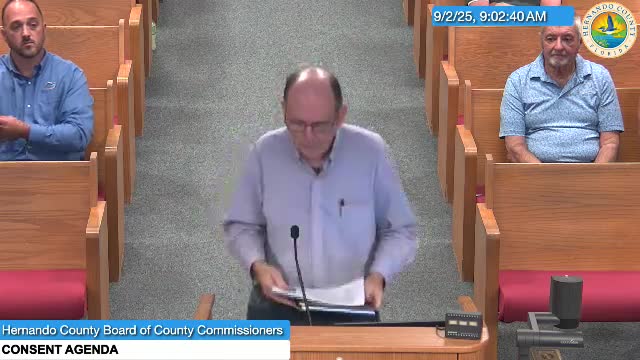
Bob Morgan of Brooksville brought a county concurrency deficiency report to the board and warned that many forthcoming development approvals could trigger concurrency deficiencies — particularly at the high-school level. “For every new development that is going to be approved going forward, it is a high percentage probability that you're going to have a problem with the school concurrency,” Morgan said.
Commissioners acknowledged the concern but noted limits on county authority to compel school construction. Commissioner Champion (board liaison to the school board, as stated during the meeting) explained that where concurrency is not met, developers and school officials commonly negotiate proportionate-share (prop-share) agreements under state statute to fund future student capacity. Commissioners also noted recent state-directed changes affecting school millage and local funding; one commissioner said state action had effectively increased millage earmarked for schools, and that declining high-school enrollment complicates decisions about when and where to build.
Commissioner Alaco and others discussed broader trends — declining enrollment, growth of charter and private schools, and expansion of dual-enrollment programs — and said longer-term state-level conversations are needed about how impact fees and local taxes are allocated between county and school budgets. Commissioners urged continued dialogue with the school board and city partners to understand incoming development’s impacts before taking unilateral county action.
Why it matters: School concurrency affects whether local development can proceed or whether developers must fund mitigation; the issue influences growth policy, impact-fee calculations and long-term facility planning for the district and county.
What’s next: Commissioners said they will continue monthly liaison meetings with school officials and track upcoming concurrency items noted by the public commenter. No formal county action on school construction was taken at the meeting.