Get Full Government Meeting Transcripts, Videos, & Alerts Forever!
Get email alerts on the Budget Stabilization topic
No spam. Unsubscribe anytime.
Council members debate faster replenishment and larger floor for Houston’s budget stabilization fund
Summary
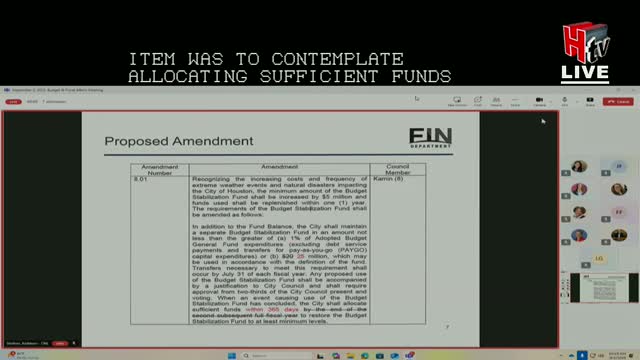
Council members debated a proposed change to the city's budget stabilization policy that would raise the floor to the greater of 1% of expenditures or $25 million and shorten the required replenishment time; finance staff supported the higher minimum but told the committee that 365-day replenishment is impractical given FEMA reimbursement timelines.
Council Member Abby Kamen offered a budget amendment (8.01) to alter the city's budget stabilization policy, proposing to increase the minimum stabilization amount from the greater of 1% of general fund expenditures or $20 million to the greater of 1% or $25 million and to require replenishment of the fund within 365 days of a drawdown.
Melissa Dabowski, the city's finance director, described the administration's position: the administration supports increasing the minimum to the greater of 1% or $25 million but warned that the proposed 365-day replenishment timeline would be difficult to meet in many disaster cases because FEMA public-assistance reimbursements are reimbursement-based and can take well over a year to obligate and close out. "Typically, what we see is that in the past it is more than 365 days after the disaster event that we would have finally closed out those project worksheets and ... received the reimbursements," Dabowski said.
Dabowski explained how FEMA processes reimbursements, including verification of departmental overtime timecards and other documentation, and noted advances and state assistance are sometimes available but that full closeout and deobligation risk can extend beyond a single year. She said that at budget adoption the administration found it could not replenish the stabilization fund to the proposed $25 million in FY26 without tapping general fund balance, and that the adopted budget included a $12 million transfer into the stabilization fund to bring it toward $14.4 million by the end of FY26.
Council members pressed on trade-offs: Kamen argued for annual replenishment so the city has protected, earmarked disaster response money and avoids asking departments to absorb costs when reimbursements are slow. Vice Mayor Pro Tem Amy Peck and others asked technical questions about whether FEMA reimbursements are routed back to the fund that advanced the money or whether they could be prioritized to restore the stabilization fund. Dabowski said reimbursements typically go back to the fund that advanced the expense (for example, a utility fund for water-utility projects), but that some disaster costs and local-share requirements can leave gaps requiring general-fund support.
Dabowski also described city insurance programs as part of the resilience approach: the city has increased combined flood coverage for city properties from about $100 million historically to $600 million and maintains separate business-interruption coverage (approximately $596 million for specified systems) and terrorism property coverage ($250 million). She cautioned that higher insurance limits carry higher premiums.
Committee discussion produced two clear policy points: the administration supported raising the stabilization-floor minimum to the greater of 1% or $25 million, and finance staff urged keeping the longer replenishment timeline in policy because FEMA closeouts and reimbursements frequently exceed a single year. The record shows the council adopted an amendment during the process to require a 1% transfer of any amount by which actual fund balance exceeds the projected fund balance; that amendment passed during committee, and the administration said it supports the increased floor while noting timing constraints for replenishment.
Ending: Committee members agreed to continue the discussion as part of the budget-cycle work; staff said they will bring formal ordinance language back for council adoption that reflects the agreed policy choices and the practical timing needed for FEMA reimbursements.