Get Full Government Meeting Transcripts, Videos, & Alerts Forever!
Get email alerts on the Redistricting topic
No spam. Unsubscribe anytime.
Fulshear council reviews redistricting options; council signals preference for compact plan and asks consultant to keep Bonterra intact
Summary
Consultant Bickerstaff presented four illustrative redistricting maps to the Fulshear City Council Sept. 2. Councilmembers favored Plan 3 — a more compact option that relaxes incumbent-preservation constraints — and asked the consultant to modify Plan 3 to avoid splitting Bonterra, then return with the adjusted map.
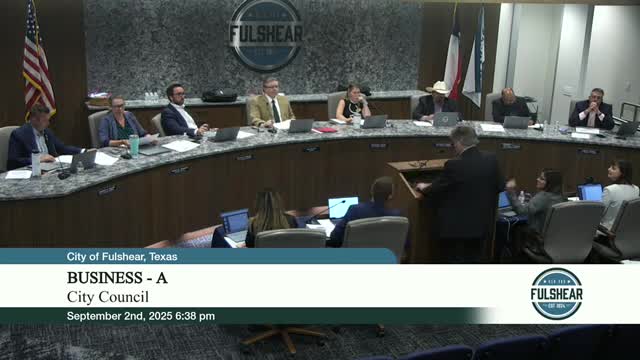
Fulshear — The City Council held a substantive review of redistricting options during its Sept. 2 meeting, with outside counsel from Bickerstaff, Heath Delgado & Acosta explaining the technical approach and legal constraints and councilmembers signaling a preference for a compact plan that minimizes elongated districts.
Attorney Sidney (Sid) Falk with the Austin law firm Bickerstaff led the presentation and described the technical data choices: because 2020 census blocks and population data are now stale for Fulshear’s rapid growth, the consultant used parcel-group aggregates (about 138 parcel groups) and city-supplied apartment/unit counts to estimate population. Falk said the consultants’ estimate produced an ideal district size of 7,745 persons per single-member district for the city’s five districts.
Falk described four illustrative plans. Plans 1, 2 and 4 preserved incumbency and subdivision boundaries where possible but resulted in elongated east–west districts because of the city’s population distribution. Plan 3 relaxed the incumbency constraint and subdivision-preservation constraint, producing more compact districts but the possibility of incumbent pairings.
Council discussion and direction Councilmembers repeatedly said they preferred a compact map and did not prioritize incumbent preservation. Several members pointed specifically to Plan 3’s more compact layout but raised a practical concern that Bonterra and Cross Creek Ranch appeared split in Plan 3. Council asked the consultant to close or ‘‘heal’’ the Bonterra split so Bonterra would not be divided between districts.
Falk confirmed the practical limits: redistricting must be based on persons on the ground, not anticipated future construction, and courts generally look for a total population deviation among districts under roughly 10 percent. He also said the Census Bureau’s block structure for 2020 was poorly aligned with current development and urged the city to participate in upcoming Census geographic reporting opportunities so blocks are drawn more usefully before the 2030 census.
Outcome The council did not adopt a final map at the meeting. Instead, the council gave direction to the consultant and staff to return with a Plan 3 variant that keeps Bonterra whole if population thresholds allow, and to present the revised map at a follow-up meeting or work session within the coming one to two weeks.
Why it matters Redistricting will affect which residents are represented in each single-member district and could require every councilmember to run in the next election under recent state law changes (Local Government Code §21.006 was discussed). Councilmembers cited rapid population growth and the need to maintain relatively compact districts that reflect neighborhoods.
Next steps - Consultant Bickerstaff will adjust Plan 3 to keep Bonterra intact if the change keeps overall population deviations within acceptable thresholds and return with a revised map for council consideration. - Staff and council discussed scheduling a workshop for detailed map-drawing if the council wants a longer, hands-on session.
Ending: Councilmembers said they preferred a compact map rather than protecting incumbency, and directed staff and Bickerstaff to refine Plan 3 to address the Bonterra split and return with the edited plan for formal consideration.