Get Full Government Meeting Transcripts, Videos, & Alerts Forever!
Get email alerts on the Capital Bonds topic
No spam. Unsubscribe anytime.
City staff outline changes to 2026 bond development: earlier project vetting, tightened eligibility
Summary
Capital Delivery Services deputy director Eric Bailey told the Urban Transportation Commission that the 2026 general obligation bond process will bring project scope, schedule and budget work forward of the ballot, tighten eligibility and use new scoring matrices to shrink a $4.9 billion needs list toward a roughly $700 million package.
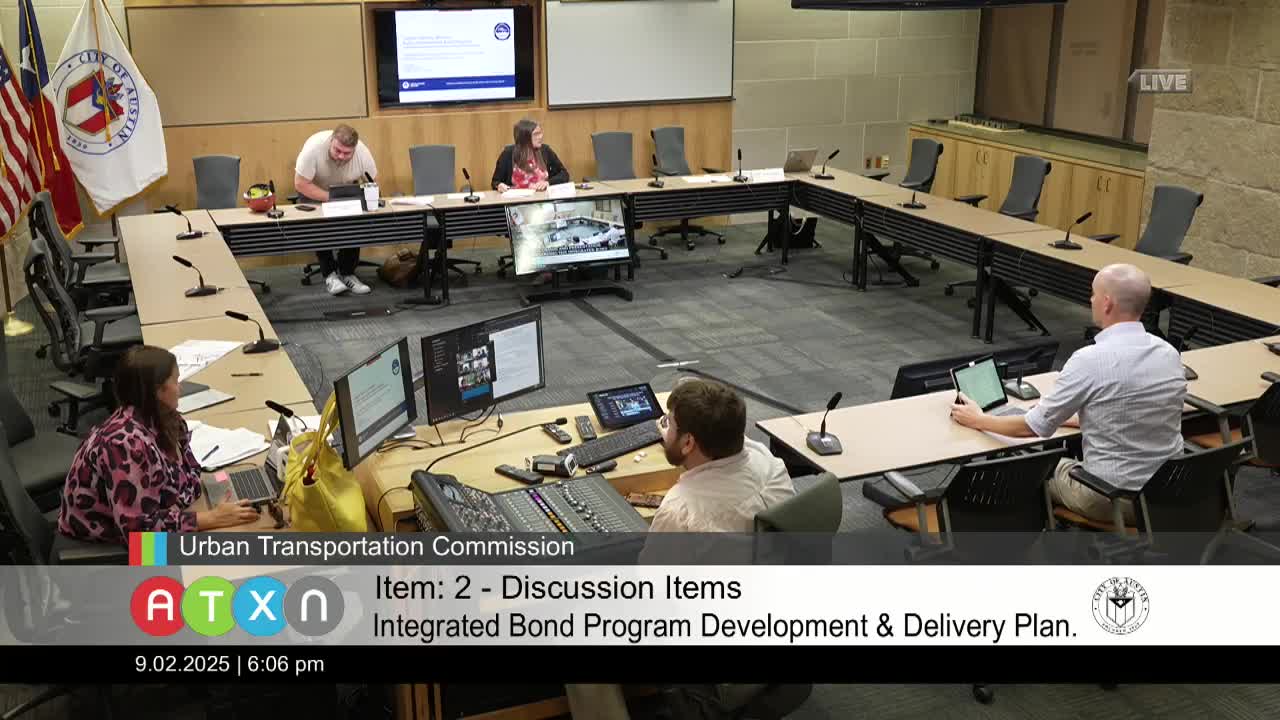
Eric Bailey, deputy director of Capital Delivery Services, briefed the Urban Transportation Commission on Sept. 2 about updates to the City of Austin’s 2026 general obligation bond development and delivery plan.
Bailey said CDS has changed its approach: rather than placing conceptual projects on the ballot and developing scope and budget after passage, staff are now completing project planning — including scope, schedule and budget estimating — before a proposition goes to voters. The intent, Bailey said, is to reduce the risk that projects will be underfunded after voter approval and to allow the city to deliver projects more quickly after a successful election.
Bailey described a substantial staff effort that has convened departments for 40+ meetings since May 2024, created a governance structure, developed technical criteria and scoring matrices aligned to the citywide strategic plan (equity, affordability, innovation, sustainability/resilience, proactive prevention and customer trust), and began a project chartering process. He told the commission that departments have presented guiding principles and technical criteria to their respective boards and commissions.
Bailey said the original departmental needs assessment list totalled about $10 billion and had been reduced to roughly $4.9 billion after eligibility screening; the expected bond package size is much smaller — on the order of $700 million — so further prioritization will follow community engagement. He noted particular constraints on what can be included in a general obligation bond: routine operation and maintenance, improvements to leased space, code enforcement and employee salaries are ineligible. He also reminded commissioners that Austin Energy and Austin Water use enterprise revenue bonds, not G.O. bonds.
Commissioners asked about how complex, expensive projects will be prioritized and whether the new approach will favor programmatic buckets (for example sidewalks or trails) or named projects. Bailey said the final package will likely include both: programmatic buckets with clearer priority lists and selected named projects with fully developed scopes. He used the Doherty Arts Center as an example of a past project where conceptual ballot language did not capture ancillary costs such as required parking, which later increased the total cost and complicated delivery.
Bailey outlined next steps: community outreach on the needs assessment will resume after the November tax‑rate election, staff will solicit public feedback in November and through early 2026, the bond task force will meet twice monthly as staff reduce the needs list to proposals for the ballot, and the bond task force will present a recommendation to City Council in spring 2026 for council to call a bond election.
Bailey encouraged commission members to share priorities and noted the Transportation and Public Works mobility working group will feed into the broader bond development process.