Get Full Government Meeting Transcripts, Videos, & Alerts Forever!
Get email alerts on the Transit Planning topic
No spam. Unsubscribe anytime.
CapMetro previews Metro 2035 plan, outlines near‑term rapid service and long‑range light‑rail connections
Summary
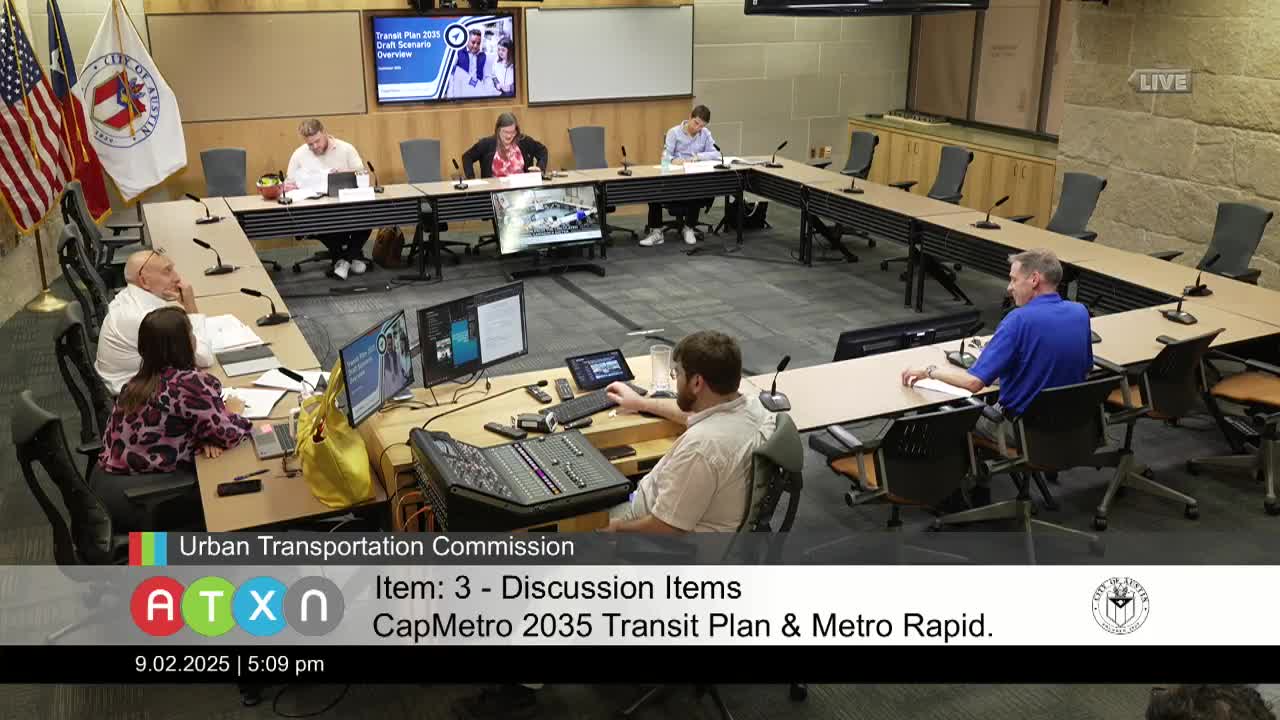
CapMetro planner Lawrence Dieter presented the agency’s Transit Plan 2035 to the Austin Urban Transportation Commission on Sept. 2, laying out 0–5, 5–10 and 10+ year service concepts that prioritize expansion of Rapid routes, targeted bus restructures and preparation for Austin light rail.
CapMetro planner Lawrence Dieter told the Urban Transportation Commission on Sept. 2 that Transit Plan 2035 is a fiscally constrained roadmap for bus, rail and pickup services that organizes recommended changes into three time horizons: 0–5 years, 5–10 years and a 10+ year unconstrained vision that prepares the system for Austin light rail.
The plan, Dieter said, follows a large community engagement effort and extensive data analysis; CapMetro staff estimate engagement with roughly 8,000 to 10,000 people during the project’s public phase. Dieter said the agency focused on population and employment density, growth projections and travel propensity for riders without cars, low‑income households, students and people with disabilities.
Dieter said the 0–5 year package emphasizes bringing new Rapid routes to their full vision (10‑minute headways on core Rapid lines where funding allows), service restructures to feed rapid corridors and selected extensions such as Route 392 to the Domain and a new Broadmoor rail station just north of Kramer. The agency proposes several restructured local routes and two new pickup zones in Lake Creek and Georgian Acres to improve east–west connectivity and access to major trip generators.
In the 5–10 year horizon the plan assumes the opening day of Austin light rail and includes bus network adjustments to feed rail stations, an 815 Rapid proposal on 290/Menchaca/William Cannon, and increased frequencies on several corridors. The 10+ year section is fiscally unconstrained and focuses on regional connectivity, additional Project Connect elements and long‑term rapid and rail concepts.
Commissioners pressed CapMetro staff on connections between Rapid routes, pickup service and local circulators. Dieter described tradeoffs such as customer confusion from branching routes versus transfers at hubs (for example, transfers between proposed Rapid 815 and existing 803 at Westgate Transit Center). He said route choices were driven by reliability, passenger experience and corridor demand, and that CapMetro will continue origin‑destination surveying and stakeholder engagement as the plan is refined.
On rail and rapid routing through downtown, Dieter presented three options for how existing Rapids could interact with future light rail: (1) Rapids routed on San Jacinto/Trinity to create an eastern spine; (2) Rapids kept running alongside light rail with shortened local branches; or (3) Rapids terminating at light‑rail stations and feeding rail. Dieter said each option has operational tradeoffs and infrastructure implications, such as bus layover and turnaround space downtown.
Dieter said CapMetro is coordinating with partners on funding constraints and will present the plan to its board this fall. He also noted that the plan is a policy and planning document; any specific service change will follow CapMetro’s standard service change process with additional public engagement and board approval.
The commission requested additional follow‑up on downtown routing options, how changes would affect ridership modeling for light rail, and connectivity at transfer hubs such as Westgate. Dieter said ATP (Austin Transit Partnership) modeling and future origin–destination studies will inform final sequencing and implementation timing.