Get Full Government Meeting Transcripts, Videos, & Alerts Forever!
Get email alerts on the Development Services Budget topic
No spam. Unsubscribe anytime.
Development Services presents FY2026 budget; proposes staff freezes, fee increases and continued enforcement programs
Summary
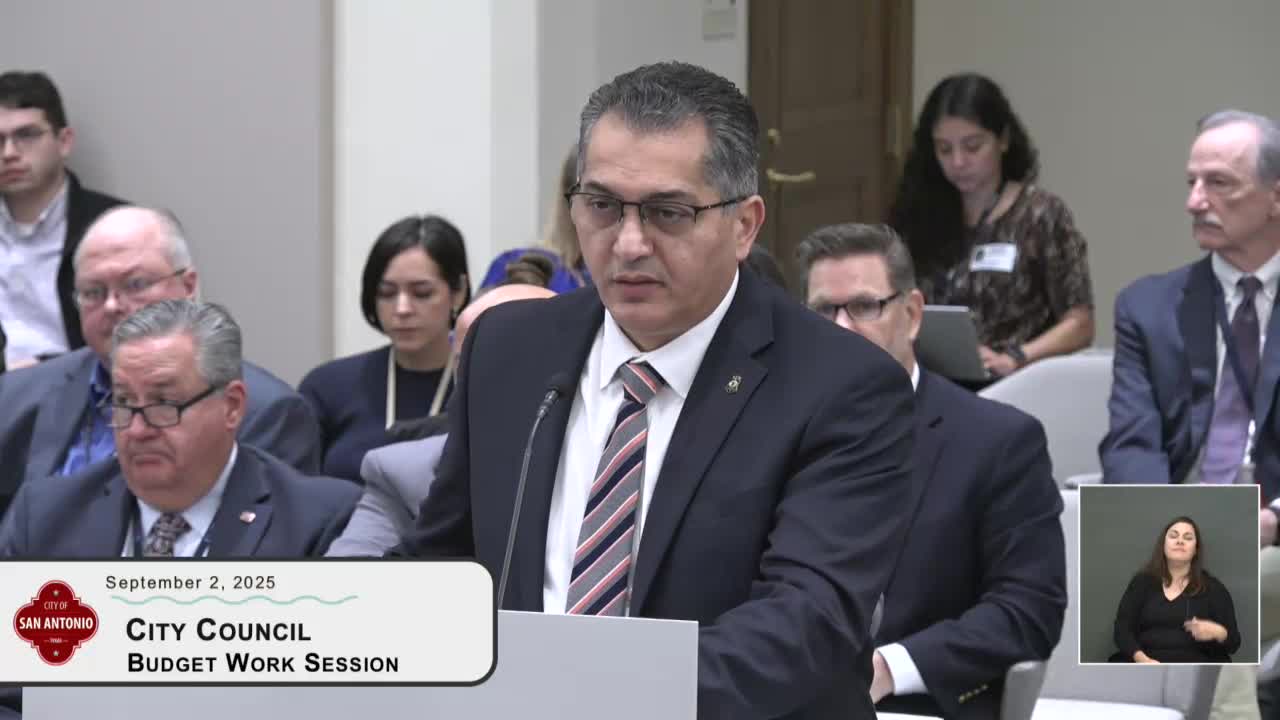
Amin Thomas, director of Development Services, presented the department's proposed fiscal 2026 budget and described permit volume, inspection performance, enforcement priorities and several targeted programs, telling council the department aims to "partner with our community to build and maintain safer San Antonio."
Amin Thomas, director of Development Services, presented the department's proposed fiscal 2026 budget and described permit volume, inspection performance, enforcement priorities and several targeted programs, telling council the department aims to "partner with our community to build and maintain safer San Antonio."
Nut graf: The department proposed a total FY2026 budget of about $69.3 million (roughly $18.5 million in general-fund code-enforcement operations and $48.8 million in the enterprise fund for development-review functions), described a plan to freeze up to 42 vacant development positions to reduce costs, and requested $2 million for a multiyear residential streetlight program while highlighting the status of proactive apartment inspections, short-term-rental compliance work and a senior-assistance pilot.
Thomas told council the department remains accredited by national organizations and reported high inspection throughput: year-to-date figures cited by staff included more than 3,700 new residential permits and more than 2,200 commercial permits, roughly 210,000 inspections performed, and a 99% on-target inspection scheduling rate (the department's goal is 95%). Council members pressed staff on service impacts if vacancies remain frozen and on ways to scale the senior-assistance and streetlight initiatives.
Development Services staff described the streetlight gap analysis: inspectors reviewed about 3,292 miles of residential streets and identified 4,275 lights needed to close spacing gaps. The department said it has funding and installation in place for about 1,034 lights and estimated the remaining 3,241 lights would cost roughly $27.8 million to $32.4 million to install; staff proposed $2 million in FY2026 to continue installations.
On enforcement programs, Thomas reported the proactive apartment-inspection program had performed about 61,000 inspections across 2,031 complexes; 49 complexes were placed into the program for violations, 24 of those have since come into compliance and 25 remain under remediation. The department reported 3,278 permitted short-term rental units citywide; code staff investigated about 1,400 suspected violations and found 448 violations, of which 82% were resolved after notices.
The senior-assistance pilot — a $100,000 citywide program to help elderly or disabled residents with vegetation, debris and similar exterior issues — has assisted 57 households year to date, with an average cost per instance reported at about $1,700 in FY25 (FY24 average was about $1,400). Council members suggested partnering with Solid Waste to explore mulch or lawn-replacement options to lower recurring costs for some households.
Thomas also said the department proposes modest fee increases for some long-unchanged permits and administrative charges — examples presented included raising the junkyard/metal-recycler license to $1,000 per year and increasing certain abatement administrative fees — and estimated those fee changes would raise about $200,000 in revenue if approved.
Council discussion focused on how the hiring freeze would be managed operationally, how permit‑processing times compare to peer cities (Thomas said San Antonio's commercial permit timeline averages about 209 days from application to issuance, with a plan-review target for complex plans of 18 days per internal review), and how the code-enforcement strategic-plan consultant will present recommendations to the Planning, Community and Development Committee for potential action later this fall. No formal votes were taken during the session.