Get Full Government Meeting Transcripts, Videos, & Alerts Forever!
Get email alerts on the Workforce Survey topic
No spam. Unsubscribe anytime.
City staff survey shows large gains; commission debates frequency and open comments
Summary
An ETC Institute employee survey found strong overall satisfaction at the City of Coconut Creek, with 340 responses and large year‑over‑year gains. Commissioners debated whether to include open‑ended responses in future surveys, how often to run them, and whether surveys should be tied to leadership transitions or city manager contract timing.
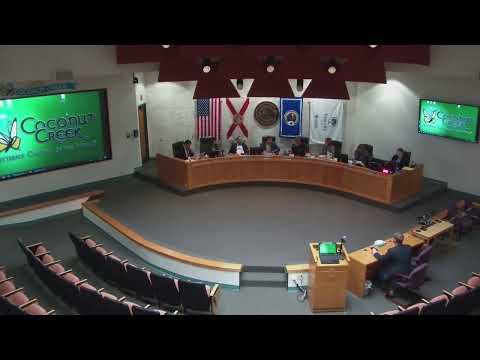
An independent employee survey presented to the Coconut Creek City Commission on Aug. 28 found notably higher staff satisfaction compared with the 2023 survey, and city and consultant discussions focused on how to use the results to guide improvements.
Ryan Murray, assistant director of community research for ETC Institute, said the city received 340 completed surveys (a margin of error of roughly 2.9% at the 95% confidence level). He said the survey showed increases across 23 of 27 comparable items and that 91% of respondents said they would recommend the city as an employer. Murray highlighted compensation/benefits and career development as priority areas for continued attention even though overall satisfaction rose markedly.
Commissioners praised the results but debated survey design features for future rounds. Commissioner Brody argued for allowing open‑ended text boxes so employees could identify specific problems in their own words. ‘‘If somebody says, hey, I can’t get X from my supervisor, that’s very specific to what unsatisfactory means,’’ Brody said.
Vice Mayor Wasserman and other commissioners cautioned that free‑form anonymous comments can generate legal and HR risks and might create unintended hostility or false allegations. City Manager Sheila Rose and Human Resources staff said they had discussed the tradeoffs and considered focus groups where appropriate. Rose said staff favors targeted focus groups for follow‑up in areas that require deeper probing.
Commissioners also debated survey frequency. Murray (ETC) said every one to two years would be the business case for his practice, but he also noted survey fatigue and cost. City HR staff recommended every two years at most as a practical cadence; Murray suggested a 3–5 year rhythm could be appropriate when balanced against staff capacity. Several commissioners proposed tying survey timing to leadership changes or contract renewal milestones for the city manager as one way to ensure results inform major personnel decisions.
Murray recommended sharing findings openly with employees, pursuing focused follow‑up where gaps exist, and committing to a future re‑survey to measure progress. No formal commission action was taken at the meeting; commissioners directed staff to use the report to plan targeted follow‑ups (focus groups and action steps) and to return with a recommended schedule for future surveys.
Why it matters: Employee surveys inform recruitment, retention and service delivery. Coconut Creek’s large reported increase in satisfaction is notable for benchmarking against similar cities and can influence staffing, benefits budgeting and leadership evaluation.
What’s next: Staff will propose a follow‑up plan that may include focus groups, a timeline for the next full survey and possible linkage of a re‑survey to significant leadership milestones.