Get Full Government Meeting Transcripts, Videos, & Alerts Forever!
Get email alerts on the Public Safety Funding topic
No spam. Unsubscribe anytime.
Lane County commissioners ask staff to begin public outreach, map funding options after public-safety task force report
Summary
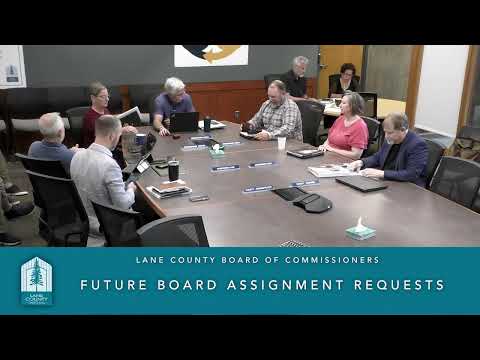
Lane County commissioners on Wednesday reviewed a year‑long public‑safety task force report and directed county staff to begin an accelerated public‑engagement effort, prepare budget‑prioritization scenarios and return with a roadmap for preserving current patrol and prosecution services.
Lane County commissioners on Wednesday reviewed a year‑long public‑safety task force report and directed county staff to begin an accelerated public‑engagement effort, prepare budget‑prioritization scenarios and return with a roadmap for preserving current patrol and prosecution services.
The task force concentrated on three core elements it said are most reliant on general‑fund dollars: rural patrol, the district attorney’s office and adult corrections. The group presented a range of funding scenarios, from a targeted $27 million package to larger options that would expand the county’s public‑safety budget further.
County Administrator Mokrysky opened the work session by flagging the broader fiscal context: “the forecast is posted, and it's officially the state forecast officially reducing the '25 to '27 biennium revenue by $845,700,000,” he said, noting state and federal budget shifts that will affect counties over the next two to three years.
Why it matters: Commissioners said the county faces a choice between pursuing new revenues or re‑allocating existing dollars; many emphasized the need to build trust with voters and clearly explain tradeoffs before advancing any ballot measure. The board also asked staff to prepare for near‑term budget decisions because some one‑time funds supporting increased rural patrol expire at the end of the fiscal year on June 30.
Most significant numbers and options - Task force priorities: rural patrol (about $22 million annually to fund roughly 68 deputies), district attorney staffing (about $5 million annually) and adult corrections funding. Those two items combined were presented as a roughly $27 million package. - Larger options presented: $55 million (adds the temporary jail levy to the $27 million baseline) and a $95 million option that would further reduce reliance on the general fund for the sheriff's office. - Payroll tax example: the report estimated a 0.5% payroll tax could produce roughly $45.3 million, offered as a ballpark illustration rather than a formal proposal. - One‑time patch: the board previously used about $12 million in one‑time funds to add deputies; thatmoney is scheduled to run out (the administration said it is scheduled to be fully spent by the end of the fiscal year).
What officials said - Judy Williams, chief of staff, summarized the task force’s process and recommendations, saying the group narrowed its focus “to three essential functions of public safety” and recommending a mix of efficiencies, prioritization, district options and layered smaller fees as possible tools. - Sheriff Wilkerson said the task force “hit the nail on the head” and argued that the county must show it is prioritizing public safety to earn community support for larger revenue asks: “public safety is a cornerstone of government,” he said. - The district attorney (unnamed in the meeting transcript) told commissioners the office has 24 criminal division prosecutors, a lower staffing level than decades ago, and “we have some of the highest caseloads per prosecutor in the state,” urging additions to allow prosecutors time to review modern evidence such as body‑worn camera footage. - Parole and probation and other system partners warned that statewide funding formulas and risk‑assessment differences complicate local decisions. Parole and probation staff said local caseloads run roughly double neighboring counties and that state guidance on risk assessment sometimes conflicts with locally used tools (LSCMI), which staff said gives a fuller picture for supervising people on supervision.
Board direction and near‑term steps Commissioners did not take a formal vote on a funding measure. Instead they coalesced around several staff directions: - Ask the county administrator to assemble a cross‑department team and present a proposed timeline and work plan for community engagement, including options to hire an outside consultant or polling firm for a county‑wide “temperature read.” The board asked staff to pursue a more aggressive timeline than some prior multi‑year efforts and to return with options in the coming weeks. - Begin a public information effort to explain the county’s current public‑safety gaps and the task force options; craft a single, consistent message the commissioners can use in district meetings. - Hold regular check‑ins: commissioners asked for a monthly cadence of progress reports and recommended setting a formal date for the next status update. - Prepare budget‑prioritization scenarios that would preserve the enhanced rural patrol positions funded with one‑time money and identify tradeoffs if those funds are not replaced; staff noted the one‑time funds that supported additional deputies will run out by June 30. - Staff were also asked to report back on other operational topics raised during the meeting, including an update on the Glenwood transfer station study and specific program impacts tied to state funding changes.
How the task force framed choices The task force report stresses a multilayered approach: pursue operational efficiencies and transparency to build public trust; consider structural options such as a public‑safety district or a payroll tax; and explore smaller fees or layered charges to reduce any single ask. The group explicitly recommended starting with a narrower package focused on rural patrol and the DA’s office while continuing to evaluate longer‑term solutions.
What’s next County staff will return with a proposed consultant RFP and an engagement timeline, budget‑scenario options to sustain current patrol staffing, and monthly status reports to the board. Commissioners said they intend to hold public meetings across the county to explain the choices and solicit community feedback before any decision to place a funding measure on a ballot.
Quotes in context - “The forecast is posted, and it's officially the state forecast officially reducing the '25 to '27 biennium revenue by $845,700,000,” — County Administrator Mokrysky. - “Public safety is a cornerstone of government,” — Sheriff Wilkerson. - “We have 24 criminal division prosecutors. That's 1 less than we had in the mid 1980s when we had 40% lower population,” — District Attorney (as reported in the transcript).
Ending Commissioners thanked the task force members for their work and set a schedule to keep the topic on regular monthly agendas while staff develops community‑engagement options and budget scenarios for preserving patrol and prosecution services.