Get Full Government Meeting Transcripts, Videos, & Alerts Forever!
Get email alerts on the Budget And Tax Rate topic
No spam. Unsubscribe anytime.
Temple City Council adopts FY2026 budget, sets property tax rate at 0.6999 to fund police, fire and capital plan
Summary
On Aug. 28 the Temple City Council adopted a $___ multi-year business plan and fiscal 2026 budget and set a tax rate of $0.6999 per $100 valuation (5–0). Council and staff said the increases will fund police and fire staffing, equipment and capital projects; water and wastewater fee changes were approved separately and take effect Oct. 1.
TEMPLE, Texas — The Temple City Council on Thursday, Aug. 28, adopted the city’s fiscal year 2026 budget and business plan and set a property tax rate of $0.6999 per $100 of valuation, voting 5–0 to approve the measures.
Council adopted the operating and capital budget for the fiscal year beginning Oct. 1, 2025, and ending Sept. 30, 2026, and ratified a property-tax increase reflected in the budget. Finance staff said the budget will raise $11,689,227 more in total property taxes than last year (a 20.95% increase). The revenue from new property added to the roll this year is $3,450,556.
City Finance Director Tracy (first name given in meeting) told the council the proposed $0.6999 rate is comprised of $0.3754 for maintenance and operations and $0.3245 for debt service. Tracy said the average taxable value in Temple this year is $220,566; at the adopted rate the typical Temple homeowner would pay $1,543.74 in city property tax — an annual increase of $238.85, or about $19.90 per month. The council adopted the budget, the tax roll ordinance and the final tax-rate ordinance in separate votes; all measures passed unanimously.
Why it matters: City leaders said the revenue will pay for public-safety staffing, equipment and a multiyear capital-improvement program the council reviewed as a six-year business plan. City staff highlighted immediate priorities including additional police and fire positions, station and equipment planning, an expanded fleet maintenance shift and investments in water and wastewater capacity and rehabilitation.
What the budget funds: City management outlined a number of near-term staffing and capital priorities tied to the adopted budget and business plan: - Police: staff described a multiyear plan to expand patrol districts from eight to 10 and move from 12-hour to 10-hour shifts. The six-year plan calls for 36 police positions (30 sworn, six civilian); FY2026 includes funding for several frontline and training positions. - Fire: staff proposed steps toward a two‑battalion response model, additional squads, and three new stations (Stations 9–11) phased in over the plan. FY2026 includes funding for 10 sworn fire positions and two non‑sworn positions; the plan anticipates 70 new fire positions over six years (68 sworn, two civilian) as minimum staffing needs grow. - Fleet and equipment: staff proposed establishing a second shift in the fleet department (11 positions) to speed repairs and keep trash and service vehicles available; staff also emphasized capital-equipment purchases that were ordered years earlier and only now are arriving. - Streets and drainage: staff reiterated a multi‑year pavement-preservation approach (crack sealing, slurry seal, mill-and-overlay) and signaled work to create a dedicated street-maintenance revenue fund in FY2027 and beyond. - Solid waste: staff reported two new residential routes (one garbage and one recycling) planned for FY2026 and an additional commercial side-load route; officials said new trucks recently delivered have stabilized service.
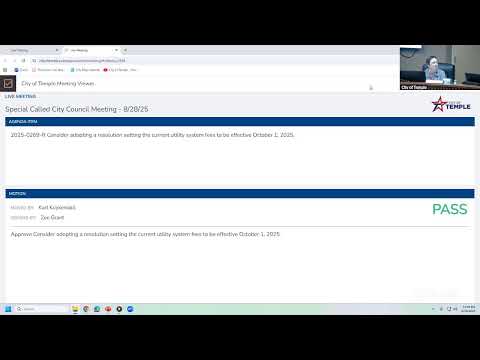
Utility fees: The council also adopted a separate resolution setting utility system fees effective Oct. 1, 2025 (vote 5–0). The water and wastewater changes approved by the council include increases the staff said are necessary to cover operations, debt and capital. Key rate changes presented were: the residential minimum charge for a 3/4-inch meter from $12.75 to $13.40 (approx.), the water volumetric rate from $4.50 to $4.85 per 1,000 gallons, wastewater base from $22.10 to $25.90 and the wastewater volumetric rate from $9.00 to $9.75 per 1,000 gallons. Tracy told council those rates are intended to sustain utility operations and planned capital work including planned wastewater inflow-and-infiltration crews and groundwater/asr (aquifer storage and recovery) projects.
Public comment and council response: During the public hearing speakers expressed concern about the timing of the special call meeting and the tax increase. Resident Twila Clayton, who said she has lived in Temple 45 years, said residents “deserve better” road maintenance and questioned the meeting’s mid‑morning hour for a vote on a tax increase. Resident Robert Hubbard said he is "81 years old" and asked, “When will my taxes stop?” Business owner and lifelong resident Todd Weber described property valuations and tax increases as drivers of housing affordability problems and urged the council to prioritize core services and infrastructure. City staff and councilors repeatedly responded that the budget and tax-rate process is governed by state law and the city charter and that the adopted budget focuses on core services such as police, fire, streets and solid waste.
Votes at a glance (all passed 5–0): - Item 2a — Adopt FY2026 budget and business plan (motion: Mayor Pro Tem Tim Walker; second: Councilmember Bookington). Outcome: approved 5–0. - Item 2b — Ratify property tax increase reflected in the budget (motion: Mayor Pro Tem Tim Walker; second: not recorded on transcript). Outcome: approved 5–0. Staff reported the budget raises $11,689,227 more in total property taxes than last year; $3,450,556 is from new property on the roll. - Item 3 — Second and final reading to adopt an ordinance approving the tax roll and authorizing calculation of taxes for FY2026 (motion: Councilmember Grant; second: Mayor Pro Tem Tim Walker). Outcome: approved 5–0. - Item 4 — Second and final reading adopting an ordinance to set a tax rate of $0.6999 per $100 valuation (motion: Mayor Pro Tem Tim Walker; second: Councilmember Pilkington). Outcome: approved 5–0. - Item 5 — Adopt resolution approving third-quarter financial results for FY2025 (motion: Councilmember Kuykendahl; second: Councilmember Pilkington). Outcome: approved 5–0. - Item 6 — Adopt resolution setting current utility system fees effective Oct. 1, 2025 (motion: moved by a councilmember; second: Councilmember Grant). Outcome: approved 5–0.
Details council requested and next steps: Staff said design work for several capital projects will continue and that construction scheduling will be tied to cost estimates and coordination with other agencies (for example, TxDOT work near I‑35). The adopted tax-rate ordinance takes effect for the FY2026 fiscal year; utility rate changes become effective Oct. 1. City staff said they will return with final project cost estimates and options for council decisions on phasing and funding.
Ending: Council members and staff framed the adopted package as a fiscally conservative plan to fund core public-safety and utility needs while advancing a multiyear capital program. Several speakers during public comment urged the council to re‑examine priorities and timing so more residents can participate in future budget decisions.