Get Full Government Meeting Transcripts, Videos, & Alerts Forever!
Get email alerts on the Court Security Budget Cut topic
No spam. Unsubscribe anytime.
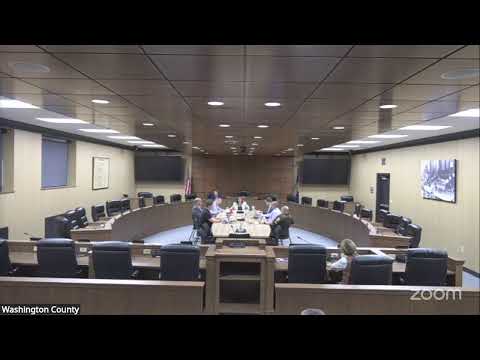
Washington County subcommittee weighs $300,000 courthouse security cut; explores transport, warrant and staffing options
Summary
A Washington County Criminal Justice Coordinating Committee subcommittee reviewed a proposed $300,000 reduction to courthouse security funding and discussed options including renegotiating a transport contract, increasing video appearances, and geo-restricting certain warrants to reduce transport costs.
A Washington County Criminal Justice Coordinating Committee (CJCC) subcommittee on courthouse security on Sept. 10 discussed how a proposed $300,000 reduction in court security funding would affect courthouse operations, and identified steps county officials could take to try to find equivalent savings elsewhere in the justice system.
The subcommittee heard from Sheriff Schulteis, who told members that “a $300,000 cut is about a third of the operational budget for [courthouse] security,” and that most of the expense is personnel. County executive staff stated the executive’s objective is a flat levy and that $300,000 in savings must be found countywide but “does not have to come from court security.”
The discussion matters because the sheriff’s office said current staffing is already below the benchmarks used in other counties, and cuts would reduce the level of service for courtroom safety and for movement of incarcerated people to and from court. Participants identified several operational levers that could produce savings or shift costs, but emphasized that none were formal budget decisions and many would require cooperation from multiple agencies and vendors.
Sheriff Schulteis described current operations and staffing: five deputies assigned to cover four circuit branches plus a court commissioner, and two deputies at screening. He said most court security costs are wages and benefits and that cutting $300,000 could equate to removing roughly one to two full-time-equivalent positions or eliminating part-time and pool hours.
Subcommittee members and court staff outlined four main avenues to pursue: renegotiating the Ready Transport contract for prisoner transports; increasing the use of courtroom video appearances for incarcerated defendants; geo-restricting certain warrants (particularly for operating after revocation and operating without a license, referred to in the meeting as OAR and OWL) so out-of-county pickups would not drive transport costs; and clarifying a staffing/vacancy accounting discrepancy that BPA reported as a vacancy worth roughly $116,000 on paper.
On transport costs, the sheriff said he had just signed a two-year contract with Ready Transport that reduced annual transports to an estimated 950 and projected contract costs of about $206,000 a year. He said he was willing to discuss the contract with the vendor but identified the signed contract as a hurdle. County staff agreed that asking Ready Transport to revisit terms was an obvious first step.
Court leadership and the district attorney’s office urged expanding video appearances where statute and parties allow. The presiding judge noted that many incarcerated defendants prefer video appearances and that the court already has equipment to accommodate them. The judge also cautioned that statutory rules permit defendants or the state to object to video appearances and that expanding video hearings can shift staffing burdens from courthouse deputies to jail staff. The public defender’s office was flagged as a necessary stakeholder to determine whether attorneys could be present with clients in the jail while appearances occur by video (a model some counties use).
On warrants, court staff and the district attorney discussed geo-restricting certain misdemeanor warrants so that only Washington County agencies would process them, reducing the number of out-of-county transports paid for by the sheriff’s office. The district attorney said higher-level repeat OAR cases could still be requested for statewide or broader warrants at prosecutors’ discretion. The clerk of courts data presented to the subcommittee showed that, for many months in 2024–2025, returns on warrants for initial appearances were dominated by OAR and OWL case types, though the packet lacked a breakdown showing whether those warrants originated in-county or out-of-county.
Members noted potential downstream effects and limits: reducing on-site court security could increase overtime in the sheriff’s budget, raise costs for the clerk of courts and district attorney (who must staff hearings), and affect defense counsel access. The judge said separating defendants from counsel (by relying on jail-based video with counsel only on video) had produced measurable increases in timely preliminary hearings during COVID-era operations and could create additional workload and ripple effects.
The subcommittee agreed on a list of next steps to gather facts before any formal budget action: (1) sheriff’s office will ask Ready Transport whether contract terms can be revisited; (2) the sheriff and operations staff will examine whether transports can be reduced via video appearances and whether jail staffing could absorb new responsibilities; (3) the district attorney’s office will evaluate geo-restricting warrants by case type and identify criteria for exceptions in more serious repeat-offender cases; (4) county budget staff will clarify the reported vacancy that BPA shows as a savings of roughly $116,000 on paper; and (5) the public defender’s office will be asked for its view on attorney access if hearings are conducted from the jail. Subcommittee members agreed to share results through the subcommittee’s liaison rather than group email, and to reconvene only after the requested information is collected.
No formal vote or budget amendment was taken at the meeting. Members emphasized that the proposals remain exploratory: the county executive’s $300,000 target is part of preparing a flat-levy executive budget and “does not have to come from court security,” but the subcommittee must identify verifiable dollar savings to justify operational changes.
The subcommittee adjourned after setting the information requests and asking staff to return findings on transport-contract flexibility, warrant origin data, vacancy accounting, and logistical impacts on jail staffing and defense counsel access. The group did not set a date for a follow-up meeting.