Get Full Government Meeting Transcripts, Videos, & Alerts Forever!
Get email alerts on the Municipal Finance topic
No spam. Unsubscribe anytime.
City finance adviser outlines $5 million every‑other‑year borrowing plan to accelerate road work
Summary
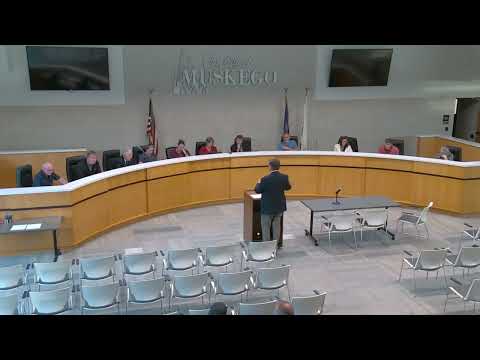
Kevin Mullen, a director in the public finance practice at Robert W. Baird & Co., told the Muskego City Committee of the Whole on Aug. 26 that the city could accelerate road work by establishing a recurring borrowing pattern and described one illustrative scenario of $5 million issued every other year.
Kevin Mullen, a director in the public finance practice at Robert W. Baird & Co., told the Muskego City Committee of the Whole on Aug. 26 that the city could accelerate road work by establishing a recurring borrowing pattern and described one illustrative scenario of $5 million issued every other year.
Mullen said the example was conceptual, not a formal proposal, and that the figures were meant to show how the city could move from a “pay‑as‑you‑go” approach toward a sustained capital improvement program. "If you were to borrow $5,000,000 in 2026," he told aldermen, "you'd then have a payment in 02/1927. . . . If that borrowing is spread out over that 15‑year period, assuming an interest rate of 4.3%, we've been conservative in that estimate." He added the rate assumption included about 50 basis points above current observed yields to be conservative.
Mullen framed the plan as a way to address the city’s road‑rating backlog faster than current maintenance funding allows. He said, under the city’s current pace, many streets would remain in lower condition ratings for decades and that a program of recurring bond issues would allow a more steady, predictable replacement schedule.
Why it matters: The finance presentation tied directly to the budget choices Muskego aldermen must make this fall. The committee is balancing an operating deficit of roughly $1.6 million and ongoing commitments the city now funds from operating levy dollars, including a $750,000 annual operating allocation for roads. Borrowing for capital can be counted outside levy limits, Mullen said, and many Wisconsin municipalities use debt to fund long‑lived assets when levy growth is constrained.
Key details and council questions
- Structure shown: Mullen described a hypothetical 15‑year bond and the mechanics of levy years (the levy is set in one budget year and used to pay debt service in the subsequent year). He said some communities borrow up to 20 years ("state statute allows you to borrow for up to 20 years"), but Baird used 15 years in the example as a common balance between payment size and useful life.
- Illustrative size and costs: The slide example assumed a $5 million borrowing in 2026, a 15‑year amortization and a conservative 4.3% interest assumption (current yields plus a margin). Mullen said the first debt service year shown would be an interest‑only payment of about $184,000, with larger principal and interest payments in subsequent years as that schedule ramps up.
- Layering and longer horizon: Mullen ran a scenario that layered a new $5 million issue every other year. Over 15 years the illustration reached roughly $40 million of new borrowing in aggregate and a combined debt‑service path that would rise in the middle years and then “plateau” as prior issues amortize.
- Tax‑impact illustrations: Mullen summarized modeled mill‑rate impacts in cents (his presentation used cents notation): he said the combined tax‑supported levy rate would increase over several years and ultimately "plateau at 63¢" in his scenario. He translated one example to household effect: "On a $400,000 home, it's about $68," he said. Mullen cautioned the number depends on many moving parts — property valuation growth, future levies and the precise borrowing schedule.
- Timing and market risk: Committee members asked whether rates might fall if the city delayed issuance until spring; Mullen said short‑term (near‑term) yields could modestly decline if the Federal Reserve eases policy, but the long‑end of the yield curve (cost for a 15‑year borrowing) historically moves less. He recommended the committee consider both market timing and policy needs when deciding whether to issue now or later.
- Operational choices and tradeoffs: Several aldermen asked whether the city should keep the existing $750,000 annual operating road allocation while layering borrowing, or substitute borrowing for that operating money. Mullen and city staff noted one option would be to remove the $750,000 from operating and borrow for those road projects; doing so would reduce the immediate operating deficit but shift the cost into debt service. One alderman said he would oppose removing the $750,000 operating allocation if the city expects to borrow, because it would effectively borrow to replace money the city already sets aside.
- Cash flow and prepayment: Mullen explained common municipal bond features including call provisions. He said bonds often carry an eight‑year call that lets a municipality refund the bonds after that call date with no additional cost; more aggressive call protection raises interest rates.
What the committee decided
No formal borrowing motion was made at the Aug. 26 meeting. Committee members asked staff to refine options and to return with alternatives that will let aldermen compare different initial issue sizes, amortization terms and potential combinations of operating vs. debt funding for roads.
Quotes
"This plan is meant to address not only the current needs but also needs that might be in front of you in the future," Kevin Mullen said. "Hypothetically, we said, okay, if we were to borrow in 2026 for $5,000,000 — how does it look if we continue to borrow every other year?"
On tax impact: "That tax rate is based on annual growth in value of 1 and a half percent a year," Mullen said, noting staff used conservative valuation growth assumptions in the model. "On a $400,000 home, it's about $68."
Looking ahead
City finance staff and the committee agreed to incorporate borrowing scenarios into the capital budget discussion this fall. Aldermen directed staff to return with a narrower set of options — different principal sizes, potential first‑year structures (interest only vs. level debt service), and the effect of keeping or removing the $750,000 annual operating road allocation — so the council can weigh tradeoffs during the formal budget process.
Provenance: City committee discussion of Baird presentation and council Q&A occurred Aug. 26, 2025; committee did not act on borrowing at that meeting.