Get Full Government Meeting Transcripts, Videos, & Alerts Forever!
Get email alerts on the 1 York Fire Plan topic
No spam. Unsubscribe anytime.
Committee backs monthly work to develop "1 York Fire" 10‑year framework; council motion approved
Summary
After presentations on a proposed 10‑year fire service plan, the Justice & Public Safety Committee approved a motion asking staff and the committee to meet monthly and work with chiefs to create a 1‑ to 3‑year collaborative plan that leads to a 10‑year "1 York Fire" vision by July 1, 2035.
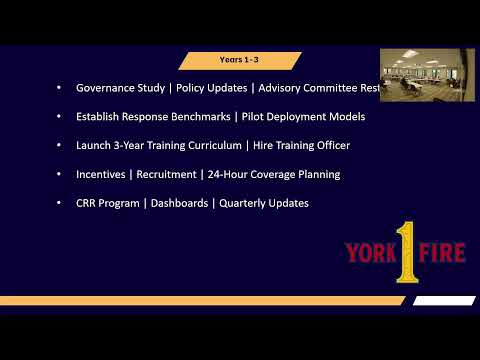
York County’s Justice & Public Safety Committee on Aug. 27 directed staff to begin monthly planning sessions with the committee and fire chiefs to develop a multi‑year pathway to a unified county‑wide fire service framework branded in the meeting as “1 York Fire.” The committee approved a motion requesting staff and the committee meet monthly to initiate a 1‑ to 3‑year collaborative plan that will lead toward a 10‑year vision by July 1, 2035.
Matt Davis, the county fire service director, described a strategic approach based on a SWOT review and interviews with leaders from 16 fire departments and seven tax districts. Davis and other staff said the plan seeks to address inconsistent service levels across the county by emphasizing equity of funding and service, data‑driven deployment, workforce development and recruitment, and standardized response‑time benchmarks.
Staff outlined a goal to unify fire organizations into a countywide system while preserving local station identity and volunteer recruitment pipelines. Key elements discussed included hiring a full‑time training officer, developing career pathways from volunteer service into paid positions, piloting staffing or integrated models in selected districts, and conducting a facilities/critical‑needs study to inform capital planning.
Council members and fire leaders raised annexation and municipal boundary issues and stressed the need to negotiate municipal agreements and automatic‑aid protocols so that residents do not experience widely varying service based on arbitrary district lines. Funding approaches discussed included a single funding pool or standard millage to create equity, with the acknowledgement that large capital projects could require referendum or bonding and that detailed fiscal planning was part of later phases.
The committee’s motion directed staff to convene monthly, include fire chiefs and other stakeholders in the work, and return with a framework for short‑term (1–3 year) steps that build toward the 10‑year plan. A committee member moved the request and it was seconded; the motion was approved at the meeting. The transcript does not record individual yes/no vote tallies by name.