Get Full Government Meeting Transcripts, Videos, & Alerts Forever!
Get email alerts on the Housing topic
No spam. Unsubscribe anytime.
Carbondale holds public hearing on ADU code changes; commission schedules continuation after detailed public comments
Summary
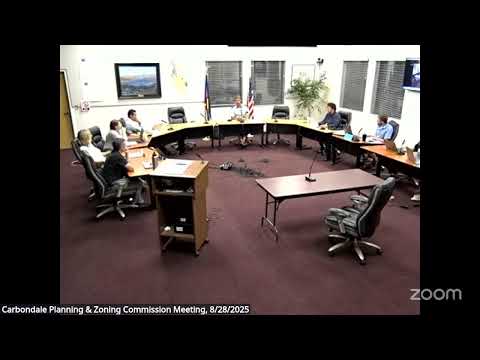
Town planning staff presented a package of proposed changes to Carbondale’s ADU rules on Aug. 28 and the Planning and Zoning Commission heard extended public comment and staff background before voting to continue the public hearing to Sept. 11, 2025.
Carbondale planning staff opened a public hearing Aug. 28 on proposed amendments to accessory dwelling unit (ADU) regulations in the town’s Unified Development Code, outlining existing rules and asking the Planning and Zoning Commission for direction on process, locations, unit size, parking, and short-term rental limits.
Jared (town planning staff) told commissioners the purpose of the hearing was to gather guidance before staff drafts code language. He summarized current rules and practice: ADUs are defined as subordinate dwelling units created within or detached from a single-family residence; they are permitted in many residential zone districts but are often limited or excluded in PUDs (planned unit developments). The code currently allows one ADU per property, generally limits ADUs to one bedroom, requires cooking and sanitary facilities, prohibits separate ownership or separate utilities, and sets ADU sizes roughly between 300 and 850 square feet depending on zone and lot. Parking requirements now call for two spaces per ADU but the commission may reduce that to one in some cases; staff noted the commission had in 2024 exempted ADU parking spaces from impervious lot-coverage calculations.
Staff and commissioners reviewed a map and spreadsheet summarizing where ADUs are permitted, where they are allowed in limited circumstances, and where PUD language effectively excludes ADUs. Jared described River Valley Ranch (RVR) as an example where the PUD granted ADU rights to specific platted lots; staff noted roughly 40 ADUs were constructed in RVR through 2018 under that prior approval process. Staff reported that, since 2014, the town had approved 17 ADUs through land-use review (four approved but not built, two withdrawn, and two under review). Jared also summarized prior 2023 work sessions and recent state legislative efforts that were proposed but did not pass; he said a state bill that would have preempted PUD restrictions in some jurisdictions did not become law.
The hearing drew several public speakers. Chester White (project owner) framed the discussion as an opportunity to set a “common-sense approach” so businesses and homeowners can navigate permitting. Brad Zeigel, a homeowner with an ADU, described the unit’s social uses over many years — housing a person who became a paraplegic, teen mothers, seniors and workers — and said ADUs provide important housing flexibility. Bob Schultz urged the commission to consider tools for affordable ADUs (deed restrictions, fee waivers, preapproved modular plans) and said streamlining review and lowering fees can encourage deed-restricted units. Several residents asked the commission to re-examine Old Town Residential (OTR) impervious limits that can make building ADUs very difficult without removing existing driveway area. John Williams and others urged simplifying the process and treating ADUs more uniformly across town.
Commissioners debated a set of policy choices and in several cases expressed preliminary consensus: - Parking: commissioners favored moving from two required ADU parking spaces to one in most cases; commissioners asked staff to consider how a parking study for the town should inform this change and whether exceptions (for two-bedroom units, if allowed) should remain. - Impervious coverage: commissioners and public commenters asked staff to explore ways to reduce the impervious-area barrier for ADUs. Staff noted impervious lot coverage functions in Carbondale as a tool to control overall built area and street character as well as stormwater, and cautioned changes could affect tree canopy and landscaping; commissioners indicated willingness to pursue trade-offs (for example reducing required parking while easing building-area limits) and asked staff to draft specific options. - Attached vs. detached ADUs: commissioners generally favored allowing detached ADUs in addition to attached units, noting detached units can reduce conflicts with house occupants and may be less costly to build, with some commissioners saying detached ADUs are often the more practical option for infill lots or where alley access exists.
Staff also asked for direction on other matters — whether to permit multiple bedrooms in ADUs, size and design compatibility rules, and whether ADUs should be prohibited from short-term rental licensing. Public speakers and commissioners generally supported streamlining review (moving some ADU types to a straight administrative permit rather than a minor site plan with a public hearing) but raised neighbors’ notification concerns if public hearings were removed entirely.
After public comment and extended discussion, Commissioner Jesse moved and Anne seconded a motion to continue the public hearing on the ADU code amendment to Sept. 11, 2025. The motion passed with an aye vote recorded. Staff said the continuation will let them return with targeted draft code language informed by the commission’s input and additional data (including a parking study and more detailed impervious-coverage data).
The transcript records many technical clarifications from staff: Old Town Residential (OTR) currently generally allows attached ADUs only unless the structure is historic; PUDs vary widely and many omit ADUs because older PUDs were written long before ADUs were common; the UDC’s primary ADU standards sit in Section 4.4.4; and recent administrative changes exempted ADU parking from impervious-lot-coverage calculations. Staff recommended the commission focus next time on parking/impervious trade-offs and attached vs. detached standards as near-term priorities. Commissioners asked staff to return with clearer tables showing how many lots would be affected by any map-based changes and to draft code options that minimize unintended impacts to tree canopy and neighborhood character.
The hearing produced a record of public concerns about affordability, neighborhood character, parking impacts, and whether a change should be town-wide or phased. Several public commenters recommended specific tools to encourage affordable ADUs, including deed restrictions paired with fee waivers or preapproved modular plans to speed construction and lower costs. Commissioners and staff also discussed the Colorado wildfire resiliency code and whether additions of 500 square feet or more would trigger state wildfire resiliency requirements; staff said the town’s building official and the fire protection district are reviewing those rules and the town has until the state’s adoption deadline to decide how to proceed.
The commission left the record open for further deliberation and directed staff to prepare draft code language and supplemental data for the next meeting, plus to consider stakeholder outreach methods (including targeted PUD outreach and door-knocking in neighborhoods where PUD covenants are dormant). The public hearing will be continued on Sept. 11, 2025, as the commission and staff work to translate the discussion into proposed text amendments.