Get Full Government Meeting Transcripts, Videos, & Alerts Forever!
Get email alerts on the Advanced Manufacturing Site Mundy topic
No spam. Unsubscribe anytime.
House panel hears competing testimony on Mundy Township ‘mega site,’ with residents warning of PFAS and developers touting jobs
Summary
The House Oversight Subcommittee on Corporate Subsidies and State Investments heard competing testimony October 25 about the proposed Advanced Manufacturing District (AMD) in Mundy Township, known locally as the “mega site.”
The House Oversight Subcommittee on Corporate Subsidies and State Investments heard competing testimony October 25 about the proposed Advanced Manufacturing District (AMD) in Mundy Township, known locally as the “mega site.” Joanne Mendy, president of Mendy Engineering Solutions LLC and a Mundy Township resident, told the committee residents have organized in opposition and raised health and groundwater concerns; Flint and Genesee Economic Alliance executive director Tyler Rossmesler and Michigan Economic Development Corporation officials defended the site-preparation work and said the state-funded effort is meant to attract large manufacturing investment.
The testimony matters because state funds have already been used to assemble and prepare the site, lawmakers were shown detailed incentive scenarios for a potential semiconductor fabrication project, and residents say environmental risks and public-health impacts have not been resolved. Committee members pressed witnesses on how taxpayer dollars were spent, what oversight exists, and what next steps the legislature, appropriations committees and local officials might take.
Joanne Mendy told the panel she represents a grassroots group, the Genesee County Coalition for Clean Water, that formed in 2023 to oppose the mega site. Mendy said the group collected roughly 1,200 petition signatures from residents in a roughly three-mile radius of the Advanced Manufacturing District; conducted a one-month survey with 403 responses (she said more than 80% of respondents were “extremely concerned” about water pollution, environmental and worker health); and requested a one-year moratorium from the Mundy Township board to allow more study. Mendy said the group sought baseline water testing at three Genesee County locations in 2023 and was denied by Eagle (the transcript identifies the response as citing “insufficient funds”).
Mendy outlined worker- and community-health concerns frequently raised about semiconductor manufacturing, including studies the group cites on reproductive and developmental risks for some semiconductor workers and the group’s concern about PFAS, the class of chemicals often called “forever chemicals.” “We do not need jobs that cause serious health concerns or damage our environment,” Mendy told the committee, and she asked, “What is the path forward after these senate committee hearings?” (Joanne Mendy, president, Mendy Engineering Solutions LLC).
Representatives of local economic-development organizations described a different picture. Tyler Rossmesler, executive director of the Flint and Genesee Economic Alliance (a private nonprofit), said the group assembled control or option agreements on about 1,300 acres for the Advanced Manufacturing District and has “the best site in America,” citing proximity to rail, major highways, Bishop International Airport and nearby talent pipelines such as Mott Community College, University of Michigan–Flint and Kettering University. Rossmesler said the site had drawn interest from semiconductor companies and that an initial company visit occurred in 2022; he said the company later declined to proceed because of federal uncertainty and market conditions.
Officials from the Michigan Economic Development Corporation (MEDC) described the state funding and approval framework that supports strategic site preparation. Quentin Messer, MEDC (self-identified as lead in Team Michigan presentations), and Kristen Armstrong, MEDC chief operating and performance officer, said site work has been supported through state programs, notably the Strategic Site Readiness Program (SSRP). MEDC testimony described a $9,250,000 SSRP grant made from an earlier supplemental appropriation and a later $250,000,000 SSRP grant approved in May 2024 to support land acquisition and preliminary site preparation. Kristen Armstrong said $192,100,000 of the $250,000,000 has been disbursed to the Flint and Genesee Group Foundation and that the Michigan Strategic Fund holds security interests and controls on spending and land transfers.
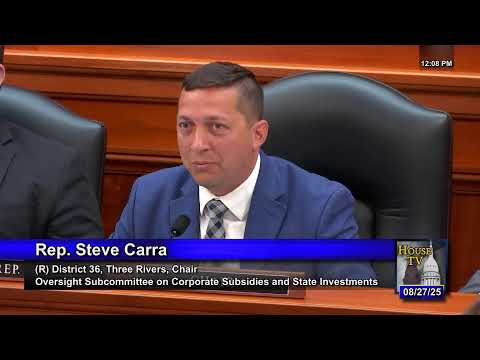
Committee members pressed witnesses on several recurring themes: whether baseline water testing was denied and, if so, why; why an economic-development nonprofit did not pay for private testing; who controls land purchases and whether owners were paid above market value; the nature of nondisclosure agreements used while recruiting an end user; and how legislative oversight and appropriations fit into the approval process for SSRP and other incentive tools. Chair Cara and several members emphasized that transfers from the SOAR/SSRP program must follow statutory transfer and appropriations procedures and that the appropriations committees in each chamber handle transfer approvals.
MEDC and Flint-area officials outlined the incentive structure that had been discussed with a potential semiconductor investor. Witnesses said an illustrative proposal for the company included a mix of performance-based cash grants, workforce grants and SSRP support for infrastructure; MEDC staff said only a minority (they cited roughly 14%) of the proposed package would have been cash and that the package would have required multiple approvals — local, Michigan Strategic Fund and, for some taxes or credits, legislative action. Committee members cited MEDC presentations showing a state-level proposal in the billions (witnesses used figures such as $6.24 billion in state offers in slides discussed at the hearing) and noted that the company had discussed accessing federal CHIPS Act funds (witnesses cited up to $16 billion in potential federal support for the project in some scenarios). MEDC witnesses repeatedly stated there was never a signed agreement and that no state dollars had been dispersed to an end user.
Several lawmakers questioned whether the state should use large amounts of public funding to assemble a single large greenfield site versus directing those dollars to other public priorities. Minority vice chair Wigela and other members listed alternative uses of multi‑billion-dollar packages discussed in the hearing and said the legislature must weigh those tradeoffs. MEDC witnesses said their role is to create investment-ready opportunities and return proposed projects to lawmakers for public decisions.
No committee action on the mega site was taken at the hearing. The only formal action recorded in the transcript was a unanimous motion to approve the committee’s Aug. 20 minutes: “Vice chair Green moves to approve the minutes of the August 20 meeting. Without objection, so ordered.” (Mover: Vice Chair Green; outcome: approved). The committee chair closed the hearing after questioning and indicated the committee would continue oversight activity and invite additional witnesses as appropriate.
The subcommittee requested follow-up items during the hearing: details about the denied water-testing request, documentation on SSRP disbursements and land-closing controls held by the Michigan Strategic Fund, and an accounting of outreach to local stakeholders and donors to the Flint and Genesee Group. Members said future testimony could include additional local residents and business leaders and reiterated that transfers from the SOAR/SSRP fund and other incentive tools require further, separate legislative approval by appropriations panels and, in some instances, the full Legislature.
The hearing record contains competing factual claims the committee will need to reconcile: residents’ assertions that proactive water testing was denied and that PFAS and worker-health risks merit moratoria or stricter county/township controls; and economic-development testimony that the site has been assembled with state safeguards, that funds are controlled by the Michigan Strategic Fund and that offers to potential end users were performance-based and unconsummated. Committee members asked for additional documentation and witnesses to help resolve those competing claims.
The committee adjourned after the scheduled testimony and questioning; members signaled they may call additional witnesses and review supplemental materials provided by both opposition groups and economic-development officials.