Get Full Government Meeting Transcripts, Videos, & Alerts Forever!
Get email alerts on the School Nutrition topic
No spam. Unsubscribe anytime.
Tennessee Department of Education reviews federal "Smart Snacks" standards and fundraiser limits in virtual training
Summary
Jennifer Smart, the Tennessee Department of Education's Mid Cumberland West regional nutrition consultant, led a recorded virtual training on federal Smart Snacks nutrition standards, beverage portion limits by grade, fundraiser exemptions and administrative review expectations for school food sales.
Jennifer Smart, Mid Cumberland West regional nutrition consultant for the Tennessee Department of Education, led a recorded virtual training reviewing federal Smart Snacks nutrition standards, beverage portion limits by grade level, and rules for specially exempted fundraisers.
Smart Snacks matter because they regulate foods and beverages sold to students outside the federally reimbursable school meal programs. "Smart snacks are important because almost a quarter of kids' daily calories come from snacks," Smart said, summarizing the federal rationale behind the standards.
The session defined the school day for Smart Snacks enforcement as beginning at midnight and ending 30 minutes after the official end of the school day. Smart outlined the core nutrient and ingredient tests: compliant snack and entrée items must meet limits for calories, sodium, total fat, saturated fat and total sugars, and must be a grain product that is at least 50% whole grain by weight or list a whole grain as the first ingredient, a fruit/vegetable/dairy/protein food as the first ingredient, or a combination food that contains at least 1/4 cup fruit and/or vegetables.
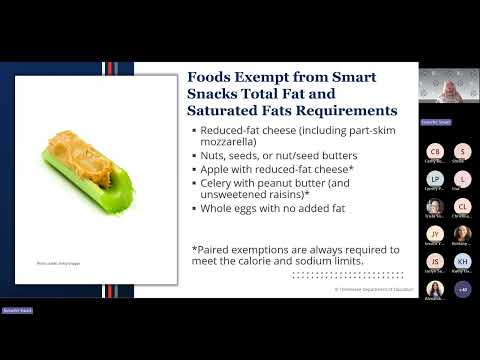
Smart explained exemptions that commonly apply in schools: school breakfast and lunch entrees offered a la carte may be sold as competitive items without meeting Smart Snacks standards on the day they are served and the following school day (for example, a lunch entree served Wednesday can be sold a la carte Wednesday and Thursday). By contrast, meal side dishes sold a la carte must always meet Smart Snacks standards. Several categories of foods are exempt from some nutrient limits when they meet specified conditions, including fresh fruits and vegetables, frozen fruits/vegetables with no added ingredients other than water, canned fruit packed in 100% juice or light syrup, reduced-fat cheeses, nuts and seeds, plain whole eggs, and certain dried fruit and trail-mix combinations. Smart emphasized that paired exemptions (for example, fruit plus reduced-fat cheese) still must meet calorie and sodium limits.
The presentation covered beverage rules that vary by grade band. Water (plain, with or without carbonation) has no portion limit for any grade group. For elementary students, milk and 100% juice (or diluted 100% juice) are limited to 8 ounces; for middle and high school students these are limited to 12 ounces. Caffeine is prohibited in beverages sold to elementary and middle school students except for naturally occurring caffeine; high schools may sell caffeinated beverages under the Smart Snacks rules. Smart gave the numeric low-calorie/no-calorie thresholds the federal rule uses (for example, a low-calorie beverage limit expressed per 8 or 12 ounces and a no-calorie threshold per 20 ounces) and stressed districts should consult label information when determining compliance.
Smart reviewed how specially exempted fundraisers work in Tennessee: foods and beverages that do not meet Smart Snacks nutrition standards may be sold under a special exemption for school-sponsored fundraisers, but no more than 20 days per semester per school. The principal or an assigned designee is responsible for tracking the 20-day limit and retaining documentation. Specially exempted fundraiser sales may not be sold in competition with school meals in the food service area during meal service. Activities occurring off campus, on weekends or during non-school hours do not need to meet Smart Snacks requirements.
On compliance and administrative review, Smart said the state agency evaluates a minimum of 10% of foods and beverages sold as Smart Snacks and ensures districts are following state-set exempt fundraiser rules. During school year 2024–25 the state reported nine findings related to this module; Smart provided an example corrective action requiring a school to remove a noncompliant item (chili cheese Fritos) from a la carte sale and to upload images of the items sold to demonstrate compliance.
Smart ran skill-check scenarios with attendees (for example, whether mini corn dogs sold a la carte on Friday would be allowable if they were served as a lunch entree on Wednesday) to highlight common compliance pitfalls. She closed by listing resources: the department's school meal program web page (operational requirements and Smart Snacks information), USDA Food and Nutrition Service Smart Snacks resources and guide, the State Board of Education fundraiser rules, and the Alliance for a Healthier Generation Smart Snacks calculator—tools she said many districts use to determine compliance.
The training ended with a brief QR-code evaluation and an offer to answer additional questions in the chat.