Get Full Government Meeting Transcripts, Videos, & Alerts Forever!
Get email alerts on the Homelessness Shelter Policy topic
No spam. Unsubscribe anytime.
County outlines hotel-based regional shelter program; Vista mayor presses for information-sharing after renewed encampments
Summary
The County of San Diego reviewed its Regional Homeless Assistance Program, which uses scattered-site hotels and motels including a site in Vista, and city leaders pressed county staff for faster, confidential information-sharing about program participants after encampment and public-safety concerns.
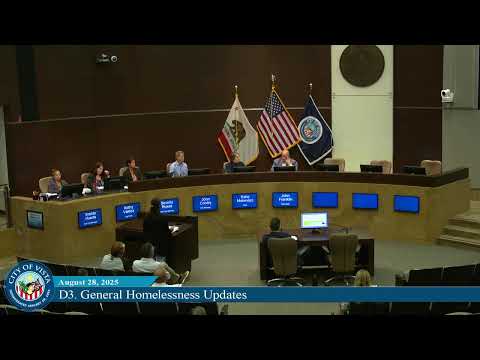
Diana Beck, director of the Office of Homeless Solutions for the County of San Diego, told the City of Vista committee that the county's Regional Homeless Assistance Program (RHAP) began in January 2020 and uses hotels and motels to shelter people while offering case management and housing navigation.
Beck said RHAP is a scattered-site emergency shelter model designed for the county's large unincorporated geography, not a single brick-and-mortar shelter. "We are currently providing shelter for up to 250 households on any given night," she said, adding that could be about 400 individuals. She said the program has served more than 2,600 people since inception and that roughly 40% of participating households exit to permanent housing, a rate she described as higher than many comparable programs.
The program is operated under contract with a vendor identified in committee remarks as ECWIS. Beck said hotels that host program participants sign agreements with the contractor and agree to monitor on-site activity, enforce participant rules and report problems to program managers. She acknowledged problems do occur and said the contractor and county respond to reports to mitigate them.
Why it matters: city leaders said they are not opposing the county shelters but want timely, actionable information so local outreach workers and public-safety staff can follow up when people move in and out of hotel sites inside Vista. Mayor (name not specified) said one woman she knew, referenced as "Carla," was put on an involuntary psychiatric hold, later returned to the same outdoor location in Vista and remains unsheltered. The mayor pressed county staff for a way to share participant rosters with local service providers so case workers in Vista can coordinate follow-up and care.
"We want better information sharing," the mayor said. "If the people are in our city boundaries, then we need to have full awareness of what's going on." The mayor added that local professionals would not publish confidential records and asked the county to consider an information-sharing agreement with the city's outreach partners.
County response and limits: Beck and other county staff acknowledged legal limits around protected health information and said behavioral-health records are confidential. Beck said the county does provide weekly reports on the hotel the committee discussed and committed to continued outreach: "We're sending weekly reports on the Equus Hotel here so that that's transparent as far as we're seeing positive exits out of the hotel into permanent housing." She also said her office would continue follow-up with behavioral-health services for the individual the mayor named.
On the question of whether the city can compel the county to share records, the committee's legal staff said local regulatory authority to mandate the county's communications is limited; instead, the parties should pursue an interagency agreement. Beck agreed to explore an information-sharing agreement with the city and to keep communicating with Jonathan (city staff) and Vista outreach partners.
Program details and next steps: Beck described other RHAP elements the county is adding or expanding: the county is procuring a new contractor agreement (reprocurement was underway at the time of the meeting), it recently stood up three safe-parking sites and is piloting a single-site sleeping-cabin project in Lemon Grove expected to include about 60 cabins with on-site case management and an anticipated average cabin stay of about six months. Beck said hotels used for RHAP sometimes are located inside incorporated cities (including a Vista hotel that housed about 22'24 households on average at the time of the briefing) because hotels are scarce in many unincorporated areas.
What the committee directed: City and county staff agreed to pursue a narrower, lawful way to share nonmedical case-management information with Vista's outreach providers and to continue weekly incident and exit reporting for the hotel in question. County staff emphasized statutory privacy protections for medical and behavioral-health records and said any agreement would have to respect those laws.
Ending: The committee did not take formal legislative action on the item. City staff said they would follow up with county counterparts to draft an interagency information-sharing agreement and report back to the committee; county staff said they would continue weekly reporting on the hotel and prioritize follow-up with the behavioral-health provider for the named individual.