Get Full Government Meeting Transcripts, Videos, & Alerts Forever!
Get email alerts on the Land Use Development topic
No spam. Unsubscribe anytime.
Planning Commission finds Bay Meadows Phase 2 owner complied in good faith; parking dispute raised by residents
Summary
The San Mateo Planning Commission on Aug. 20 adopted a resolution finding Bay Meadows Phase 2 owner complied in good faith for the review period 12/21/2023–12/20/2024. Residents pressed the commission over off‑street guest parking; the applicant and staff said parking enforcement and time limits are city decisions.
The San Mateo City Planning Commission on Aug. 20 adopted a resolution finding that Bay Meadows Main Track Investors LLC complied in good faith with the Bay Meadows Phase 2 Development Agreement for the period Dec. 21, 2023, through Dec. 20, 2024.
The commission voted to accept the annual review after a staff presentation describing construction progress in the 83‑acre Phase 2 area and noting that most public benefits required under the development agreement — including a $1,000,000 contribution for public art, three new public parks and a donation of about 1 acre for 68 affordable apartments — have been delivered. Simin Zakhovan, Associate Planner, told commissioners that two remaining mixed‑use blocks (MU‑2 and MU‑3) have shoring and excavation permits complete and that the applicant expects to obtain building and superstructure permits before the development‑agreement expiration in November 2025.
Residents raised parking concerns during the public‑comment period. David Egorovich, who identified himself as a Bay Meadows resident, said the approved specific plan and parking management plan called for 171 off‑street visitor parking spaces but that the SPAR amendment delivered only 73 off‑street visitor spaces, a 98‑space shortfall that has been addressed with on‑street, time‑limited parking instead of the unrestricted off‑street guest parking the plan anticipated. Egorovich said enforcement of two‑hour on‑street limits and the developer’s decision to charge for parking in apartment leases have had “a disparate impact” on elderly residents, low‑income residents and home‑health providers who rely on longer‑term visitor spaces.
Janice Thatcher of Wilson Meany, representing the applicant, said the developer complies with the SPAR (site plan and architectural review) requirements for where guest parking is to be located inside apartment buildings, that the streets at Bay Meadows are public (the city adopted a two‑hour limit) and that the developer’s decision to charge for parking is a market response and not caused by the city’s time limits. Thatcher said below‑market‑rate residents do not pay for parking and that leases provide required parking spaces for those units.
Commissioners asked staff about pathways to change the existing agreement or parking regime. Staff explained an amendment would generally be applicant‑ or community‑driven, would require an updated parking analysis and an application with fees and consultant work, and that staff must consider equity and consistent citywide procedures before processing any change. Staff also said the development agreement prohibits a neighborhood parking‑permit program unless amended.
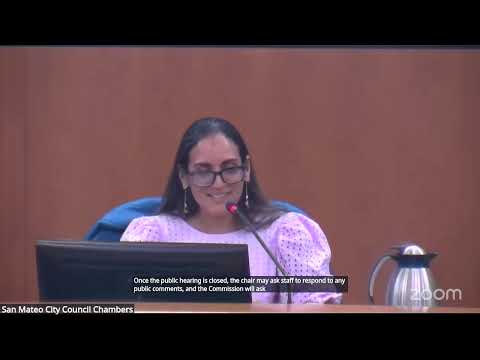
After discussion, Commissioner Clafter moved and Commissioner Busch seconded a resolution finding the owner complied in good faith for the 12/21/2023–12/20/2024 review period. Chair Seema Patel, Commissioner Busch, Commissioner Clafter and Commissioner Williams voted yes; Commissioner Schumkel recused himself from the item because the project is within 500 feet of his residence. The motion carried.
The commission’s action was limited to the required annual compliance determination; staff will continue to work with residents and the applicant on parking‑management options if an interested party initiates an application to amend the agreement or to seek other remedies.
Additional project context: Residential Block 6 (a 54‑unit multifamily building with 50 apartments and four townhomes) received its certificate of occupancy in May 2024 and was about 85% occupied at the time of the review; two office buildings (Office Station 1 and Office Station 5) received certificates of occupancy in 2024 and are leased to Roblox. The MU‑2 and MU‑3 permits were under review and staff said only a few public‑works comments remained.