Get Full Government Meeting Transcripts, Videos, & Alerts Forever!
Get email alerts on the Parking topic
No spam. Unsubscribe anytime.
Laguna Beach staff seek Coastal Commission OK for five-year parking plan; residents press for neighborhood permits and tougher enforcement
Summary
City staff briefed residents on a proposed five-year Coastal Development Permit that would set parking rates and enable paid parking along South Coast Highway; public commenters urged stronger enforcement, resident permit options and clearer maps before any rollout.
City of Laguna Beach staff on Wednesday presented a proposed five-year Coastal Development Permit (CDP) that would extend the city's parking-rate framework and give the city authority to pursue paid parking on parts of Coast Highway in South Laguna, staff said. The proposal will go to the City Council for general direction at a special meeting Sept. 23, and — if the council supports parking changes — staff said the Planning Commission would issue the CDP and the city would apply to Caltrans for an encroachment permit for paid parking spaces on state right-of-way.
The CDP proposal would continue a policy first approved in 2021 that allows a 10% annual summer rate increase for downtown parking meters and a $1 per-meter increase in off-season rates across the five-year period. Staff said shoppers permits would remain valid in newly designated paid spaces during posted hours.
Why it matters: The plan would reshape where and how people pay to park in parts of Laguna Beach that are almost entirely within the coastal zone, moving the debate from technical rate-setting to questions of neighborhood access, emergency access and environmental impacts. The Coastal Commission and Caltrans both have roles that could limit or modify what the city can do, residents and staff noted.
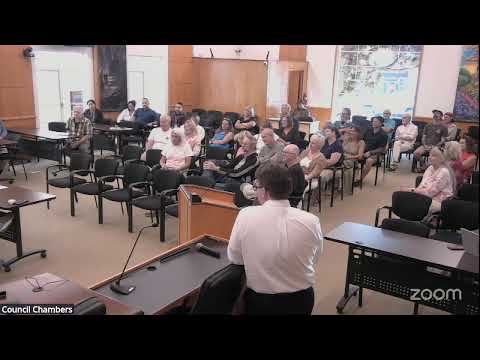
Staff presentation and city options City Manager Dave Kiff and Alexis Braun, the city's community and transit leader, told more than two hours of attendees that the city operates under a five-year permit for parking rates and must secure a new CDP to extend the approach through 2026'30. Braun summarized existing off-street, downtown and peripheral options: a trolley program that has carried more than 1,000,000 riders annually, free parking at the Mission Hospital lot (with seasonal hours), the Sea Cove lot with a three-hour limit, and a summer shuttle from an Irvine lot.
On South Laguna specifically, staff described pursuing a Caltrans encroachment permit that could allow paid parking from Moss Street south to Vista Del Sol. Staff estimated roughly 593 potential paid spaces: about 361 on the inland side of Coast Highway and about 232 on the coastal side, where sidewalks exist or are planned. The city is also discussing about 47 potential additional spaces at Laguna Terrace. Staff emphasized pay stations would be part of any deployment and said shoppers permits would work in the new paid spaces if used within posted hours.
Public concerns and alternatives Residents who spoke at the meeting urged the city to prioritize enforcement and neighborhood protections over creating net new parking. David, a South Laguna resident, said the central problem is neighborhood traffic rather than the absence of paid parking: "The fundamental problem in South Laguna is not the creation of more paid parking ... The problem is the traffic in the neighborhoods." Justin, another South Laguna resident, added: "The traffic in the neighborhoods is so bad. Emergency vehicles can't get past. It's really dangerous." Several residents described driveways blocked by visitors, overflowing trash, people leaving coolers and debris, and inconsistent signage.
Multiple speakers proposed resident-focused permit systems as an alternative to simply adding paid spaces on Coast Highway. Speakers pointed to models in other jurisdictions that sell advance or zone-based permits (Costa Mesa, Newport Beach, Los Angeles and Santa Monica were cited as examples) and recommended limited, weekend-only or phased approaches in the most impacted blocks. Aaron, a neighborhood resident, suggested a pilot that would charge for parking up to five blocks inland on weekends and holidays with resident hang tags exempting homeowners during enforcement hours.
Enforcement, technology and design suggestions Speakers urged stronger, quicker enforcement and clearer signage. Deborah Gilbert recommended modern pay-by-phone systems that warn users before expiration and a backend workflow that feeds expired-meter lists to enforcement officers. Several residents called for towing of long-term violators and higher fines; Joanne McMahon described confrontations when visitors ignored requests to move.
Several commenters urged the city to pursue public-private partnerships to unlock underused private lots such as Gelson's or the hospital lot and to deploy dynamic signage ("Aliso Beach parking: full") to reduce cruising and neighborhood spillover. Technology proposals included QR-code payment, license-plate-based meters, camera-assisted enforcement and reservation-style sales to cap the number of vehicles that can arrive on peak days.
Staff response and next steps City staff acknowledged legal constraints imposed by the local coastal program and the Coastal Commission's oversight. Kiff said the city attorney is advising staff on whether residents-only parking is allowable and on potential requirements for coin- or pay-station access for people without phones. Staff said the City Council will receive a staff report on Sept. 23 seeking general direction; if council supports a parking program staff will apply to Caltrans for an encroachment permit and pursue a CDP through the Planning Commission.
What remains undecided Staff did not commit to specific hours, permit prices, or exact block boundaries for any residential paid zones. Several residents requested that the city publish clearer maps showing where sidewalks exist, where new sidewalks are planned, and which blocks would be eligible for paid curbside parking before any council action.
The discussion continues as staff prepares the council packet and refines revenue and enforcement projections that residents asked to review publicly.