Get Full Government Meeting Transcripts, Videos, & Alerts Forever!
Get email alerts on the Criminal Justice topic
No spam. Unsubscribe anytime.
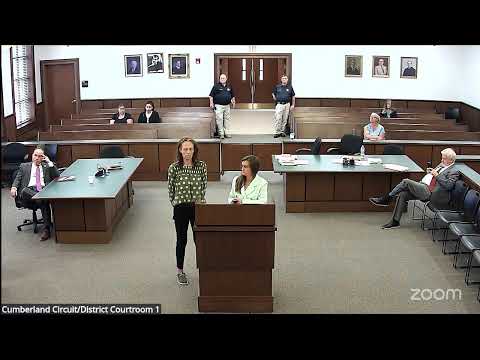
Judge denies bid to bar detective on cell‑site evidence and rejects challenge to murder-for-hire aggravator in O'Donnell case
Summary
At a lengthy pretrial hearing in Cumberland County Circuit Court, the judge denied defense motions to exclude non‑expert testimony about geolocation data and to strike a murder aggravator for vagueness; other motions on sequencing and privilege review were left open or scheduled for later action.
A Cumberland County Circuit Court judge on Wednesday denied multiple defense motions in the pending Thomas O'Donnell murder prosecution, ruling that a lead detective may testify about foundational steps in obtaining cell‑site and phone extraction data and rejecting a defense attack on the statutory “murder for hire/for profit” aggravator as not constitutionally void on its face.
The hearing focused on three major pretrial disputes: whether Detective B.J. Burton may testify about interpreting geolocation/cell‑phone data without being disclosed as an expert; whether an aggravating circumstance that refers to an offender acting “for the purpose of receiving money or any other thing of monetary value, or for other profit” is unconstitutionally vague; and whether the trial should be trifurcated into separate phases for guilt, aggravator proof and sentencing.
The judge told defense counsel he was not persuaded to exclude Burton completely and said the court could manage presentation at trial so the lead detective provides foundation testimony and an expert can be brought in to give technical interpretation. The judge denied the defense motion “at this time,” while leaving open the possibility of renewed objections after the parties have briefed and exchanged qualifications. Defense counsel cited a recent Kentucky Supreme Court decision, Hollingsworth v. Commonwealth (opinion rendered Aug. 14), as a reason to press for stricter expert disclosure; the court directed the parties to review that decision and said it would revisit the issue if necessary.
On the statutory aggravator, defense counsel argued the phrase “for other profit” is so broad that a jury could find aggravation from virtually any motive; the judge said while the language “might be vague, [it] might be vague by necessity” and declined to declare the aggravator unconstitutional at the pretrial stage. The court denied the motion to strike the aggravator, explaining that factual questions about notice and what the Commonwealth can prove belong to the trial record and, if necessary, to a directed‑verdict motion.
The judge also declined to adopt the defense’s request for a three‑stage trifurcation. Defense counsel said separate phases would clarify what jurors decide at each stage; the judge said Kentucky law favors bifurcation and that he would consider case law the defense might supply as authority for trifurcation but would not order it without clear controlling precedent.
A separate defense motion raised claims that jail staff had accessed materials marked confidential in the defendant’s jail property and that information might have been communicated to prosecutors. Counsel asked the court to conduct an in‑camera review of the notebook to determine whether the material was privileged and whether any communication occurred. The judge said he was reluctant to review privileged materials in camera because any knowledge gained could prejudice later rulings; he asked defense counsel to identify authority for an in‑camera review and scheduled a later evidentiary hearing to resolve the chain‑of‑custody and privilege issues. Counsel for the defense said they believed multiple jail employees viewed the material and that there was a chain of communication to the Commonwealth, an allegation prosecutors disputed.
The judge set further motion scheduling and told parties to exchange any additional expert disclosures or citations to Hollingsworth so the court can rule before trial if possible.
Evidence and procedure cited at the hearing included: the Hollingsworth v. Commonwealth Kentucky Supreme Court opinion on geolocation and expert/witness roles; discovery and expert disclosure deadlines; and requests for a Kentucky Center for Public Criminology (KCPC) evaluation and other third‑party assessments. The judge repeatedly emphasized the court’s preference to allow foundational testimony by investigative personnel while requiring formal experts to provide interpretive testimony if needed.
The court’s rulings kept the core counts and aggravators pending and left scheduling and some evidentiary rulings for further briefing and hearing dates.
Ending
The case remains set for later pretrial management; the judge instructed both sides to exchange authority and expert qualifications promptly and indicated he will reconsider portions of the rulings if new affidavits or case law warrant it.