Get Full Government Meeting Transcripts, Videos, & Alerts Forever!
Get email alerts on the Sister Cities topic
No spam. Unsubscribe anytime.
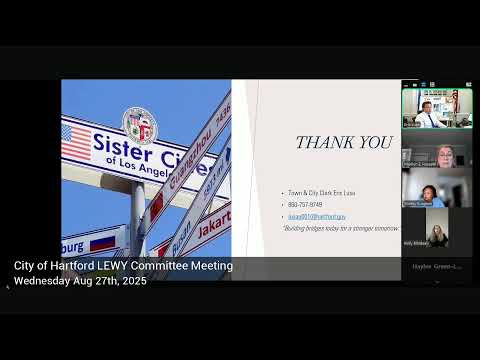
Hartford City committee backs resolution to reestablish Sister Cities program
Summary
A Hartford City committee voted to forward a resolution to reestablish the city’s Sister Cities program, after a presentation from the city clerk outlining the program’s history, proposed bylaws updates and next steps for recruiting an executive board.
The Hartford City Labor, Education, Workforce, Youth and Development Committee voted on Aug. 27 to forward to full council a resolution to reestablish the city’s Sister Cities program following a presentation by Town Clerk Eric Musa.
Town Clerk Eric Musa outlined the program’s purpose and history, saying, “What is a sister city? It's a formal partnership between cities in different countries to promote cultural exchange, economic ties, education opportunities, and mutual understanding.” He described meetings in Fort Worth, Texas with other municipal programs and said Hartford City has several historic sister-city links that have become dormant.
Why it matters: Committee Chair Majority Leader Marilyn Rosetti said the program could “build bridges” that leverage Hartford City’s large Jamaican and Puerto Rican communities and local institutions. Council President Shirley Surgeon called the concept “people to people diplomacy,” a phrasing Musa had used to describe the program’s value amid strained federal-level relations.
Details from the presentation: Musa said the program’s existing bylaws date from the late 1980s and early 1990s and were written for an approximately 16-member organization with an executive committee (president, vice president, treasurer, secretary). He recommended updating the bylaws, establishing diversity expectations for committee membership (for example, having representatives for Jamaica, Puerto Rico and Nicaragua), forming subcommittees (trade, education, cultural events) and pursuing fundraising and support from elected officials and local institutions.
Musa named Sister Cities International and said representatives from New Haven and other U.S. cities offered best-practice examples, including partnerships that link municipal goals with universities and cultural institutions. He said Jessica Nunez is acting as a state-level contact for Sister Cities work in Connecticut and that New Haven’s program, which partners with Yale University and other institutions, was described to the committee as a “gold standard.”
Next steps and timeline: Committee members discussed scheduling an initial working group meeting in late September or early October to draft agendas and next steps leading to a formal annual meeting in March 2026, which Musa said is the date called for under the current bylaws. Committee members also noted an upcoming Irish parade in March as a potential public launch opportunity.
Committee action: A motion to send the resolution reestablishing the Sister Cities program to the full council with a favorable recommendation was made and seconded. The chair called for the vote; those present responded “Aye,” and one member identified in the record as Moe abstained. The motion passed and the item will be placed on the full council agenda. Specific roll-call vote counts were not specified in the committee transcript.
Quotes and attributions in this article come from the committee meeting transcript, including remarks by Town Clerk Eric Musa and Council President Shirley Surgeon. The committee’s staff indicated they will distribute the presentation to council members and set initial meetings for volunteer recruitment and bylaw updates.
The committee did not adopt a final membership list, budget, or a binding implementation plan during the meeting; those items were discussed as future work pending the council’s consideration of the forwarded resolution.